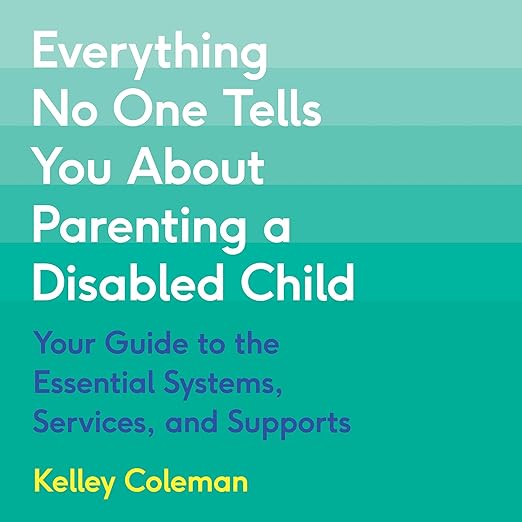
Quick Take
- Narration: Kelley Coleman narrates her own book, and self-narration is non-negotiable here, the humor, warmth, and hard-won authority come through in ways a professional narrator couldn’t replicate.
- Themes: Navigating disability systems, parenting advocacy, IEPs and educational rights, financial planning for caregivers
- Mood: Warm and fiercely practical, with real grief underneath and real humor on top
- Verdict: The handbook parents of disabled children have been trying to piece together from a dozen different sources, consolidated, humanized, and narrated with the voice of someone who has actually done the work.
There’s a particular kind of loneliness that comes with navigating a child’s disability diagnosis in systems designed, it often seems, to exhaust you into compliance. You’re given terminology without definitions, forms without context, and meetings full of professionals who know the acronyms and timelines far better than you do. Kelley Coleman’s book exists precisely to close that gap, and she narrates it herself, which turns out to matter a great deal.
I was halfway through a Saturday afternoon when I put everything else aside to listen to the first two chapters. Coleman writes with the kind of specific, practical honesty that signals immediately that this isn’t a wellness memoir or a motivational framework, it’s an actual guide to navigating IEPs, insurance, financial planning, and disability rights, written by someone who has spent over a decade inside these systems for her own child. The CDC statistic she opens with is worth sitting with: one in 33 babies in the United States is born with a birth defect. That’s not a rare circumstance. It’s a reality with no centralized roadmap.
What the Systems Don’t Tell You, and Why That Matters
The book’s core argument is structural rather than emotional: parents of disabled children are repeatedly asked to reinvent the same wheels, navigating the same bureaucratic terrain without the benefit of the accumulated knowledge of those who came before them. Coleman’s response is to document that knowledge. The topics she covers span the entire span of practical need, diagnosis processes, working with medical teams, understanding insurance coverage, financial planning including trusts and government benefit eligibility, the mechanics of individualized education plans, and disability rights and advocacy strategies. These aren’t light treatments; she worked with over forty subject-matter experts to build out the professional dimension of the content.
What prevents this from reading as a dry reference is the way Coleman weaves her own story through the frameworks. Her decade-plus of experience navigating these systems for her own child gives every section a quality of verified testimony rather than theoretical advice. One reviewer described wishing the book had existed at the start of their daughter’s Rett syndrome diagnosis, that specific resonance speaks to how accurately Coleman has captured the terrain that families encounter in those early, overwhelming months.
The Tone That Makes the Practical Bearable
Coleman’s humor is not a decoration. It’s structural. Several reviewers specifically noted the combination of compassion and humor, and one described her as representing compassionate radical honesty alongside enthusiasm and joy, optimistic in the face of adversity without toxic positivity. That last distinction is important. There’s a kind of disability parenting literature that functions as spiritual reassurance, everything happens for a reason, you were chosen for this journey, and Coleman’s book is explicitly not that. It takes the difficulty seriously while refusing to stop at grief. The humor earns its place because it’s the humor of someone who has actually been in the room, not the humor of someone who has observed it from a comfortable distance.
The templates and tools scattered throughout the book are a specific strength. Rather than describing what a well-organized medical binder looks like, Coleman gives you the organizational framework. Rather than summarizing what insurance appeals require, she walks through the actual process. The practical density could feel overwhelming, but the pacing, Coleman’s own narration keeps things human-scaled and forward-moving, prevents that.
Why Self-Narration Is the Right Call Here
Kelley Coleman narrating her own book is not a nice-to-have, it’s what makes the audio version work. The humor lands because her timing is her own. The harder passages about navigating grief and exhaustion carry weight because the voice telling you these things is the same voice that lived them. At eight hours and twenty-five minutes, this is a substantial listen, but Coleman’s narration keeps it from feeling like a textbook reading. A professional narrator could have delivered the information accurately; only Coleman can deliver the authority that comes from having sat across the table from the same systems she’s describing.
Audience and Scope
This is primarily written for parents of children with disabilities in the United States, and the systems content, IEPs, IDEA, SSI eligibility, special needs trusts, is US-specific. International listeners will find the advocacy frameworks and emotional navigation broadly applicable, but the legal and financial specifics will require supplementation with country-specific resources. Within the US context, however, this is among the most practically comprehensive parenting guides in the disability space currently available in audio.
Skip it if you’re looking primarily for emotional support and community, Coleman provides some of that, but the book’s center of gravity is practical. If you need someone to sit with you in the harder feelings, a memoir focused on the emotional journey of disability parenting will serve that need more directly. But if what you need is to stop wasting time figuring out what forms to fill out and who to call, this is where you start.
Frequently Asked Questions
Does the book cover all types of disabilities, or is it focused on specific conditions?
Coleman explicitly designed this book for parents across the full range of childhood disabilities, physical, developmental, behavioral, mental health, and chronic illness. She draws on her own experience with one type of disability while working with over forty experts to ensure the systems and frameworks apply broadly. The approach is condition-agnostic where possible.
Is the financial planning content genuinely detailed, or is it introductory?
It goes beyond introductory. Coleman addresses special needs trusts, government benefit eligibility including how earned income can affect SSI, financial planning considerations specific to long-term caregiving, and how to build a financial picture that accounts for a child who may not achieve full financial independence. She recommends professional consultation for personalized planning, but the foundational knowledge she provides is substantive.
How does the IEP content hold up, is it current and detailed enough to actually help in meetings?
The IEP content is among the most practically useful sections of the book. Coleman covers the legal framework under IDEA, how to prepare for IEP meetings, what parents have the right to request, how to document disagreements, and how to navigate situations where school districts push back on services. It’s designed to make parents more effective advocates in rooms where professionals hold informational advantages.
At over eight hours, is there a way to use this as a reference rather than a linear listen?
The book is organized by topic, diagnosis, medical teams, insurance, financial planning, education, rights, so it works well as a reference if you use chapters as entry points for specific situations. Most listeners will probably do an initial full listen and then return to specific sections as those systems become immediately relevant.