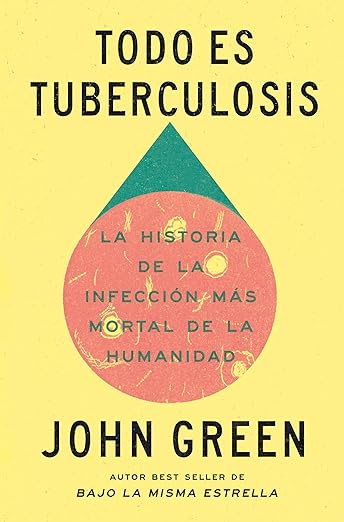
John Green's reputation rests primarily on young adult fiction, but his nonfiction attention has been increasingly directed toward tuberculosis, a disease that kills more people annually than any other infectious pathogen and yet receives a fraction of the public attention devoted to rarer illnesses. Everything Is Tuberculosis, narrated by Green himself across five hours and thirty-five minutes, began with a specific encounter at the Government Hospital of Lakka in Sierra Leone, where he met Henry, a young patient with thin legs and a wide smile who became for Green both a personal connection and a symbol of the profound inequity embedded in how the world decides which diseases deserve sustained attention and resources. Available records include a Spanish-language synopsis, indicating the book's international distribution as a bestseller recognized by the New York Times, Washington Post, and USA Today; this review addresses the English-language audiobook.
Tuberculosis Reveals a Political, Not Medical, Failure
Green has spent years following tuberculosis advocacy through his work with Partners in Health and through his public platforms, and the audiobook is structured as both personal history and scientific-social argument. The title's provocation is deliberate: Green's thesis is that tuberculosis is not merely a disease but a lens through which to understand everything about how global health systems distribute care, attention, and resources. The disease that Robert Koch identified in 1882 still kills 1.5 million people annually, almost exclusively in low-income countries with inadequate healthcare infrastructure, not because effective treatment is unavailable but because the economic and political conditions required to deliver that treatment at scale have not been created. Green's argument is that this represents not a medical failure but a moral and political one, and he makes it without the hedging that might make a general audience more comfortable.
The historical sections trace how tuberculosis shaped culture, literature, and medicine across two centuries. The Romantic-era aestheticization of the disease, the sanatorium movement, the development of streptomycin and isoniazid, the emergence of multidrug-resistant strains, and the contemporary landscape of treatment access are connected with a clarity that reflects genuine research engagement rather than surface-level journalism. Green is a skilled synthesizer of complex information, and the connection he draws between tuberculosis's cultural glamorization in wealthy nineteenth-century societies and its persistent neglect in impoverished twenty-first-century ones is one of the book's more provocative and precise analytical moves. Chapters covering the biological mechanics of transmission sit alongside chapters analyzing the economics of pharmaceutical development and the incentive structures that determine which diseases attract research funding, and Green moves between these registers without losing his general audience in the transition.
Green Reads Henry's Story Without Melodrama
Green's self-narration is essential to the audiobook's effect. His voice is known to millions through his podcast The Anthropocene Reviewed and his Crash Course educational videos, and he has developed a specific audio register that is reflective, warm, and intellectually direct without becoming preachy. That register serves this subject particularly well because the material risks either clinical detachment or activist melodrama, and Green avoids both. He reads the passages about Henry with the restraint of someone who knows that a specific person's story deserves to be heard rather than performed for effect.
The five-and-a-half-hour runtime means the audiobook asks relatively little of its listener in terms of time while delivering an unusually concentrated argument about global health justice. At under six hours, there is no pacing problem; the audiobook moves efficiently from historical grounding through epidemiological argument to contemporary advocacy without the expansiveness that longer works often mistake for depth. The 4.8 rating across more than 3,700 reviews reflects an audience that found the format well matched to the subject and Green's narration appropriate to the material's moral seriousness.
Green Names the Funding Gaps Directly
The contemporary advocacy sections are more direct than the historical material in their asks of the listener. Green is clear about the organizations working on tuberculosis treatment access, about the funding gaps that perpetuate preventable deaths, and about the specific policy and resource allocation decisions that determine outcomes for patients like Henry. Listeners who find advocacy nonfiction uncomfortable when it moves from description to prescription should know this audiobook does make explicit asks. The book does not pretend to be a neutral survey of the landscape. Green has a position and he states it, which is consistent with his general approach to public-facing intellectual work but is worth knowing before you start if you prefer purely observational journalism.
Fault in Our Stars Fans Find It Darker
The audiobook is designed for a general audience rather than medical or policy specialists, and Green's explanations of epidemiology and global health financing are accessible without prior background. Readers who encountered Green through The Fault in Our Stars or The Anthropocene Reviewed will find the register familiar though the subject is considerably darker and the advocacy more explicit than either of those works. Listeners interested in global health equity, the history of infectious disease, or the practical mechanics of how individual advocacy scales to systemic change will find genuine depth here. Henry's story is where the audiobook begins and where its moral weight ultimately rests, and Green's handling of that relationship, specific, honest, and free of sentimentality, is reason enough to spend five hours on a subject the book argues deserves far more than that. This is one of the more compact yet substantive works of health advocacy produced for a general audience, and its relatively brief runtime makes it difficult to argue against adding it to any list of important recent nonfiction.
Is this audiobook primarily about tuberculosis science or about global health advocacy?
Both, in roughly equal measure. Green covers the scientific history and treatment arc, but the organizing argument is about health equity: why a curable disease with known treatments continues killing 1.5 million people annually in an era of medical abundance.
At under six hours, does this audiobook cover tuberculosis comprehensively or is it more of an introduction?
It is focused rather than comprehensive. Green covers the historical arc, the contemporary crisis, and the advocacy landscape, but the runtime is designed to create attention and urgency rather than to substitute for specialist reading. It's a primer that points toward deeper engagement.