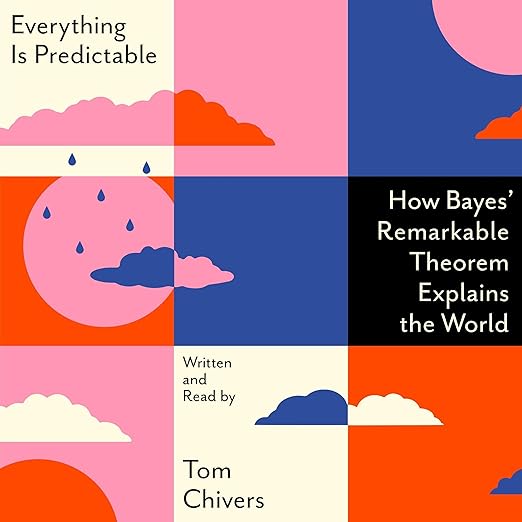
- Narration: Tom Chivers reads his own book with the same discursive, anecdote-rich quality as his writing, which works better than a professional narrator might for material this personal in its framing.
- Themes: Bayesian reasoning, intellectual history of probability, the limits and applications of mathematical thinking in everyday life
- Mood: Curious and conversational, intellectually rewarding without demanding technical fluency
- Verdict: A genuinely valuable popular science book that makes Bayes' theorem accessible without falsifying it, shortlisted for the Royal Society Science Book Prize for good reason.
I have an ongoing project of trying to understand Bayesian reasoning well enough to actually apply it, and I have read enough books on the subject to know that most of them fail in one of two predictable directions: they become too technical too quickly and lose general readers, or they become too hand-wavy and leave those readers with the feeling they understand something they actually do not. Tom Chivers's Everything Is Predictable is one of the more successful navigations of that narrow passage I have encountered, and it was shortlisted for the Royal Society Trivedi Science Book Prize in 2024, which provides external confirmation of its accuracy and quality from a source that does not reward mere accessibility alone.
Chivers is a science journalist, which means he is professionally trained to make complex ideas accessible without insulting the intelligence of the reader. Oliver Burkeman's blurb describes it as perspective-shifting and leaving him with an invigorating sense of greater purchase on the world, and that captures something real about what the book delivers when it is working best. The promise is not that you will emerge knowing more mathematics but that you will see decision-making and probability differently.
Where This One Lands
One of the smarter structural choices Chivers makes is anchoring the book in biography and intellectual history rather than jumping immediately to modern applications. Thomas Bayes was an eighteenth-century Presbyterian minister and amateur mathematician who published nothing on probability during his lifetime. The theorem that bears his name was published posthumously and largely forgotten before being independently rediscovered and developed by figures including Laplace. That history is genuinely interesting and Chivers tells it with the narrative momentum of a good biography.
Starting in the eighteenth century also allows Chivers to build the reader's intuition for the theorem before introducing its modern applications, which is the pedagogically correct order. By the time he is discussing artificial intelligence, medical testing, and legal evidence, the reader has spent enough time with the underlying logic to follow the applications without getting lost in the abstractions. That sequencing is one of the things that distinguishes this from books that try to sell you on Bayesian reasoning's importance before they have done the work of making you actually understand what it means and why it differs from conventional probabilistic thinking. The history earns the application.
The Best Parts of Everything Is Predictable
Chivers writes and reads this book with a distinctly personal, digressive voice. He inserts himself into the material, references his own life and opinions, and occasionally makes comments that some reviewers flagged as problematic, particularly around sensitive topics where the context of his remarks was felt to be poorly handled. The self-narration amplifies both the strengths and weaknesses of this quality.
Chivers's voice on the page sounds like Chivers's voice reading it, which creates an intimacy and authenticity that a professional narrator would probably smooth out into something more controlled. One reviewer noted the author speaks in a somewhat rambling manner that eventually makes interesting points, and the same observation applies to the narrated experience. If you find that conversational, digressive style engaging, the self-narration is an asset. If you prefer tightly controlled delivery, it may test your patience across eight hours. The book rewards the former disposition more consistently than the latter, and the rambling quality feels more natural in audio than it might appear on the page.
Points to Consider
The sections on AI, medical testing, and legal reasoning are where the book delivers its most immediately practical value. Chivers is particularly strong on medical testing, explaining why a positive test result for a rare disease is often less alarming than it initially seems, and why intuitions about probability systematically mislead us in ways that have real-world consequences for medical decisions, legal verdicts, and policy analysis. These sections feel genuinely useful in a way that the historical sections, though well-told, do not quite match in practical terms.
One reviewer with an MBA background who studied Bayesian statistics formally found the book confirmed and expanded his existing understanding without going into technical intricacies that a specialist treatment would provide. Another with substantial professional experience applying Bayesian methods found it appropriately introductory for its intended audience. The book is honest about being a popular treatment rather than a technical one, and readers who come expecting technical depth will be disappointed in a way that is the book's clear and legitimate intention rather than its failure.
The Right Listener for Everything Is Predictable
This free audiobook is the right starting point for anyone who has heard Bayes' theorem discussed in the context of AI or statistical reasoning and wants to understand what it actually means without committing to a textbook. The Royal Society shortlisting and the quality of endorsements are not incidental; this is a book that does what popular science is supposed to do, illuminating a genuinely important idea through history, example, and argument, and doing it with enthusiasm for the subject that comes through in the self-narration. Listeners who want to go deeper after finishing this will have a solid enough conceptual foundation to pursue more technical resources productively without starting from scratch.
The book's value extends beyond understanding Bayes specifically. What Chivers is really teaching is a disposition toward uncertainty, a way of updating beliefs based on evidence rather than anchoring them against prior conviction. That disposition is relevant everywhere from evaluating medical advice to reading political polling to making decisions under incomplete information, which is to say it is relevant constantly. The historical depth of the first half and the practical examples of the second half together build a case for this disposition that is more convincing than a purely abstract argument would be. Whether that case changes your behavior depends on you, but it will change how you think about the cases where it should.
What does Tom Chivers reading his own book add compared to a professional narrator?
Self-narration brings intimacy and authenticity that matches the personal, digressive quality of his writing voice. He sounds like he is having a conversation rather than reading a prepared text. The trade-off is that his delivery can feel rambling and lacks the polished control of a professional narrator. Whether this is an asset depends on your tolerance for a conversational, non-linear speaking style.
Some reviewers mentioned uncomfortable passages in the book. What should listeners know?
At least one reviewer flagged comments related to sensitive topics as poorly contextualized, suggesting the author made comparisons in ways that seemed insensitive. These appear to be relatively isolated moments rather than a pervasive pattern, but listeners who are sensitive to these topics should be aware they may encounter passages that require some critical distance from the author's framing.
Is this book better suited to listeners who already know something about Bayes or complete newcomers?
The book is most rewarding for complete newcomers who want thorough conceptual grounding in the theorem and its history. Readers with prior exposure to Bayesian statistics will find the historical sections valuable but may feel the applications sections are too introductory. It is explicitly popular science, and readers with technical backgrounds should calibrate their expectations accordingly.