Everything Is Horrible and Wonderful
Audiobook & Ebook

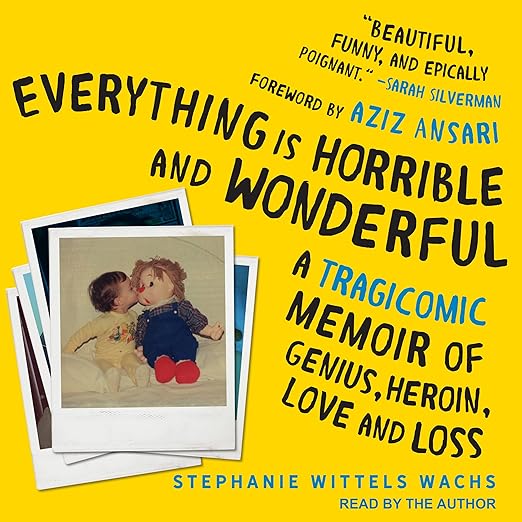
Everything Is Horrible and Wonderful by Stephanie Wittels Wachs | Free Audiobook

By Stephanie Wittels Wachs

Narrated by Stephanie Wittels Wachs

🎧 6 hours and 52 minutes 📘 Tantor Audio 📅 February 27, 2018 🌐 English
🎧 Listen Free on Audible 📖 Read on Kindle

Free 30-day trial · Cancel anytime

About This Audiobook

The space between life and death is a moment. But it will remain alive in me for hundreds of thousands of future moments.

One phone call. That’s all it took to change Stephanie Wittels Wachs’s life forever…. Her younger brother Harris, a star in the comedy world known for his work on shows like Parks and Recreation, had died of a heroin overdose. How do you make sense of such a tragic end to a life of so much hilarious brilliance?

In beautiful, unsentimental, and surprisingly funny prose, Stephanie Wittels Wachs alternates between her brother’s struggle with addiction, which she learned about three days before her wedding, and the first year after his death, in all its emotional devastation. This compelling portrait of a comedic genius and a profound exploration of the love between siblings is The Year of Magical Thinking for a new generation of listeners.

A heartbreaking but hopeful memoir of addiction, grief, and family, Everything Is Horrible and Wonderful will make you laugh, cry, and wonder if that possum on the fence is really your brother’s spirit animal.

🎧 Listen Free on Audible

Free 30-day trial · Cancel anytime

Quick Take

  • Narration: Stephanie Wittels Wachs narrating her own memoir is essential to the experience; the grief, the dark humor, and the love are inseparable from her voice.
  • Themes: Addiction and the family members left navigating it, grief without linear resolution, the complicated love between siblings
  • Mood: Devastatingly honest and surprisingly funny, in the specific way that profound grief can be
  • Verdict: Wachs’s memoir about losing her brother Harris Wittels to heroin is the kind of book that earns its comparisons to The Year of Magical Thinking not through imitation but through the same refusal to make grief neat.

I listened to Everything Is Horrible and Wonderful on a train journey, headphones in, which meant I had to manage whatever my face was doing for six hours in a car full of strangers. That was a miscalculation. By the time the memoir reached the account of the phone call that changed everything, I had stopped worrying about my face entirely. Stephanie Wittels Wachs writes grief the way it actually operates: as something that ambushes you at ordinary moments, that coexists with dark humor because the person you are grieving would have wanted it that way, that refuses to resolve into lesson or comfort on any schedule you can predict.

Harris Wittels, for those who did not know his work, was a comedy writer and performer whose fingerprints are all over Parks and Recreation and whose concept of humblebrag made it into the cultural vocabulary. He was talented in the specific way that makes a life feel both larger and more fragile. Stephanie, his older sister, found out about his heroin addiction three days before her wedding. The memoir alternates between following Harris through that addiction and its escalation, and tracking Stephanie’s first year after his death from overdose. The parallel structure is formally smart and emotionally devastating: you are always watching both timelines progress toward the outcome you already know.

The Specific Grammar of Sibling Grief

What this memoir does that most addiction-and-loss books do not is to center the sibling relationship with the same precision it brings to the addiction itself. Wachs is not writing as a parent or a spouse, which are the perspectives addiction literature most commonly occupies. She is writing as a sister, and the particular grammar of that relationship, the shared history, the specific quality of care that comes without the legal or romantic entanglements, is rendered with unusual clarity. One reviewer who is herself the sister of an addict described this as the first book that made her feel genuinely seen rather than addressed, which is the highest praise that can be given to a memoir about a largely invisible category of grief.

The book does not editorialize about addiction as a disease or as a moral failure. It simply shows what it looks like to love someone who is being consumed by something larger than the relationship. Wachs’s frustration, her helplessness, her fury, and her unwillingness to stop loving her brother through all of it are documented without the softening that turns memoir into therapy and grief into insight. She is not trying to teach you how to handle addiction in your family. She is trying to tell you what it was like in hers.

Why the Author Must Narrate This Book

The question of whether an author should narrate their own memoir is usually answered by the quality of the performance. Wachs is not a trained audiobook narrator. She is a performer, a comedian, a grief-stricken sister who has chosen to tell the story out loud. The difference between those things and a trained narrator becomes irrelevant within minutes. Her voice carries the specific weight of someone who knows exactly what she is describing because she lived inside it, and no amount of professional vocal training replicates that knowledge. The dark humor that runs through the prose lands in her narration because she delivers it the way Harris would have wanted it delivered: with genuine conviction rather than apologetic diffidence about whether laughter is appropriate.

Multiple reviewers noted that they were both Harris Wittels fans who wanted closure and readers encountering the story without prior investment, and both groups found the book equally valuable. That dual accessibility is unusual in memoir, which often presupposes the reader’s existing emotional investment in the subject. Wachs achieves it by writing about Harris as a full person rather than as a collection of comedy credentials, which means even readers who had never heard of him before come to feel the weight of what was lost.

The Year of Magical Thinking Comparison

The comparison to Joan Didion’s The Year of Magical Thinking in the synopsis is a high standard to invoke and not entirely misplaced. Both books are committed to describing grief as it actually operates rather than as it should resolve. Both resist the consoling arc. Both use formal structure to hold material that formal structure cannot ultimately contain. What distinguishes Wachs’s memoir is the comedy and the addiction specificity: this is grief that coexists with jokes because the person who died would have made them, and the specific texture of losing someone to heroin rather than to age or illness carries its own particular anguish that Wachs does not generalize away.

The memoir has a 4.7 rating across more than 700 listeners, which represents a sustained consensus across the years since publication. It is not a book that ages out of relevance. The questions it raises about how families navigate addiction, and how grief operates in its aftermath, remain entirely current.

Who Should Listen and Who Should Skip

Listen if you have lost someone, or are currently living alongside someone’s addiction, and need a book that will not tell you how to feel or when to stop. Listen if you were a Harris Wittels fan who has been looking for a way to understand what happened and to feel the presence of someone genuinely funny and genuinely lost. Skip if you are not in a place to sit with unresolved grief and dark comedy simultaneously; this book does not offer comfort in any conventional sense. Skip if you need memoir to move toward resolution, because Wachs is more interested in the ongoing fact of loss than in its management.


Frequently Asked Questions

Do you need to know who Harris Wittels was before listening to Everything Is Horrible and Wonderful?

No. Wachs writes about her brother as a full person rather than primarily as a comedy figure, and listeners with no prior knowledge of his work have described finding the memoir equally moving and complete. Fans of his comedy will find added dimension, but prior knowledge is not required.

Is the alternating timeline structure easy to follow in audio, or does switching between the addiction narrative and the grief narrative create confusion?

The two timelines are clearly distinguished, and Wachs narrates the transitions with enough clarity that the structure becomes intuitive quickly. Most listeners describe the parallel construction as emotionally effective rather than disorienting.

How does the book handle the dark humor given the subject matter, and does it feel appropriate or jarring?

The humor is integral rather than decorative, which is part of what makes this memoir unusual. Wachs is writing in the voice of someone who was shaped by comedy and who is grieving a comedian. The jokes arrive because they are honest, and they make the grief more rather than less present.

Is this book primarily useful for people who have a family member with addiction, or does it speak to broader grief experiences?

Wachs writes with enough universality about the structure of grief that the book works for anyone who has experienced sudden loss. Its specific value for families navigating addiction, particularly siblings rather than parents or spouses, is exceptional. But the memoir’s formal achievements and emotional honesty make it valuable well beyond that particular readership.

Ready to listen?

🎧 Listen to Everything Is Horrible and Wonderful for free

Free 30-day trial · Cancel anytime

What Listeners Are Saying

★★★★★

But never have I encountered a book that so brilliantly illustrates the multitude of feelings

As a sister of an addict, I've attended classes, read books, and done research on this disease for as long as I can remember. But never have I encountered a book that so brilliantly illustrates the multitude of feelings, thoughts, and emotions that families of addicts (particularly siblings) experience in…

– Amazon Customer
★★★★★

I loved this book

I loved this book. I'm a big fan of Harris' work and felt like I didn't have closure with his passing. Listening to podcasts and seeing him perform, I just felt like there were gaps in my understanding of what happened leading up to his death and it's so hard…

– Bethany Meyer
★★★★☆

Unapologetically truthful.

I’m fascinated by memoirs. They are raw, real, and intriguing. This read did not disappoint. The author truly loved her brother and clearly writing this allowed her to heal in a way she might never have had she not told her “or his” story.

– Amazon Customer
★★★★★

Wonderfully Told Story of a Heart-wrenching Loss

Mrs. Wittels WachsMadam, I'll begin by saying that I am a big fan of the Oxford comma. As painful as this book may be to read emotionally, the word usage and punctuation make it more tolerable to proceed through such sorrowful territory.As a fan of Comedy Bang Bang!, I grew…

– Paul C.
★★★★★

Touching Story by an Amateur Writer

I recently became interested in Harris Wittels from listening to a phish podcast. I started to consume everything possible about Harris and all the pods he did and came across this book by his sister. I love this book because his sister is not a professional writer and you can…

– A Love

Start Listening: Everything Is Horrible and Wonderful


Free 30-day trial · Cancel anytime

Alexandra Reed

Written by Alexandra Reed

Founder & Literary Critic