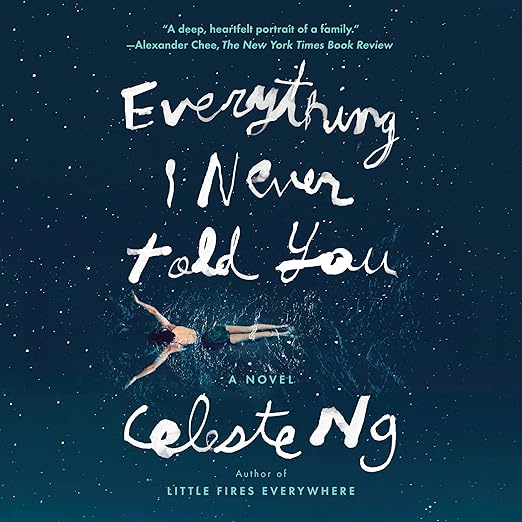
The first sentence gives away the death. Lydia is dead, and they do not know this yet, and everything afterward is a family failing to notice things in the correct order. Celeste Ng built a debut novel on that inversion, and it is the reason the audiobook works as well as it does: with the plot's engine visible from minute one, ten hours of listening turns into an exercise in watching people talk past one another. Cassandra Campbell voices it for Penguin Audio. The setting is a small Ohio town in the 1970s, the family is Chinese American, and the mystery turns out to be the smaller half of what is under investigation.
First, the Big Picture
The four-star from August 2014 gets closest to what this book is doing. That response was hooked from the start, calls the parenting narcissistic in its own headline, concedes that the author goes a little over the top with certain plot points, and then argues the excess is functional, because it magnifies how extreme the individual motivations of James and Marilyn actually are. I think that reading is exactly right. The Lee parents are not written as monsters. They are written as two people who each failed at something specific and decided a daughter would repair it. The overreach that response identifies is the mechanism by which two private disappointments become somebody else's entire life.
The listing is less careful than the novel. Its opening block stacks awards and best-of citations without punctuation until the sentence simply collapses: NPR, San Francisco Chronicle, Entertainment Weekly, Book Riot, School Library Journal, Bustle, and then it runs headlong into the phrase Time Our New York, which is neither a publication nor a sentence. Somewhere in the assembly, two lines fused. That is a small thing on its own, but it occupies the most prominent position on the page, and it is the kind of detail that makes a buyer wonder what else on the record was pasted rather than written.
Returning to a book to test whether it still holds is what a five-star from July 2022 describes, after a first reading in 2014, and the verdict came back unchanged. That is a useful data point for a book whose author became famous on a later title. This one came first. The same response reports having read Little Fires Everywhere and watched its television adaptation, which makes the comparison considered rather than reflexive, and what it credits both novels with is the handling of dysfunctional family dynamics. This is the one where the dysfunction has nowhere to hide: one family, one lake, no ensemble to spread the damage across.
The prose is doing something audio suits unusually well. The description supplies the frame, with parents determined that a daughter will complete ambitions they were unable to pursue themselves, and a novel that keeps turning to look at mothers and daughters, then fathers and sons, then husbands and wives. Moving among those vantage points is the book's basic motion. On a page, the turns are marked by white space. Spoken aloud, they have to be marked by something else, which is a real technical demand and the reason this recording is harder than it looks. Ten hours and one minute is close to ideal for the material as well, long enough to feel years of accumulated silence and short enough that the withheld information stays taut.
What to Watch For in Everything I Never Told You
A trap on this page is worth naming outright. A five-star posted from France in September 2016 praises what it calls la narration, saying it is extremely well conducted and holds you in suspense, and pairs that with the intelligence of the plot. In French the word means the storytelling, not the reading. Nobody on this page has written a syllable about Cassandra Campbell's performance. Eighty-six ratings and five written responses, and every one of them is discussing the prose, the parents or the effect of the ending. If you are buying for the voice, the reception column cannot help you, and the one phrase that looks as though it can will send you the wrong way.
The composition of that column explains part of it. Two of these entries are not in English at all, and three were filed from outside the United States, from France, Japan and Brazil. A Portuguese entry from April 2018 praises the way each character and each ordinary situation is described, and became a fan on the strength of it. Whatever edition those readers held, they are grading Ng's writing rather than an American audio release issued in December 2021. It also goes some way toward explaining, though not excusing, the topical tag on this record, which reads World Literature above a novel set in small-town Ohio.
Who It's For
Families that argue about ambition will hear themselves in it, which is the most honest recommendation available. A five-star filed from Japan in July 2018 describes finishing it and needing to stop and ask a few questions about life, and calls the writing beautifully sad. That is the effect to expect. If you have ever been the child expected to complete somebody else's unfinished plan, or the parent who noticed too late that this was what you were doing, the novel will not let you off. Readers of literary suspense who want the mystery to be the smaller half of the book are also well served here.
Comfort listening is not on the menu. The book opens on a dead child and spends ten hours explaining how a family made that possible without meaning to, and the description promises struggle rather than resolution: mothers and daughters, fathers and sons, husbands and wives failing all their lives to understand one another. Anyone in an acute period of grief should wait. So should anyone who wants a mystery that behaves like one, since the death is a device for prying the family open and a listener expecting procedural momentum will wait a long time for it. The World Literature tag is the last thing to discount, because this is small-town American fiction of the 1970s and nothing else.
Frequently Asked Questions
Does this audiobook give away its own plot in the first line?
Deliberately, yes. The novel opens by stating that Lydia is dead while her family does not yet know it, so the question is never who did what. Ten hours then run on dramatic irony rather than suspense, which is a demanding structure in audio, because the listener carries information every character on the file lacks.
Is Everything I Never Told You really a mystery?
Only in its machinery. A body is found in a local lake and the family unravels, but the investigation exists to pry the Lees open rather than to be solved. The publisher quotes on the record call it a propulsive mystery and a portrait of a mixed-race family in the same breath, and the second description is the larger one.
How does the audiobook handle the shifts between family members?
That is the central technical demand, and the record says nothing about how it was met. The novel moves among the Lees continuously, and print marks those turns with white space no recording can use. Cassandra Campbell is credited alone across ten hours and one minute, so every transition rests on the reading itself.
Which Celeste Ng book makes the best starting point?
This one is the debut, and the description positions it that way, naming Little Fires Everywhere and Our Missing Hearts as what came afterward. No plot connects them, so order is a question of appetite rather than continuity. Begin here if you want the smallest cast and the most concentrated version of the family material.