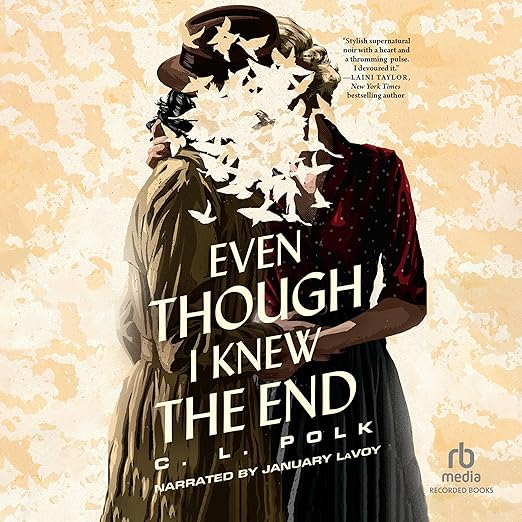
In Brief
- Narration: January LaVoy brings Helen/Elena's world-weary resolve to vivid life, capturing the snap of 1940s noir dialogue and the quiet ache beneath it.
- Themes: Sapphic romance against the clock, soul-bargain moral stakes, 1930s-40s Chicago atmosphere
- Mood: Smoky and bittersweet, urgent but tender
- Verdict: A tightly wound novella that earns every one of its emotional punches precisely because it never wastes a single word on anything other than what matters.
I pressed play on this one late on a Tuesday evening, expecting a quick listen to fill an hour before bed. Three hours and fifty-two minutes later I was still sitting in the same chair, slightly stunned. C.L. Polk's novella operates on a scale that should feel cramped but doesn't. The world is complete, the stakes are genuine, and the romance at the center of it all lands harder than most full-length novels manage.
The setup is elegantly cruel: Elena is an exiled augur who sold her soul to save her brother. Her debt is almost due. A stranger offers her a way out, one last job that could buy her a future with the woman she loves, Edith. All she has to do is track down the White City Vampire in three days. The clock-ticking structure is not a gimmick here. It's load-bearing architecture.
January LaVoy's narration is exactly right for this material. She doesn't push the period atmosphere into parody. The 1930s and 40s inflections are there, the snap of noir phrasing, the world-worn cadence of a woman who has seen too much. But LaVoy never lets the stylization swallow the emotion underneath. When Elena's voice catches around Edith, you feel the weight of what's at stake. One reviewer described it as a story with grit and action but also heart and soul, and LaVoy is the reason the heart and soul land as solidly as the grit does. She voices the sinister clients and the demonic gatekeepers with enough distinction that the cast never blurs, which matters enormously in a short-form piece where you don't have chapters to recover lost threads.
What C.L. Polk Gets Right
What distinguishes this from many other paranormal detective novellas is the specificity of its moral stakes. Elena didn't sell her soul for power or ambition. She did it for her brother. That detail reshapes every scene that follows. Her desperation to find a loophole isn't selfish greed; it's love trying to outrun its own consequences. When she asks her client for a claiming mark to shield herself from their captors' designs, it isn't an act of calculated seduction. It's a woman trying to protect herself with the only currency she has left. Polk makes these distinctions matter without ever stopping to explain them. The story trusts the listener completely.
One critical reader noted that Act One has pacing issues, and that observation isn't unfair. The opening does take a few minutes to find its groove. If you push through that first stretch, though, you'll find the narrative tightens into something surprisingly propulsive. The three-day deadline becomes visceral once Elena is actually moving through the city, reading crime scenes, negotiating with divine monsters, and trying to keep Edith out of the blast radius of a job that was never supposed to involve her.
Where C.L. Polk Loses Some Ground
Calling this a noir-fantasy-sapphic-romance sounds like a pitch designed to lose every category reader simultaneously. In practice, the combination is seamless. Polk understands that these genres share a structural DNA: someone trapped by circumstances beyond their control, trying to outmaneuver a system rigged against them, usually for love. The magic system, which involves augury, soul contracts, and Chicago's underworld of divine beings, feels grounded rather than decorative. It's there to create real consequences, not spectacle. The romance between Elena and Edith is genuine and specific. Edith isn't a prize to be won. She's a person with her own judgment about risk, and the story acknowledges this even when Elena is trying to shield her.
Multiple reviewers called out wanting a sequel, and that reaction makes complete sense. The world Polk has built in under four hours is dense with unexplored corners. The White City mythology, the hierarchies of divine beings, the question of what Elena's augury costs her beyond the obvious. There's enough here to sustain a series. Whether or not that ever happens, the novella works exactly as it is.
Who Should Pick Up Even Though I Knew the End
This is the right listen if you enjoy literary fantasy that takes its emotional stakes as seriously as its plot mechanics, if you want sapphic romance that doesn't reduce the relationship to a subplot, or if you're interested in a compact noir that uses its brevity as a feature rather than a limitation. Fans of Zen Cho, Alix E. Harrow, and P. Djeli Clark's The Black God's Drums will find familiar pleasures here.
Skip it if you need your fantasy worlds extensively documented before you feel comfortable in them, or if you find novellas frustrating because they end before you're ready. That frustration is somewhat the point. The title tells you exactly how this story works. You know what's coming. The craft is in making you listen anyway, all the way through to the bittersweet finish line.
Frequently Asked Questions
Does the novella length hurt the story, or does it fit the material?
The brevity is deliberate and effective. C.L. Polk uses the three-day deadline as a structural container that makes the short runtime feel earned rather than incomplete. Most readers report the pacing clicks into place once Act One establishes the rules.
Is this a standalone or do I need to have read other C.L. Polk work first?
Completely standalone. The novella is self-contained with its own world, characters, and resolution. No prior knowledge of Polk's other novels is required.
How explicit is the sapphic romance content?
The romance is central but not graphically explicit. The emotional intimacy between Elena and Edith is the core of the story, but the focus is on longing, devotion, and sacrifice rather than physical scenes.
Does January LaVoy handle the 1930s-40s period atmosphere well without it feeling like a caricature?
Yes, LaVoy strikes a careful balance. The period voice is present in her delivery without tipping into parody. She handles both the hardboiled exterior and the emotional vulnerability of Elena's situation with equal conviction.