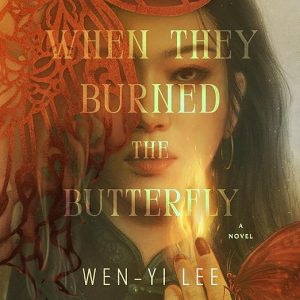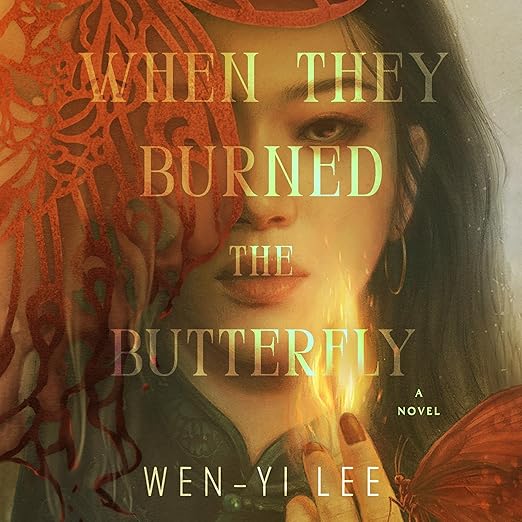
Singapore in 1972 is a setting almost nobody uses, and Wen-yi Lee has built an entire magic system out of what it makes possible. The country is newly independent and modernizing fast; the Chinese secret societies are the last channel to the migrant gods their ancestors carried over, and the back alleys where the gangs fight are the last ground where magic has not been assimilated and legislated away. Adeline Siow can call flame off her fingertips. Her mother dies in a house fire with a butterfly seared into her skin. The audiobook runs seventeen hours and fifty-two minutes, a Macmillan Audio production from Tor Books, read by Su Ling Chan and released October 21, 2025.
What Wen-yi Lee Delivers
Something unusual sits in this description: a trade notice about the narration, printed inside the publisher's own sales copy, above the plot summary. Kirkus is quoted calling Chan's narration bright, clear and almost melodic as she sets the stage for a cinematic listen, and saying the narration and the prose weave together into an intense and emotional fusion of mythology and character drama. Publishers rarely open with a performance notice, since most jacket copy treats the recording as a delivery mechanism for the words. Note the bracket while you are there: the quote reads [Su Ling] Chan, meaning the original notice used the surname alone and somebody expanded it for this page. A small thing, but it marks the sentence as borrowed and tidied rather than written here.
Eighteen ratings support the 4.4 badge, and the five visible grades run five, four, five, three and four, totaling twenty-one. This pool does not resolve to a single answer the way smaller ones sometimes do. Displaying 4.4 across eighteen votes requires a total of seventy-nine or eighty, so the thirteen ratings carrying no text sum to either fifty-eight or fifty-nine and average somewhere between 4.46 and 4.54. A band rather than a point. What the band does establish is that the thirteen silent votes sit above the five written ones, which is worth knowing when the written column holds every reservation you can actually read.
Trade notices are not listener reports, and they are also not nothing. What Kirkus describes is a clear, bright instrument used to set a scene rather than to inhabit it, and the phrase cinematic listen points at a particular kind of reading, one that keeps the camera moving. That suits the assignment. Chan has seventeen hours and fifty-two minutes to hold together: a schoolgirl protagonist, an entire gang of girls with individual names and grievances, rival organizations pressing at the border of their territory, a fire goddess, and a dead mother who turns out to have been two people. The names in play come from more than one language tradition, and getting them right is a technical requirement rather than a stylistic option.
Vengeance is the engine, and the five-star verdict filed on the release date itself names why that matters. It describes a book that embraces a version of women eager for violence and revenge rather than the meek, submissive role society had built for Asian women, and credits the use of multiple minor gods from Asian mythology as brilliantly executed. The Red Butterflies are girls who came from nothing, sworn to a fire goddess and empowered specifically against men who abuse and underestimate them. That is a revenge fantasy with a theology attached, and the copy's comparison stack, Silvia Moreno-Garcia meeting Fonda Lee at the feverish intensity of R.F. Kuang's Poppy War trilogy, at least sets an expectation of scale and cruelty the premise can carry.
Where Wen-yi Lee Loses Some Ground
Prose is the first caveat, and the three-star verdict of October 28, 2025 states it plainly before its text runs out on the page: the prose takes a while. That reader otherwise recommends the book to anybody after urban paranormal adventure, and supplies the clearest map of the magic anywhere in the response column, noting it is built on tattoos whose designs mark which gang or faction of Chinatown a body belongs to. Seventeen hours and fifty-two minutes is a long ramp if the opening is dense. The four-star verdict of November 7, 2025 grades itself at three and three-quarter stars rounded up, calling the premise one of the most compelling it had come across in a while, with the rest of its assessment cut off mid-sentence.
Classification is where this record falls apart. A seventeen-hour historical fantasy set in 1972 Singapore, running on migrant gods, gang magic and a fire goddess, is labeled once and once only, as LGBTQ+, with nothing whatever in its tag field. The sapphic thread is real and the copy itself builds the second half of its pitch around Adeline's entanglement with the charismatic Tian, but a book with no fantasy label, no historical label and no mythology label is invisible to anyone browsing for those things. The series field adds a second gap: The Butterfly Duet, book one, on a description that never mentions a second volume. And the four-star verdict of November 4, 2025 states outright that it read the hardcover from Tor, which is a print assessment sitting in an audio response column.
Who Should Pick Up When They Burned the Butterfly
Fantasy listeners who want their magic tied to a specific place and a specific decade will get more here than almost anywhere else on the shelf. The setting is not wallpaper: independence, rapid modernization, old practice being legislated out of existence, and secret societies surviving as the last channel to gods that arrived with migrants. Readers who came through Poppy War and want that intensity in a tighter, more intimate frame are the direct target. Anyone who needs a book to move from its first minute should sample the opening chapter rather than trusting the premise, and anyone who wants a complete story in one volume should note that the series field promises a second half nobody has named.
Content is the last thing to check, and the page offers nothing formal. The copy itself names a mother burning to death, bodies turning up in the red light district suffused with strange new magic, back-alley fights, and a gang built expressly to take revenge on men who hurt women. That is the advisory, such as it is, and it arrives embedded in the sales pitch rather than stated as a warning anywhere a buyer would look for one. Give the sample its due, because the prose is the variable here and the premise is not.
A Few Questions About When They Burned the Butterfly
How specific is the 1972 Singapore setting in this audiobook?
The copy makes it structural rather than decorative. It names a newly independent country modernizing fast, Chinese secret societies acting as the last conduits to migrant gods, and back alleys as the last ground where magic has not been assimilated or legislated away. The period is why the magic still works.
Is this audiobook standalone, or does it open a series?
The series field reads The Butterfly Duet, book one, which announces a two-volume arc. The description itself never mentions a sequel, names one, or gives a date. Anyone who dislikes waiting between halves of a story should know a second book is implied but left entirely unspecified.