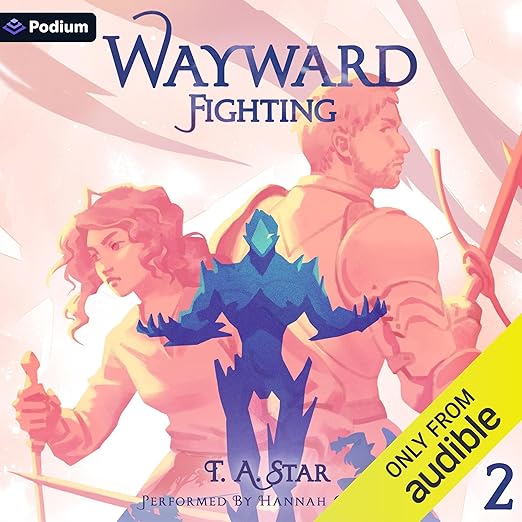
Seventeen hours, one minute short of it, is a long time to spend inside a single head, and this is the second such stretch T. A. Star is asking for. Phoenix Fraser was pulled out of a body that did not fit her and into Makera, where the illness is gone, the loneliness is gone, and what remains is the harder problem of belonging to other people. The audiobook runs sixteen hours and fifty-nine minutes for Podium Audio, published November 25, 2025, with Hannah Church credited as reader. The series began life as a web serial with more than a million views on Royal Road, and the copy still advertises paperback, ebook and audio in the same breath.
Is Wayward: Fighting: An Isekai LitRPG Worth Your Time?
Enthusiasm on this page settles somewhere unexpected, and it is not on the magic system. The five-star posting of March 14, 2026 credits depth in every character and meaning in every decision, arguing that events happen for a reason rather than because a plot needed them to. The five-star of February 10, 2026 singles out the way the characters work new things out and how they behave toward one another, and its headline points at a late mechanic Phoenix figures out as the high point of the book. Both readers are describing people rather than systems. For a volume filed under a genre named after its progression mechanics, that is a revealing place for the enthusiasm to settle. Star writes toward the party, and the praise on this page follows.
The February 1, 2026 posting is the strangest artifact here. It opens by answering a different review that called the book a ripoff, concedes that the themes overlap with something else, and argues that the focus on group dynamics, plus what it calls an inverse reflection of the character in question, is what lets the series stand on its own. The accused review is not displayed on this page. A browser therefore reads a defense without ever seeing the charge, and comes away knowing only that a comparison exists, that it was close enough to require a rebuttal, and that one reader worked through it and landed on the book's side. Useful, in an oblique way, but an odd thing to have to reconstruct while deciding whether to buy.
The Best Parts of Wayward: Fighting: An Isekai LitRPG
Hannah Church reads all sixteen hours and fifty-nine minutes, and the form itself sets the hardest part of that job. LitRPG is built around progress that gets stated rather than implied: abilities named, thresholds crossed, numbers moved. On a page those passages sit in boxes and the eye slides over them. In audio nothing can be skimmed, so whatever share of this runtime is system text has to be spoken in a way that keeps it inside the story instead of turning it into a recital. Layered on top of that is a first-person protagonist whose interior life is the actual subject, plus an adventuring party and a mentor who all need to stay distinguishable across a very long sitting. Podium Audio credits one reader for the entire assignment.
Point a prospective buyer at the December 3, 2025 posting. It describes watching King's Dream and Phoenix learn about each other and adapt to caring for one another, and it makes the case in a single clause that most fantasy blurbs never manage: the character growth wasn't instant, but was very genuine in learning to understand the why behind someone's actions. That is a precise description of a slow relationship written well, and it is the real payload of this volume. The same reader reports having found the world and its systems immersive since book one, which tells you this verdict comes from somebody carrying the full arc rather than dropping in.
Before You Commit to Wayward: Fighting: An Isekai LitRPG
Weigh the three-star of December 5, 2025 seriously if progression is why you read the genre. It reports the second book as slow, expected Phoenix's powers to grow further than they do, expected the story to advance further than it does, and concludes that the author is stretching things out. That is a coherent complaint rather than a mood, and it lines up exactly with what the enthusiastic responses praise: a volume spending its length on relationships is not spending it on the power curve. Sixteen hours and fifty-nine minutes is a lot of runway for a book whose own supporters describe its best moments as two characters coming to understand each other. Patience or padding depends entirely on what you came for.
Now the record's own problems, which are worse than the book's. This listing carries exactly one category, LGBTQ+, and its tag array is empty. No fantasy label, no science fiction label, no LitRPG label, nothing that would surface a near-seventeen-hour isekai to anybody browsing for one. Phoenix's identity is central rather than incidental, so the category is not wrong, but as the sole classification on a genre novel it is close to useless for discovery. The series field compounds it: Wayward, book two, with the first volume's full title appearing nowhere on the page. Anyone told to start at the beginning has to go find the beginning themselves.
Who Should Pick Up Wayward: Fighting: An Isekai LitRPG
The audience is people who finished the first Wayward and want more time with Phoenix and her party, not people looking for a way in. Star is writing a trans protagonist whose liberation is bodily and specific rather than metaphorical, which the copy states plainly in its second paragraph, and readers who want that handled with care rather than as a gesture will get it. Listeners who need their LitRPG to deliver escalating power on a schedule should look elsewhere, since nothing in the copy or the response column promises that here.
Two practical notes before committing. The recording sits in the middle of a series with no announced end, and the page offers no content advisory, no cast information and no runtime breakdown to help you plan around its length. Set against that, the copy is unusually honest about what the book is: the burdens of an old life lifted, and a new existence that still has its struggles. Newcomers should begin at volume one, because the emotional weight here is borrowed from it.
- Narration: Hannah Church reads a first-person protagonist whose transformation is physical, which puts the voice itself unusually close to the book's subject.
- Themes: Isekai displacement and bodily self-determination, found family inside an adventuring party, the cost of keeping secrets from allies
- Mood: Warm and unhurried, far more party dynamics than power curve
- Verdict: Rewarding if you loved the first volume and read LitRPG for the people, frustrating if you read it for escalation.
Frequently Asked Questions
Does this audiobook stand alone, or does it assume the first Wayward volume?
It assumes it. Both the copy and the series field place this second in the run, and Phoenix's party, her mentor and the rules of Makera all arrive already established. Compounding the problem, the first book's full title appears nowhere on this listing, so finding it takes a search rather than a click.
Why is a near-seventeen-hour isekai filed under LGBTQ+ and nothing else?
The record carries one category and an empty tag array, so that single label is doing all the classification work. Phoenix's identity is central rather than incidental, which makes the label accurate, but nothing marks the book as fantasy, isekai or LitRPG. Category browsing will simply miss it.
How much system and stat content does the audiobook actually contain?
The record never says. It labels the book an isekai LitRPG and promises strange abilities, which sets an expectation of spoken mechanics, but no field quantifies how much runtime that occupies. Auditioning the excerpt is the one way to hear how those passages land before paying for the full length.
Was this story available anywhere before the audiobook edition?
The copy states the series drew more than a million views on Royal Road before release, and advertises paperback, ebook and audio together. That makes this a serial adaptation rather than an original audio commission, which matters if you want to sample the prose style before committing to nearly seventeen hours.