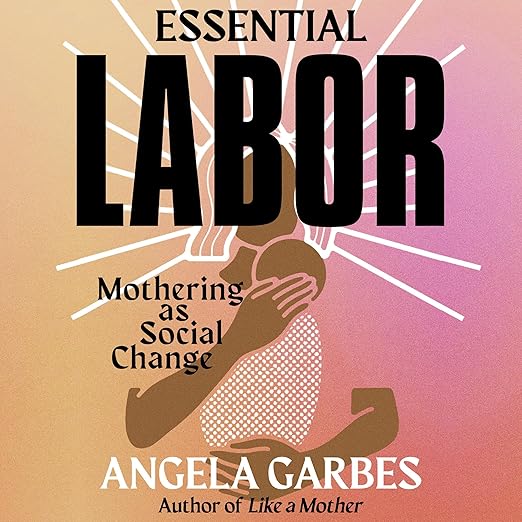
Quick Take
- Narration: Angela Garbes narrating her own work is not optional, her Filipino-American voice, her cadence when reading personal passages about her family and her body, carries emotional weight that no professional narrator could replicate.
- Themes: mothering as political act, care work and racial capitalism, the devaluation of domestic labor in American life
- Mood: Galvanizing and intimate, the kind of book that makes the daily feel like the structural
- Verdict: A fiercely intelligent book about caregiving as both personal practice and political terrain, most powerful in audio when Garbes reads the passages drawn from her own life.
I listened to most of Essential Labor on a long drive back from visiting my sister, who had recently had her second child. She had been describing, in that tired but precise way new parents speak, the exhaustion of being responsible for another person’s every need, the constant calculation of hunger and sleep and stimulation, the way her own body had become instrumental. By the time I was an hour outside the city, I had Angela Garbes in my ears making the argument that this exhaustion was not a private problem but a political one, and I had to pull off the highway for a few minutes.
Essential Labor is Garbes’ follow-up to Like a Mother, her acclaimed book on the science and culture of pregnancy. This one is broader in scope and more explicitly political in its ambitions. At its center is an argument that might seem obvious in the abstract but proves surprisingly radical in its implications: mothering and caregiving are essential labor, foundational to every economy and every society, and American culture has systematically devalued that labor along racial and gendered lines. Garbes makes this argument not through policy prescription or economic analysis but through the accumulated weight of personal testimony, historical context, and rigorously reported evidence about how care work has been distributed throughout American history.
Where the Personal Becomes the Structural
What distinguishes Essential Labor from other books in the maternal-feminism space is Garbes’ insistence on tracing caregiving’s devaluation through the specific lens of race. As a first-generation Filipino-American, she brings to the subject a family history that includes women who did care work for white families, who literally kept other households functioning so those households could ignore the labor involved. This lineage gives her argument a sharpness and specificity that prevents it from becoming a generalized complaint about the difficulty of motherhood.
The book’s most powerful sections are the ones where Garbes connects the intimacy of physical care, the feeding, the bathing, the middle-of-the-night presences that no one else sees, to the broader history of whose bodies have been expected to perform that care and on what terms. She draws on the work of scholars like Arlie Hochschild and care ethicists, but she wears her research lightly. The argument moves through her personal experience, her reporting, and her analysis in a way that rarely feels schematic.
What Garbes Narrating Her Own Work Means
One reviewer writes that this book “is a joy to read and have so much of the work we do acknowledged.” That joy is audible in Garbes’ narration. She reads with a directness and occasional warmth that signals she is not performing a text she wrote but inhabiting it. When she reads about her daughters, about her own mother, about the Filipino women in her family who preceded her, the voice carries something that cannot be transcribed. There are passages in this audiobook that land differently than they would on the page precisely because her voice is in the room.
At 6 hours and 21 minutes, this is a genuinely efficient audiobook, long enough to develop its arguments fully, short enough to listen to in a weekend. The brevity is part of the design. Garbes is not writing a policy brief or a comprehensive history. She is writing a manifesto that works through intimacy, and manifestos that overstay their welcome lose their force.
The Argument’s Limits and Strengths
The book is strongest when it is most personal and most specific, and occasionally thinner when it reaches for broader prescription. The final chapters, which gesture toward what a more equitable model of caregiving might look like, are less fully developed than the diagnostic sections that precede them. Some readers will find this frustrating. One reviewer notes a desire to return to certain passages repeatedly, which suggests the book is better at articulating problems than charting solutions, but that articulation is itself valuable, particularly for readers who have been living inside the problem without language for it.
The book’s shortish runtime also means that certain threads, particularly the political economy of care work and the specific demands that communities of color have historically faced, receive less space than they might warrant. Garbes gestures toward Angela Davis and Dorothy Roberts but doesn’t linger. Listeners who want a fuller account of care work as labor activism might turn to Ai-jen Poo’s The Age of Dignity alongside this. The two books make natural companions.
Who Will Find This Essential
Listen to this if you are a parent, of any gender, who has felt the invisible weight of care and wanted a framework for understanding why it feels that way. Listen to it if you are interested in how racial capitalism shapes domestic life, or if you came to Essential Labor from Like a Mother and want to see where Garbes’ thinking has developed. It functions particularly well as a book club selection, as a reviewer confirms: it generates the kind of conversation that extends well beyond the text.
It is less suited to readers looking for policy arguments, economic data, or prescriptive advice about how to change their specific caregiving arrangements. Garbes is not writing that book. She is writing the book that names the experience clearly enough that you can start asking the right questions, and in the audio format, with her voice doing that naming, the effect is more immediate than it would be otherwise.
Frequently Asked Questions
Do I need to have listened to Like a Mother first, or does Essential Labor stand on its own?
Essential Labor stands completely on its own. While it’s the same author and shares some thematic territory, the books have different arguments and different scopes. Like a Mother focuses on the science and culture of pregnancy; Essential Labor is a broader political meditation on caregiving. Reading them in order adds texture, but it isn’t necessary.
Is this book primarily aimed at mothers, or does it speak to caregivers and partners more broadly?
Garbes explicitly resists limiting her argument to biological mothers. She uses ‘mothering’ as a practice that can be taken up by anyone involved in care work, and she is clear that the devaluation she describes affects all caregivers. That said, the most personal passages draw heavily from her own experience as a mother, and listeners who are themselves parents will likely feel the most direct recognition.
How explicitly political is the book? Is it a manifesto or more of a personal essay collection?
It occupies the space between both. Garbes calls it ‘part galvanizing manifesto, part poignant narrative’ in her own framing, and that description is accurate. The politics are explicit and consistent, but they emerge from personal testimony and reported observation rather than from policy argument. It is closer to Roxane Gay or Rebecca Solnit in approach than to a policy brief.
At just over six hours, is the audiobook long enough to fully develop its arguments?
For what the book is trying to do, yes. Garbes is writing a focused intervention rather than a comprehensive treatment of care economics. The brevity is a design choice that keeps the argument concentrated. Listeners wanting a deeper scholarly engagement with the political economy of care work might pair this with Arlie Hochschild’s The Second Shift or Ai-jen Poo’s The Age of Dignity.