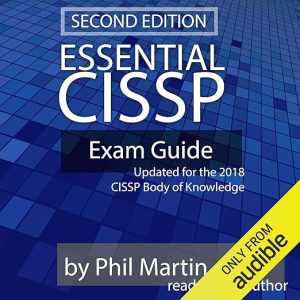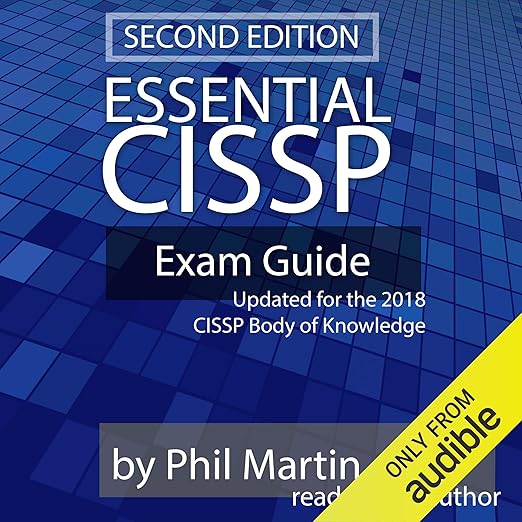
ISC2's official CISSP study guide is notorious among security professionals for burying useful information under what this audiobook's own synopsis bluntly calls “$100 words and run-on sentences,” and Essential CISSP Exam Guide exists specifically to fix that problem. Phil Martin, who wrote the book, also narrates all seventeen hours of it himself, walking through every domain of the 2018 CISSP Body of Knowledge in the same plain, direct language the official guide famously lacks.
Martin's Self-Narrated Update to His Own Guide
This is explicitly billed as an update to Martin's earlier Simple CISSP guide, expanded and revised specifically for the 2018 Body of Knowledge rather than a completely new project built from scratch. The pitch is that the full ISC2 curriculum gets translated, domain by domain, into shorter, plainly worded chapters, plus extensive examples meant to make dense security concepts effortless to remember rather than something to memorize through brute repetition.
That kind of second-edition revision cycle is itself a meaningful signal in the fast-moving security certification space, where a study guide that gets updated to track a new Body of Knowledge revision, rather than simply left to go stale, suggests an author still professionally engaged with the material rather than one who wrote a single guide years ago and moved on to other projects entirely.
Martin's self-narration carries the same advantage here that it does across his other security titles: correct pronunciation of dense acronym-heavy terminology, and a narrator who already knows, from having written and taught this material, exactly which passage needs slow, deliberate emphasis and which can move at a brisker pace. For a subject this dependent on precise vocabulary, that domain fluency in the reading voice itself is a real, tangible advantage over a generalist narrator encountering the terminology cold.
Systematic Rebuild, Never a Light Cosmetic Edit
The gap between this and Martin's original Simple CISSP is not just cosmetic updating for a new exam year. Positioning this as taking “the entire official study guide” apart and rebuilding it domain by domain suggests a more systematic, comprehensive rebuild rather than a light edit, aimed at listeners who want fuller coverage than the original's deliberately brief approach offered, even if that means a longer overall runtime.
Holly Credits This Audiobook With Her Exam Pass
Reviewer Sushi backs this up with a direct comparison, having first purchased the official ISC2 study guide in paperback and found it “super dry”, better suited to looking up a single confusing concept than to actually learning the material front to back. By contrast, Sushi describes Martin's book as laying “it all out” across a clearly organized set of domains and chapters, structured specifically to be worked through in order rather than dipped into at random.
Reviewer Holly credits the audiobook directly with exam success, writing “I think this book really helped me pass the CISSP,” and specifically praising the combination of print and audio together, noting she “bought it and the audio book, which was great” for absorbing dense material through more than one channel at once. That pairing strategy, reading along with the audio rather than choosing one format exclusively, comes up often enough in security-certification study circles to be worth taking seriously as a genuine technique rather than just one listener's preference.
The examples Martin builds into each domain function as more than illustration; for security concepts that stay abstract on the page, a concrete scenario, how a specific access-control model actually plays out in a real organization, for instance, is often what makes the difference between recognizing a term on an exam question and actually understanding when to apply it under pressure.
Not every review is about the audio experience specifically. Reviewer Pen Name ran into real formatting problems with the Kindle edition, reporting an inability to properly view the index or check quiz answers, and ultimately returned that version. It is a useful reminder that this book exists across formats with genuinely different reliability, and that audio sidesteps ebook-specific formatting problems entirely, though it obviously cannot replace a visual index for quick topic lookup the way a working ebook or print copy can.
Built for Working Professionals Studying Around Full-Time Jobs
The synopsis itself is a little muddled about the precise domain count, promising coverage of “all 10 domains” but then listing entries that read more like eight or nine due to what appears to be a formatting error merging two domain names together. Listeners should not get hung up on the exact number; what matters more is that Martin works systematically through the full modern CISSP framework, including security operations, software development security, and identity and access management, rather than skipping the less glamorous domains.
The actual CISSP exam itself uses computerized adaptive testing for most candidates, adjusting question difficulty in real time based on previous answers, which rewards genuinely broad comfort across every domain rather than deep expertise in a few favorites and real gaps elsewhere. A study resource organized methodically domain by domain, as this one is described, maps naturally onto that adaptive format better than a resource organized around topics the candidate personally finds most interesting first.
Candidates balancing full-time security work with exam preparation are the resource's clear center of gravity, and Martin's own framing throughout, breaking dense official material into digestible chapters with heavy example use, reads as written by someone who remembers exactly how limited that preparation time usually is for working professionals rather than full-time students.
Exam-day application matters as much as initial comprehension for material this dense, and reviewers consistently frame this less as a passive listen and more as active study material meant to be revisited, paired with practice questions, and worked through domain by domain rather than absorbed once straight through. That framing lines up with how serious CISSP candidates typically structure their preparation regardless of which specific resources they choose to use.
Test the Kindle Edition Before Trusting Its Index
Industry-wide, ISC2's own official guide has a long-standing reputation for dense, occasionally impenetrable prose, which has created real demand for exactly this kind of translation work across the certification study market. Martin is not the only author attempting it, but his combination of direct industry background and narrating his own material gives this particular attempt a credibility edge that a purely editorial rewrite by a non-practitioner would lack.
This has the most to offer candidates specifically studying for the current 2018-aligned CISSP exam who have already struggled through the dense, jargon-heavy official ISC2 guide and need a plainer-language walkthrough of the same material, especially listeners who, like Holly, want to combine print and audio for better retention across a genuinely long certification syllabus.
The Kindle edition specifically deserves a test run before anyone leans on it for visual study aids like the index or quiz answers, given Pen Name's formatting troubles. Candidates who already own the original Simple CISSP guide should also know this newer edition is a substantial revision rather than a minor refresh, worth the update for anyone targeting the current exam version.
Does listening to this audiobook actually help pass the CISSP exam?
At least one listener directly credits it with exam success, and several reviews describe combining the audiobook with the print or ebook edition for better retention of dense, acronym-heavy material.
Should I buy the Kindle edition alongside this audiobook?
Be cautious. One reviewer reported real formatting problems with the Kindle edition, including trouble viewing the index and checking quiz answers, and returned it, so the audio and print editions may be more reliable than the ebook specifically.
How many CISSP domains does this audiobook actually cover?
The publisher's own description promises all ten current CISSP domains, though its printed list of domain names runs together in a couple of spots. What matters is that Martin works through the full modern domain framework systematically rather than skipping sections.