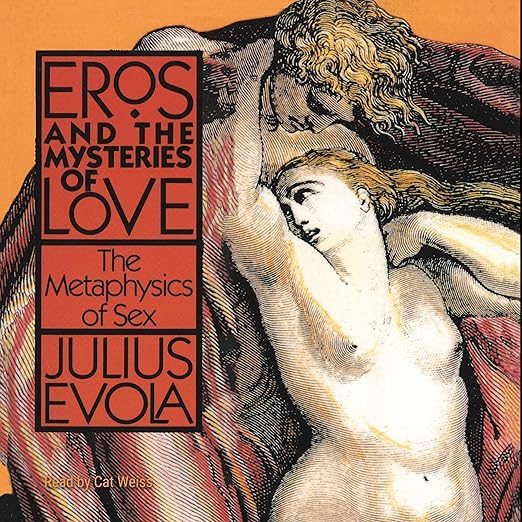
Julius Evola's Eros and the Mysteries of Love is the kind of audiobook that announces its ambitions in the opening pages and then spends fourteen hours attempting to fulfill them. The ambitions are considerable: a systematic examination of sexuality not as biology or psychology but as metaphysics, a reading of erotic experience through the lens of sacred traditions from East and West, and an argument that the deepest potentialities of human beings have been recognized and mapped in precisely the ritual and symbolic spaces that modern culture has systematically discarded. Cat Weiss narrates this production with the kind of measured, unhurried delivery that the material demands and that a different narrator might have undermined by either flattening the philosophical content or over-dramatizing it.
Evola is a controversial figure whose broader political writings place him in a tradition that many readers find incompatible with their own values. Eros and the Mysteries of Love sits in a different register from that work: it is a work of comparative mysticism and metaphysical philosophy that draws on Tantra, Taoism, medieval European courtly love traditions, Platonic philosophy, and the mystical dimensions of several major religions. One reviewer described it as the best thing Evola ever wrote, a judgment that implies the reviewer has read broadly in his catalog and found this work distinguished within it. Another called it "controversial but beyond deep," which captures the experience of approaching Evola's writing as a non-specialist: you encounter ideas that challenge, occasionally offend, and sometimes illuminate in ways that more cautious thinkers do not reach.
Cat Weiss Narrates Evola's Dense Metaphysics
The audiobook rewards listeners with genuine prior interest in the intersection of sexuality and spirituality. Evola's argument, simplified: erotic experience contains dimensions of transcendence that secular and purely psychological frameworks cannot account for, and the world's sacred traditions have in various ways recognized and encoded those dimensions in their ritual practices. He moves through sexual rites, mythological symbolism, and mystical literature to build a picture of Eros as a force with metaphysical weight, not merely biological function. This is not a guide to practice in the manner of a Tantra manual; it is philosophy that takes the ecstatic dimensions of sexuality seriously as objects of thought.
Cat Weiss's narration is measured and scholarly, which suits the density of the material. Evola's prose in translation is complex: long sentences, layered subordinate clauses, and a vocabulary that assumes familiarity with philosophical and mystical terminology. Weiss does not attempt to make it more accessible than it is, which is the right decision. Listeners who want philosophy delivered as entertainment will find the style demanding. Listeners who have spent time with comparative religious texts or classical philosophy will find it familiar territory covered with unusual breadth.
Fourteen Hours of Forced, Rewarding Immersion
The audiobook format is an interesting choice for this material, and it works better than you might expect. Evola writes in a tradition where close, patient reading is rewarded, but the audio format creates a different relationship to that density: because you cannot speed up to skim or slow down to reread, you are forced to receive the argument at the author's pace. For a work built on sustained philosophical argument, that enforced pacing can work in the listener's favor. The fourteen-hour runtime becomes a kind of intellectual immersion rather than a test of endurance.
The scope of material covered is one of the genuine attractions. Evola draws comparisons between Tantric sexual practices and medieval European mysticism, between Greek philosophical treatments of Eros and Asian concepts of sexual energy, between folklore and ritual in traditions separated by geography and century. The synthesis is idiosyncratic and occasionally overreaching, but it maps a territory that most academic philosophy of sexuality leaves uncovered. One reviewer pointed specifically to the book's treatment of the Apollonian and Dionysian paths as providing cultural touchstones for further research, and that characterization is accurate: this functions as an orientation device for a much larger field of inquiry.
Evola's Dated Views on Gender and Polarity
Evola's metaphysical framework rests on premises about gender and polarity that readers familiar with his broader work will recognize and that others will encounter as unfamiliar and possibly problematic. His treatment of the masculine and feminine principles as metaphysical categories rather than social constructs leads to arguments that contemporary readers may find reductive or at odds with current understandings of gender. These moments are not peripheral to the argument; they are structural to how Evola understands erotic transcendence. Listeners who engage with this material should expect to hold Evola's framework at some critical distance while still extracting what is valuable from the synthesis he offers.
The comparative religion sections, particularly those dealing with Tantra and various Asian mystical traditions, draw on scholarship that predates contemporary academic standards in those fields. The characterizations are broad and sometimes imprecise by current academic standards. That said, for a work originally published in 1947, the breadth of engagement with non-Western traditions is genuinely significant, and the insights that emerge from the comparisons are often more durable than the specific scholarly claims.
Demanding Reading for Scholars of Mysticism
The ideal listener for this audiobook has existing interests in the philosophy of religion, comparative mysticism, or the intersection of erotic and spiritual experience, and is prepared to engage with a demanding text that does not soften its claims. Listeners who have worked through Evola's more widely read works and want to understand what his catalog considers most important will find this frequently cited as the most accessible entry point to his thought. Scholars of Western esotericism, Tantra, or medieval mysticism will find a synthesis that, whatever its limitations, covers territory rarely assembled in one place.
Casual listeners looking for accessible spiritual reading, or those who want practical guidance in sexual practice, will find Eros and the Mysteries of Love either inaccessible or irrelevant to their actual questions. This is philosophy, not instruction, and it makes no concessions to readers who come to it without preparation. At fourteen hours, it is also a significant time commitment that pays off only for those willing to engage on Evola's terms.
Before You Press Play
- Voice: Cat Weiss handles dense philosophical prose with steady clarity, never dramatizing where the material calls for measured exposition.
- Big ideas: Metaphysics of sexuality, sacred eroticism, transcendence through desire
- Atmosphere: Dense and scholarly, with flashes of genuine mystical intensity
- Worth it?: Julius Evola's most approachable major work arrives in audio through Cat Weiss in a fourteen-hour production that rewards listeners willing to work at philosophy's register.
Common Questions
Is the Eros and the Mysteries of Love audiobook accessible to readers without a philosophy background?
It is challenging without some prior exposure to philosophical or mystical literature. Evola's vocabulary and argumentative style assume familiarity with Western philosophical traditions and at least passing acquaintance with concepts from Tantra and comparative religion. The audiobook is not designed for casual listening.
Does this audiobook contain explicit sexual content?
No. Eros and the Mysteries of Love is philosophical and metaphysical in nature. Sexual experience is discussed as an object of philosophical and spiritual inquiry, not described in graphic terms. The content is dense and scholarly rather than erotic.
How does Cat Weiss handle the complexity of Evola's prose in the audiobook?
Weiss narrates with measured, scholarly clarity that suits the material. The delivery is unhurried and precise, which is appropriate for philosophical prose that rewards careful attention. Listeners who prefer dramatic narration styles will find the approach austere but correct for the text.
Should I read other Evola works before approaching this audiobook?
No prior Evola reading is strictly required. Multiple reviewers describe this as the best and most accessible work in his catalog. However, some familiarity with Western esotericism, Platonic philosophy, or Tantric traditions will make the comparative arguments considerably easier to follow.