Quick Take
- Narration: Dr. Ania Jastreboff brings considerable clinical authority to the narration, measured and reassuring, though Oprah’s voice is notably absent from a book that presents itself as a collaborative conversation between them.
- Themes: obesity as biological disease, GLP-1 medications and metabolic science, food noise and the psychology of weight
- Mood: Compassionate and paradigm-shifting, with the cadence of a thorough patient consultation
- Verdict: The medical content is serious and well-sourced, but listeners should know this is primarily Dr. Jastreboff’s clinical voice. Oprah’s presence is framing, not narration.
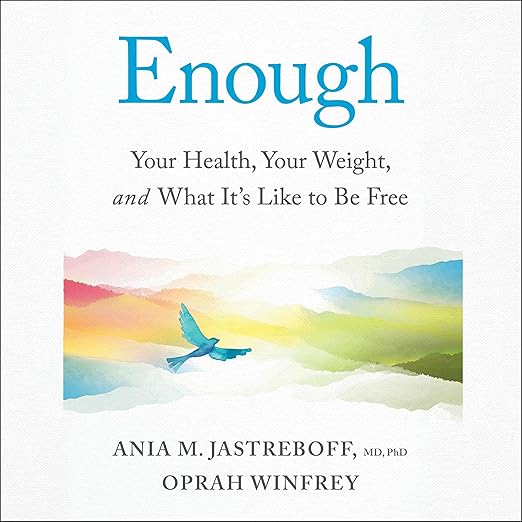
I finished most of this one on a long train journey, watching the landscape flatten out beyond the window while Dr. Ania Jastreboff walked me through a concept I had intellectually understood for years but had never heard explained with this particular combination of precision and warmth: that obesity is a disease of biology, not a failure of character. Oprah Winfrey’s name is on the cover and her personal account opens the book, her decades of public struggle with her weight given new context by the science. But what you are primarily listening to is a clinician’s explanation of a revolution in metabolic medicine.
The central argument is built around the body’s “enough point,” the neurological set point that governs how much body fat the brain registers as sufficient. GLP-1 medications, the book explains, work precisely here, lowering that set point so the body stops fighting weight loss as though it were starvation. Jastreboff describes this through the lens of her research at Yale School of Medicine and her years of clinical practice, and she is an unusually good explainer. The concept of “food noise,” those persistent, intrusive thoughts about what to eat, when to eat, how much to eat, emerges here as the defining experiential marker that the book returns to repeatedly. Reviewers who identify with this experience respond to the book almost viscerally.
What Oprah’s Presence Actually Provides
It would be dishonest to review this book without addressing the asymmetry between the cover and the content. Oprah is credited as co-author, and her personal narrative threads through the opening sections with real candor, covering the decades of public scrutiny, the diets, the feeling of biological betrayal that she describes with characteristic directness. But Dr. Jastreboff narrates the audiobook, and the result is a different experience than the title and framing might suggest. If you are drawn to this primarily for Oprah’s perspective, the opening chapters will satisfy that, but the majority of the runtime is the doctor’s clinical voice.
That said, Jastreboff earns that runtime. Her explanation of how GLP-1 receptors interact with the brain’s reward pathways is among the clearest available on this subject. She is not writing for a medical audience. The analogies are chosen carefully, the jargon is translated without condescension, and the patient stories that punctuate the clinical sections are specific enough to feel real rather than illustrative.
The Disease Framing and Why It Lands
The book’s most important work is rhetorical as much as scientific. Jastreboff and Winfrey are dismantling a cultural framework that has done considerable harm, the idea that weight is primarily a question of moral discipline, and replacing it with a biological one. The science supports this, but science alone rarely changes deeply held cultural convictions. What makes this book effective is that Oprah’s participation is not decorative. Her willingness to describe her own experience with GLP-1 therapy, including side effects, provides the human evidence that the clinical data requires to become actionable.
The strategies for optimizing GLP-1 therapy are practical: understanding how to select the right medication, the critical role of protein intake and strength training in preventing muscle loss, navigating the shifts in appetite and social eating that the medications produce. One reviewer, a board-certified obesity medicine physician, described this as essential reading for both patients and clinicians, a double audience that speaks to how successfully Jastreboff bridges the technical and the accessible.
Side Effects, Sustainability, and What the Book Does Not Solve
The book handles side effects honestly. Nausea, fatigue, and gastrointestinal disruption are addressed with the same clinical directness as the benefits, and Jastreboff offers management strategies rather than minimization. The chapter on sustaining weight loss after discontinuing GLP-1 medications is the most cautious section of the book and appropriately so. This is where the science is still catching up with clinical reality, and she does not overstate the certainty of the evidence.
What the book cannot do is resolve the access problem. GLP-1 medications are expensive, often uninsured, and politically contentious in ways that have only accelerated since publication. The book addresses this obliquely but stays largely within the clinical frame. That is probably a reasonable scope decision, but listeners who cannot access these medications may find the empowerment somewhat abstract.
Who Should Listen, Who Should Skip
Anyone currently on or considering GLP-1 therapy will find this more useful than most of what their prescribers have time to explain in an appointment. People who have struggled with weight and been told it was a willpower problem will find the framing genuinely corrective. Skip it if you are looking for a traditional diet or nutrition guide. The protocol here is pharmaceutical and lifestyle combined, and the book does not pretend otherwise.
Frequently Asked Questions
Does Oprah Winfrey narrate the audiobook, or is it only Dr. Jastreboff’s voice?
Dr. Ania Jastreboff narrates the full audiobook. Oprah’s perspective and personal account are present in the text, but her voice is not featured in the audio production.
Does the book recommend specific GLP-1 medications, or is it medication-agnostic?
Jastreboff covers the main options, including semaglutide and tirzepatide, and explains how to discuss medication selection with your physician based on your individual health profile. She does not advocate for a single option.
Is this book useful for someone who has already been on GLP-1 medications for several months?
Yes. Readers already in treatment report finding it valuable for understanding what is happening biologically, how to optimize protein and exercise during treatment, and how to think about the eventual transition off the medication.
How does this compare to Weightless by Dr. Rocio Salas-Whalen as a GLP-1 guide?
Both books cover similar clinical ground. Enough provides more personal narrative through Oprah’s framing and focuses more on the disease-classification argument. Weightless is slightly more protocol-dense, covering first appointments and medication titration in more detail. They are complementary rather than redundant.