Quick Take
- Narration: Sarah Lohman narrates her own book with the enthusiasm of someone who has genuinely eaten heirloom sugarcane in Hawaii and reefnet-fished in the Pacific Northwest, the firsthand investment is audible and makes the material come alive.
- Themes: Food as cultural memory and identity, agricultural biodiversity under threat, the politics and community of preservation
- Mood: Curious and urgent, road-trip energetic with an underlying sadness
- Verdict: Lohman’s culinary history journalism is at its strongest here, she finds the human stories inside ecological arguments, which is harder than it sounds and rarer than it should be.
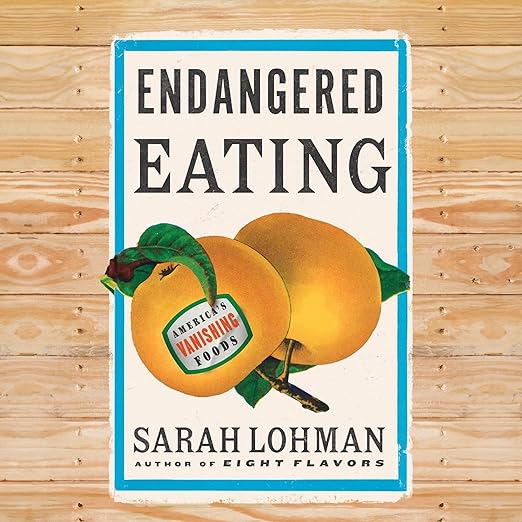
I finished the chapter on reefnet fishing somewhere around midnight, having started it fully intending to stop much earlier. That is the specific quality Sarah Lohman brings to Endangered Eating, she makes you care about things you had no idea you cared about. I have no particular connection to the Pacific Northwest fishing traditions she describes, and I came to this book knowing almost nothing about Slow Food International or its Ark of Taste project. I came away wanting to visit a Navajo Churro shepherd, find the oldest peanut variety in America, and track down heirloom sugarcane from Hawaii. That the audiobook moved me in those directions is entirely down to how Lohman writes, and, critically, how she narrates her own work.
The premise is elegantly simple: Lohman, a culinary historian whose previous work has established her as one of the most engaging writers working in food history, uses the Ark of Taste catalogue as a travel itinerary. She goes to the places where endangered foods still exist, meets the people who are keeping them alive, and then tries to understand both the ingredient and what its disappearance would mean. The resulting chapters cover extraordinary geographic and cultural range, from Hawaiian sugarcane to wild rice in the Upper Midwest, from Gulf Coast gumbo’s filé powder to California date palms operated by families shutting down one by one. Each stop is its own micro-history, and each micro-history is anchored to the human beings whose livelihoods and identities are wrapped up in these ingredients.
Our Take on Endangered Eating
What distinguishes this from other food journalism is Lohman’s refusal to be purely elegiac. She is not writing a dirge for lost flavors. She is writing about people who are actively working to prevent loss, which gives the book genuine forward energy. The chapter on Navajo Churro sheep is particularly strong, the traditional butchering Lohman participates in becomes a window into Indigenous food sovereignty arguments that she handles with care rather than condescension. One reviewer noted that the book changed how they cook salmon, which is the kind of specific, behavioral outcome that good food writing occasionally produces and that purely academic food studies almost never manages.
Why Listen to Endangered Eating
Self-narrated audiobooks live or die on whether the author has the voice and confidence to carry eleven hours of recorded material. Lohman does. Her delivery has the warmth and curiosity of a good storyteller rather than the slightly anxious quality that some academic authors bring to their own recordings. She reads with the pace of someone who wants you to enjoy the journey, and the regional specificity of her material, the different cadences of conversations with a Hawaiian sugarcane farmer versus a South Carolina peanut historian, comes through in her narration without her adopting performed accents. The PDF of recipes that accompanies the Audible version is a meaningful bonus for listeners who want to cook what they hear about.
What to Watch For in Endangered Eating
A careful reviewer flagged at least one factual error, a claim about David Fairchild and olives that does not hold up to historical scrutiny. Lohman is an engaging journalist rather than a credentialed academic historian, which means the research is generally solid but not uniformly bulletproof. Listeners who know any of these food traditions well may encounter moments of oversimplification. The book is also structured as a series of largely self-contained chapters, which means it works well for episodic listening but does not build toward a single culminating argument, readers who want a thesis rather than a collection of portraits may find the structure unsatisfying.
Who Should Listen to Endangered Eating
Essential for listeners who love Michael Pollan’s field-journalism approach to food systems, or who found themselves fascinated by books like Dan Saladino’s Eating to Extinction and want something more personal and narrative-driven in its delivery. Lohman is warmer and less scientific than Saladino, more interested in individual human stories than systemic agricultural economics, which makes this a more accessible entry point. Also genuinely rewarding for home cooks who want context for why ingredient sourcing decisions matter beyond personal taste. Skip it if you need a linear argument rather than a mosaic of portraits.
Frequently Asked Questions
What is the Ark of Taste project that Endangered Eating is based around?
The Ark of Taste is a catalogue maintained by Slow Food International that documents regional foods worldwide that are at risk of disappearing, due to industrialization, changing farming practices, or loss of the communities that traditionally produced them. Lohman uses it as both a framework and a travel guide, visiting foods on the US portion of the list to understand what preservation actually looks like in practice.
Does Sarah Lohman’s self-narration work for an 11-hour audiobook, or does it become fatiguing?
Reviewers and the listening experience both suggest it works well. Lohman has enough public speaking and documentary experience that her delivery does not have the flat quality that some author-narrated recordings suffer from. The chapter-by-chapter structure, each covering a different region and ingredient, also prevents any sense of monotony from developing across the full runtime.
Are there recipes included, and how are they handled in the audio format?
Yes, the Audible listing notes that a PDF of recipes accompanies the audiobook. Lohman references cooking and preparation throughout the text, and the recipes are provided as a supplementary document rather than read aloud, which is the sensible approach for audio. Listeners who want to cook along with the book will need to access the PDF through their Audible library.
Is the factual accuracy of Endangered Eating reliable enough to trust as culinary history?
Generally yes, with the caveat that at least one reviewer identified a specific historical error about David Fairchild and olive introduction to the Americas. Lohman is a journalist rather than an academic historian, which means the book is well-researched but not peer-reviewed. Listeners with deep expertise in any of the specific food traditions covered may encounter moments that warrant independent verification.