Quick Take
- Narration: Elizabeth Saydah handles the series’ sprawling cast and tonal range with consistency, she has narrated the full Chronicles of Dorsa trilogy, and the familiarity with the world shows in how naturally she inhabits the returning characters while differentiating the substantial roster of new voices in this final installment.
- Themes: Political intrigue and succession, sapphic love and loyalty, the cost of empire
- Mood: Epic and emotionally dense, with the weight of a trilogy conclusion that takes its own world seriously
- Verdict: A satisfying conclusion to one of indie fantasy’s best sapphic trilogies, the world-building and political complexity hold through to the end, and Elizabeth Saydah’s narration ties the full arc together.
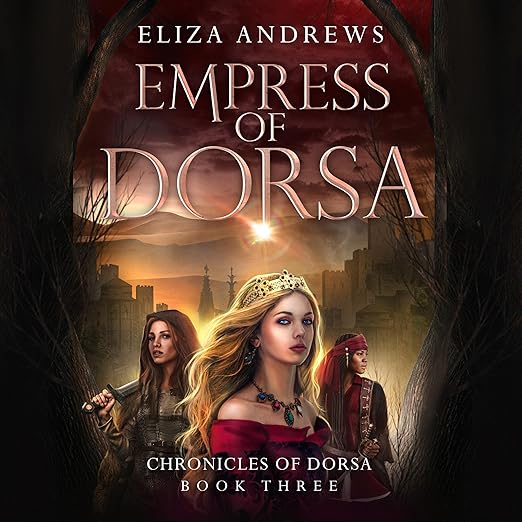
I came to Empress of Dorsa having listened to The Princess of Dorsa and Soldier of Dorsa back to back across a very long January, the kind of month that makes you grateful for a long fantasy series with a genuine story to tell. By the time I reached book three, I had opinions about Natasia and Joslyn that I hadn’t expected to develop from what started as an impulse pick in the sapphic fantasy section. That’s what Eliza Andrews does across this trilogy: she earns the investment by building a world that behaves like a world and characters who develop like people rather than plot functions.
Empress of Dorsa opens four and a half years after the Battle of the Empress’s Last Stand, the event that closed Soldier of Dorsa and whose aftermath shapes everything in this concluding volume. The Empress and her Commander are presumed dead. Linna, a new protagonist, refuses to accept that conclusion and has traveled alone to the East to find out what actually happened. From there, Andrews expands the narrative’s scope considerably, pushing past the Empire’s former borders into the Kingdom of Persopos, a realm “so shrouded in mystery that some people claim it may not even exist.”
Our Take on Empress of Dorsa
At 700-plus pages in print (and twenty-six and a half hours in audio), this is the largest and most structurally ambitious book in the trilogy. Andrews introduces a substantial number of new characters in the opening sections, Linna being the primary point-of-view character for much of the first half, before weaving them back toward the established cast. One reviewer noted that this choice made the book “feel more mature” than its predecessors, and that’s an apt observation: Andrews is trusting her readers to stay oriented across a wider cast and a more complex chronology than the earlier books required.
The political intrigue that reviewers compare to Game of Thrones is genuinely present. The power dynamics within the Empire, the fragile alliances that Natasia built and that others have spent four and a half years contesting, and the question of what “the Empress’s legacy” means without the Empress, these run through the narrative as structural concerns, not just background. Andrews is not writing an adventure story with political window dressing; she’s writing a political epic that happens to have extraordinary action sequences.
Why Listen to Empress of Dorsa
Elizabeth Saydah has been with this world from the beginning, and the cumulative effect of that continuity is significant. She knows how Natasia sounds under pressure versus when she’s at ease. She knows the rhythm of Joslyn’s speech patterns. When those characters return to the narrative, and they do, Saydah doesn’t have to reconstruct them from scratch, and the listener doesn’t experience the jarring recalibration that sometimes accompanies a narrator change or even a narrator returning to a character after a long gap. The new characters she introduces in Empress of Dorsa are differentiated clearly enough that a cast this large doesn’t collapse into indistinguishable voices.
Several reviewers have described the trilogy as a whole as among the best sapphic fantasy they’ve encountered, with comparisons to the political complexity of A Song of Ice and Fire. Those comparisons are not made lightly by people who read in the genre, and they hold up, Andrews built something with the first book that she then expanded and complicated in ways that rewarded the ongoing investment rather than depleting it.
What to Watch For in Empress of Dorsa
This is emphatically a trilogy conclusion, and it is not a standalone entry point. One reviewer was emphatic on this point: stop reading the Empress of Dorsa review and go pick up The Princess of Dorsa first. That advice stands. The emotional weight of the conclusion depends entirely on the investment accumulated across the previous two books, and listeners who parachute into book three will find the new characters’ emotional arcs comprehensible but the returning characters’ resolution hollow, they won’t feel the earned quality that makes the ending work.
The new-character-heavy opening, while a deliberate structural choice, does require patience. Reviewers who loved the book almost universally noted that the early sections needed time before the pieces clicked into place. At twenty-six hours, this is not a book that can be absorbed inattentively, but the listeners who gave it focused attention describe the finale as genuinely satisfying in the way that a well-resolved trilogy conclusion rarely is.
Who Should Listen to Empress of Dorsa
If you’ve listened to The Princess of Dorsa and Soldier of Dorsa and found yourself invested in Natasia, Joslyn, and the world Andrews built, Empress of Dorsa is exactly what you’re looking for: a conclusion that takes the material seriously and resolves it with the emotional intelligence the series established. Readers new to the Chronicles of Dorsa who are drawn to sapphic epic fantasy with genuine political complexity should start at the beginning, the trilogy rewards that full investment. Listeners who prefer their fantasy fast-paced and action-forward may find the political intricacy and the twenty-six-hour runtime demanding; this is a series for readers who want to live in a world rather than simply pass through it.
Frequently Asked Questions
Does Empress of Dorsa work as a standalone, or do I absolutely need to read the first two books?
You need the first two books. The emotional and narrative foundation of Empress of Dorsa is entirely dependent on what Andrews built in The Princess of Dorsa and Soldier of Dorsa. The new characters Linna and others can be followed without prior context, but the returning characters’ arcs, and the resolution of Natasia and Joslyn’s story, will land as hollow rather than earned without the investment the earlier books build.
The opening of Empress of Dorsa introduces a lot of new characters, how long before the familiar cast returns?
The early sections of the book are genuinely new-character-heavy, with Linna as the primary perspective. Reviewers consistently note that this requires patience but pays off as Andrews brings the storylines together. The exact timing varies by how you pace the listen, but most reviewers describe the convergence of old and new as one of the book’s most satisfying structural accomplishments once it happens.
How does Elizabeth Saydah handle the expanded cast in Empress of Dorsa compared to the earlier books?
She handles it with the clarity that comes from having lived in this world across three books. The new characters are differentiated by voice register and rhythm rather than accent work, which holds up better over a twenty-six-hour runtime than more obvious character-differentiation strategies. The returning characters sound as they should, continuous with their earlier portrayals, which is the primary thing a long-series narrator needs to get right.
Reviewers compare the political complexity to Game of Thrones, is that comparison earned, or is it overblown?
It’s earned in the structural sense: Andrews builds a political world where factions have competing interests, alliances are fragile and conditional, and the question of who holds power and why has genuine consequences for the narrative rather than serving as backdrop. The comparison isn’t to the scale of A Song of Ice and Fire but to the seriousness with which Andrews treats political logic as a narrative driver rather than decoration.