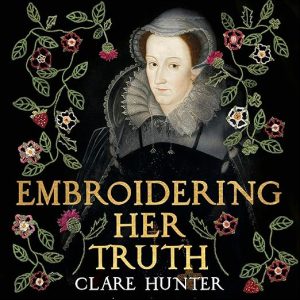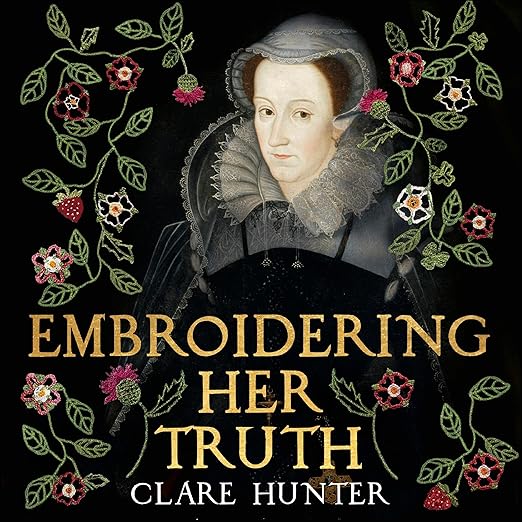
I started Embroidering Her Truth on a long train journey, specifically because I wanted something with enough intellectual substance to hold up across four hours of travel but that also had the quality of genuine discovery. Clare Hunter's previous book, Threads of Life, which became a Sunday Times bestseller, had been on my radar for a while, and when this follow-up appeared, focused specifically on Mary, Queen of Scots through the lens of her textiles, I was immediately interested. What Hunter is doing is genuinely unusual in the genre of historical biography: taking a queen whose life has been told from virtually every political and psychological angle and finding a new entry point through cloth, costume, embroidery, and the specific visual language of sixteenth-century material culture.
The governing insight is both simple and profound. In an era when women's political voices were formally suppressed, Mary exploited textiles to say things she could not safely say in other forms. From the lavishly embroidered gowns she wore as the prospective wife of the French Dauphin, which communicated claims about her lineage and her royal authority, to the fashion dolls she used to project a Marian aesthetic onto the Scottish court, to the subversive embroideries she worked during her captivity and intended for specific supporters, Mary used cloth as a medium that could carry political meaning while appearing to be merely decorative. Hunter argues that this was not incidental but strategic, and across 14 hours she makes that case with accumulated evidence that is more persuasive than any single example would be.
Redmond's Scottish Voice Fits a Scottish Queen
Siobhan Redmond narrates, and the casting is ideal. A Scottish voice for a biography of Scotland's most famous queen brings an authenticity that is more than cosmetic, and Redmond's particular quality of warmth and precision suits Hunter's prose style, which balances scholarly care with memoir-inflected personal investment. Hunter periodically draws on her own relationship to needlework, tracing how her research changed her understanding of what embroidery means culturally, and those sections require a narrator who can modulate between the biographical and the personal without losing momentum. Redmond handles both registers with ease.
The honest accounting of reader response to this book acknowledges a real division that runs along specific lines. Readers who came expecting an embroidery catalog, with detailed treatment of individual works and illustrations, were disappointed. Readers who came expecting a history of Mary's life with textiles as the organizing lens found it revelatory. One reviewer described the first two thirds as a rehash of basic Mary biography with a Catholic focus and only scattered textile detail before the most important embroideries finally receive sustained attention. Another found it to be exactly what they needed: a history they had never encountered before. The book delivers what its subtitle promises, a biography through the textiles of her life, but the textiles are more interpretive lens than descriptive catalog.
Fashion Dolls Double as Political Instruments
The audio format has a specific advantage here: the absence of illustrations that frustrated some print readers is less acute as a listening experience. Redmond's descriptions of specific embroideries, of Mary's red execution gown as the Catholic symbol of martyrdom rather than passion, of the needlework she produced in captivity with Bess of Hardwick, carry sufficient visual detail in Hunter's prose that the listening imagination does the work the print reader might wish the photographs did. This is a book where Hunter's language earns its keep as evocation rather than documentation, and audio surfaces that quality.
The political dimensions of Mary's textile choices are handled with genuine historical nuance. Hunter is not simply celebrating Mary's creative agency; she is tracking a real strategy deployed under real constraint. The fashion dolls used to establish a Marian style at the Scottish court, the specific designs of embroideries sent to supporters during captivity, the color choice at the execution itself: each of these decisions is analyzed not as an aesthetic preference but as a political act by a woman operating within the narrow range of tools available to her. That analysis elevates the book from biography to cultural history.
Bess of Hardwick and Nineteen Years of Captivity
The captivity sections are the book's most original and most significant. Mary spent the last nineteen years of her life imprisoned by Elizabeth, and it was during this period that her needlework became most overtly political and most richly documented. The collaboration with Bess of Hardwick, her co-embroiderer during years of shared captivity, is one of the most fascinating female partnerships in the period, and Hunter treats it with the complexity it deserves: two women of different political allegiances, confined together, producing work that carried messages each may not have fully shared with the other.
Assumes You Already Know Mary's Basic Story
This one is for listeners who already have some interest in Mary, Queen of Scots and want a genuinely fresh angle on a life that has been exhaustively covered, for readers drawn to material culture history and the politics of visual display in earlier centuries, and for needlework enthusiasts who understand that the history of their craft carries political weight. Skip it if you want detailed technical descriptions of embroidery techniques and illustrated treatment of specific works: Hunter is a cultural historian, not a craft historian in that descriptive sense. Also skip it if this would be your first encounter with Mary's story; the book assumes enough background knowledge that complete newcomers may find the argument easier to follow after acquiring that context.
The Short Version
- Performance: Siobhan Redmond's Scottish voice is perfectly calibrated for a biography of Mary, Queen of Scots, bringing authority and intimacy to Hunter's cultural history.
- What it covers: Textile as political language, female agency in patriarchal power structures, the material history of queenship
- Feel: Scholarly and intimate, quietly feminist
- Our call: A distinctive cultural biography that uses Mary's textiles as a lens on female political expression, most rewarding for readers who come with some existing interest in either needlework history or Mary's story.