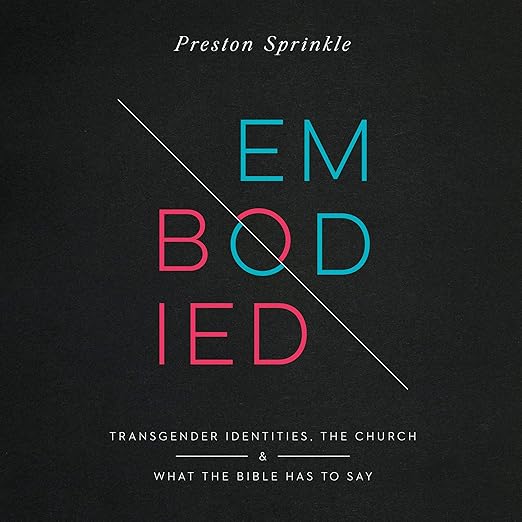
Quick Take
- Narration: Unhurried and careful, well-matched to material that moves between theological argument and pastoral narrative
- Themes: Gender identity, embodiment, conservative theological engagement with transgender experience
- Mood: Thoughtful and measured, occasionally tense with the effort of holding theological tension
- Verdict: Valuable for conservative Christian readers trying to think more carefully about these questions; will be insufficient from two directions simultaneously for readers outside that specific context.
I had been skeptical of this one before I started. The intersection of theology, psychology, and embodiment has produced a lot of earnest but thin work over the past decade, books that gesture toward integration without actually achieving it. Preston Sprinkle’s approach here surprised me by being more rigorously grounded than I expected, and more willing to hold tension than the genre usually allows.
The subject is how Christians should think about questions of gender identity, transgender experience, and bodily existence. Sprinkle is a conservative evangelical theologian, and that framework shapes everything he does here. Knowing that before you start is essential, because the book makes sense only in relation to the community it is writing for and the specific internal debates within that community that it is trying to move.
What Sprinkle Is Doing With the Theology
The distinctive move in this book is Sprinkle’s insistence on separating theological conclusion from pastoral posture, and on insisting that the second is not determined by the first. He argues that someone can hold a traditional view of sex and gender while engaging with transgender people with genuine curiosity, dignity, and care, and that the failure to do so is a theological problem, not merely a social one. For his target audience, this framing is genuinely challenging. It does not let conservatives off the hook by treating doctrinal correctness as sufficient for faithful engagement.
His engagement with the scientific literature on gender dysphoria is more careful than most evangelical writing on the subject. He does not deny the reality of the experience, and he does not pretend that the psychological literature is straightforwardly aligned with traditional theological categories. That intellectual honesty is the book’s most valuable quality. Whether it is sufficient to the complexity of what he is engaging with is a question that readers will answer differently depending on what they bring to it.
The Narrator and the Material’s Emotional Weight
The narrator brings a careful, unhurried quality to Sprinkle’s prose that serves the book well. This is not material that benefits from urgency or rhetorical acceleration. The pastoral sections, where Sprinkle is drawing on conversations with transgender Christians and parents of transgender children, carry emotional weight that requires space, and the narration provides it.
The theological exposition sections are denser, and the narration navigates them with appropriate seriousness without becoming academic in register. The performance is consistent enough that the transitions between theological argument and pastoral narrative feel natural rather than jarring. That consistency is harder to achieve than it sounds when the material moves between registers as frequently as this one does across its six-hour runtime.
Where the Book’s Framework Shows Its Limits
The book’s limits are the limits of its context. Sprinkle is writing within and for a specific tradition, and his conclusions, broadly traditionalist on sex and gender while more pastorally generous than much of his tradition, will be unsatisfying from two directions simultaneously. Readers outside evangelical Christianity who are looking for affirmation of transgender experience will not find it here. Readers inside that tradition who want straightforward doctrinal clarity without the pastoral complexity will find his insistence on holding tension uncomfortable rather than productive.
There is also a tension in the book’s structure between the theological sections, which are rigorous and carefully argued, and the pastoral sections, which rely on anecdote and individual testimony. The anecdotes are powerful, the accounts of transgender Christians navigating their faith and their gender simultaneously are among the most affecting passages in the text, but they sometimes carry more argumentative weight than anecdotes can bear. Listeners aware of that imbalance will still find the pastoral material valuable; it just works better as testimony than as evidence for the broader theological claims.
What the book does well within its chosen scope is model a kind of theological engagement that takes embodied experience seriously rather than treating it as noise to be overcome by doctrinal categories. For conservative Christian readers who are trying to think more carefully and humanely about these questions, that modeling is genuinely useful. The audiobook format works well for this material, and readers who want to engage with the footnotes and cited research will benefit from having the print edition accessible alongside it.
What Distinguishes This From Other Books on the Same Topic
The evangelical publishing space has produced a great deal of writing on gender identity and transgender experience over the past decade, most of it falling into one of two recognizable modes: pastoral dismissal that treats the experience as a spiritual failure to be corrected, or progressive affirmation that abandons traditional categories entirely. Sprinkle is attempting a third position that holds traditional conclusions while insisting that pastoral engagement must be radically reconfigured. That third position is genuinely difficult to sustain without collapsing into one of the other two, and the fact that he largely sustains it is the book’s chief accomplishment.
Whether the position is ultimately coherent is a question that readers will answer differently. Some will find that traditional conclusions about sex and gender cannot be separated from the pastoral postures that have historically accompanied them. Others will find Sprinkle’s distinction meaningful and useful. The audiobook does not resolve that question. What it does is model the attempt seriously enough that the question becomes worth engaging with rather than dismissing, and for a topic as contested as this one, that is not a small achievement.
Frequently Asked Questions
What is Sprinkle’s theological conclusion on transgender identity, and does the book state it clearly?
Sprinkle holds a broadly traditional evangelical position on sex and gender. He states this clearly while arguing at length that doctrinal position and pastoral posture are separable questions. His primary emphasis is on how Christians should engage with transgender people rather than on resolving all the theological questions to everyone’s satisfaction.
Does the book engage with the scientific research on gender dysphoria in a credible way?
More carefully than most evangelical writing on this subject. Sprinkle does not dismiss the psychological literature, and he is honest about the places where the scientific evidence does not align cleanly with traditional theological categories. Whether his engagement goes far enough is a question readers will answer differently depending on their expectations, but the intellectual honesty is genuine.
Is this audiobook appropriate for someone who is not evangelical Christian but wants to understand that community’s internal debate on this issue?
It provides real insight into how thoughtful conservative evangelicals are engaging with these questions internally. The book makes most sense in relation to the specific community it is addressing and the debates within that community, but an outside reader willing to engage with the frame on its own terms will find the pastoral emphasis substantive and sometimes surprising in its generosity.
How does the narrator handle the passages where Sprinkle draws on conversations with transgender Christians and their families?
With appropriate care and emotional presence. These are the passages where the book’s pastoral intent is most visible, and the narration gives them space rather than rushing through them to return to the theological argument. The performance is consistent enough that the transitions between theological exposition and pastoral narrative feel natural.