Quick Take
- Narration: Kirt Graves handles the polyamorous ensemble with clear voice differentiation, maintaining the emotional intensity the finale demands across nearly eleven hours.
- Themes: Chosen family and the ethics of unconditional love, trauma recovery alongside battle, the hero’s acceptance of their own power
- Mood: Emotionally intense and epic in scope, with the heightened stakes of a series finale
- Verdict: A satisfying conclusion to the Fire and Brimstone Scrolls that rewards readers who have followed Riley and his angels through the full series, though it is entirely inaccessible without that prior investment.
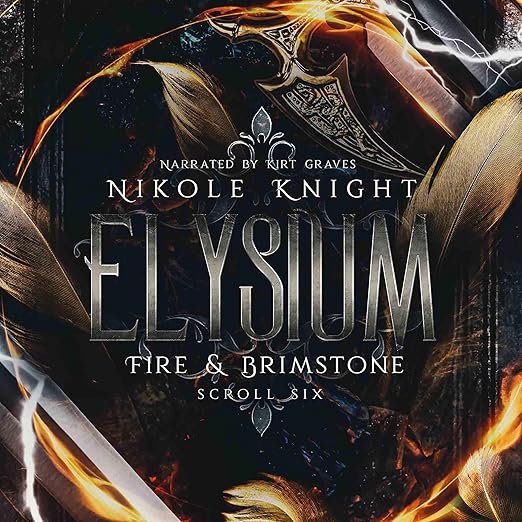
Series finales are where authors either justify the time their readers have invested or expose the gap between what the story promised and what it was able to deliver. I have read enough fantasy series conclusions to know that the most common failure mode is not catastrophic badness but a kind of narrative collapse under the weight of accumulated obligations: too many characters to honor, too many plot threads to resolve, too much emotional promise made in earlier volumes to be fully redeemed. Nikole Knight’s Elysium, the sixth and concluding entry in the Fire and Brimstone Scrolls series, avoids most of these pitfalls and earns its finale status through investment in the emotional truth of the relationships at its center.
The synopsis positions this as the book in which Riley Shepard and his guardian angels finally fight the battle they have been building toward through five preceding volumes, following two months of captivity in Purgatory that have permanently altered Riley. The mechanics of the climactic confrontation are competently handled, but what readers are responding to in the reviews is not primarily the battle sequences: it is the quality of attachment they have developed to Riley, Gideon, Jai, and Noel across the series, and whether the final book honors that attachment. By the evidence of the response, it does.
The Polyamorous Ensemble as Structural Achievement
M/M harem and polyamorous romance is a genre where the relationship dynamics are frequently the most technically demanding element of the writing. Making a four-way relationship feel emotionally coherent rather than logistically convenient requires an author who understands that different pairings within the group will have different qualities, different histories, and different pressure points. Reviewers of the Fire and Brimstone Scrolls consistently note that Knight handles this with unusual skill, and Elysium inherits the benefit of five books of careful relationship development.
One reviewer identified the specific pairing dynamics that resonate for them, citing Jai and Riley, Riley and Noel, Noel and Jai, and the overarching connection to Gideon as each having their own texture and emotional logic. That level of specificity in reader response is a reliable indicator that the characterization is working. Another reviewer who described having never been a fan of polyamorous relationships in fiction because the author usually does not write it well explicitly praised this series for making the dynamics function rather than feeling contrived. Knight earns that praise by treating each relationship as its own thing rather than as a variation on a central template.
Trauma and Battle as Dual Registers
The synopsis notes that Riley emerges from two months in Purgatory alive but forever altered, and the book holds both the altered-ness and the battle in productive tension. One reviewer described Elysium as being about healing after a long and hard journey alongside the battle, and that dual register is genuinely difficult to maintain. Books that try to be simultaneously about recovery and combat usually sacrifice one for the other, defaulting either to emotional processing that interrupts the plot momentum or combat sequences that paper over the psychological work. Knight keeps both in view through most of the narrative, and the character losses that occur in the battle hit harder because the emotional investment has been so carefully established.
The trigger warnings in the synopsis are worth acknowledging: aftermath of trauma, violence, gore, and death. For a series finale in an M/M+ paranormal romance with guardian angel mythology, these warnings are appropriate and honest. Readers who came for the romance and stayed for the plot should be prepared for the book’s willingness to inflict real cost on characters they love. The reviewer who described their heart breaking for characters who died and who they really liked was articulating the book’s genuine willingness to follow through on its darker implications.
Kirt Graves and the Ensemble Challenge
Narrating a multi-protagonist polyamorous series finale presents specific challenges. Kirt Graves has presumably developed consistent vocal approaches to Riley, Gideon, Jai, and Noel across the series, and maintaining that consistency through nearly eleven hours of emotionally escalating material requires both technical discipline and the ability to modulate intensity without losing character differentiation. The fact that reviewers describe crying and laughing through to the last line suggests the narration is functioning as a delivery mechanism for emotion rather than as an obstacle to it, which is the minimum a finale of this type requires.
Graves handles the bonus scenes appended to the main narrative with the same investment as the core text, which matters because bonus scenes in series finales serve an important function: they allow readers who are not ready to say goodbye a little more time with characters they have spent significant emotional energy on. One reviewer explicitly described not being ready to say goodbye to these boys, a response that the bonus scenes seem designed to acknowledge and partially accommodate.
Who Can Enter Elysium
This free audiobook is exclusively for listeners who have completed books one through five of the Fire and Brimstone Scrolls series. There is no meaningful sense in which Elysium functions as a standalone: it opens in medias res of a plot and relationship history that requires five books of context to feel. For those who have made that journey, this is by multiple accounts a finale that delivers on what the series promised. For listeners who enjoy M/M+ paranormal romance with fantasy elements, high emotional stakes, and ensemble casts where the relationships feel genuinely complex, the series as a whole is worth starting from book one. Listeners who prefer lower-heat, lower-stakes romance should look elsewhere.
Frequently Asked Questions
Can Elysium be listened to without having read the previous five books in the Fire and Brimstone Scrolls series?
No. This is a series conclusion that opens inside a fully developed plot and relationship history. Without the prior five books, the character attachments and plot stakes that drive the emotional impact will not be present.
How does Knight handle the polyamorous relationship dynamics in the final book, and do all the pairings within the group get meaningful attention?
Yes. Reviewers specifically call out the distinct quality of individual pairings within the four-way relationship, noting that Jai and Riley, Riley and Noel, Noel and Jai, and the connection to Gideon each have their own emotional texture even within the group dynamic.
The trigger warnings mention death. Are major beloved characters killed in Elysium?
Yes. The book follows through on its darker implications, and reviewers describe grieving characters who die in the final battle. One reviewer specifically described their heart breaking for characters they really liked, so the content warning for death is substantive rather than precautionary.
Does the book include bonus scenes after the main narrative, and do they feel integral to the ending or like a simple add-on?
Yes, bonus scenes are included, and reviewers who mention them describe them as necessary rather than optional. For readers not ready to leave the characters, the bonus content provides meaningful additional closure.