Quick Take
- Narration: Del Roy brings a quiet warmth to David Bodanis’s biographical sketches that keeps the science grounded in human experience rather than textbook abstraction.
- Themes: Scientific discovery, the politics of genius, electricity as civilizational force
- Mood: Intimate and illuminating, the feeling of understanding something that was always present but never fully seen
- Verdict: Bodanis writes science history the way it should be written: through the people who made it, with all their ambitions, failures, and complicated lives intact.
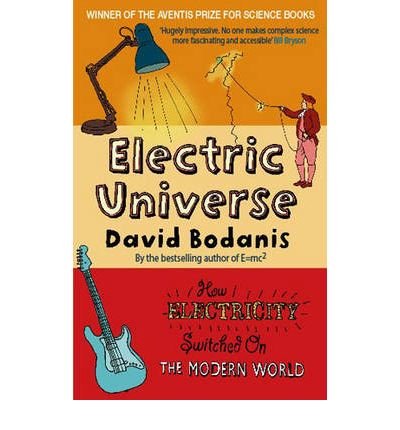
There is a particular pleasure in listening to a science history that assumes you don’t need to be reassured. David Bodanis’s Electric Universe, which I returned to a few weeks ago after having read an earlier version years before, trusts its audience to stay interested in Michael Faraday’s struggle against British class prejudice and Alan Turing’s tragedy alongside the electromagnetic field equations. It is a book that believes the human story and the scientific story are the same story. I think Bodanis is right about that, and listening to it confirmed the conviction.
The title is both literal and figurative. Bodanis argues that electricity is not just a technology but a framework for understanding modern life at multiple scales: from the Atlantic telegraph cable to the synapses firing in a human brain, from Morse’s telegraph to the computers that now occupy the role Turing’s “thinking machine” vision imagined. This is a large claim, but Bodanis makes it through accumulation of specific, well-chosen cases rather than through abstraction.
Faraday in the Margins
The chapter on Michael Faraday is the one that has stayed with me longest. Faraday was the son of a blacksmith who taught himself science through books borrowed from the shop where he worked as a bookbinder’s apprentice. His lack of formal mathematical training was used against him by the scientific establishment of his era, men who believed that if you couldn’t express a physical relationship in differential equations you hadn’t understood it. Faraday understood it differently: through visual intuition, through the concept of field lines, through a way of seeing electromagnetic relationships that his more credentialed contemporaries literally could not perceive.
Bodanis handles Faraday’s story with real sympathy and without hagiography. The resentments Faraday accumulated across his career, the way class operated as a ceiling, the ways he was dismissed and then claimed after his discoveries proved indispensable: these are rendered with the same care as the science itself. Del Roy’s narration gives Faraday a quiet dignity that suits the portrait.
Turing, and the Weight of What Followed
The Alan Turing section is the book’s most emotionally demanding, which makes sense given the biographical material. Bodanis traces Turing’s vision of a thinking machine, the indifference with which his proposals were often met, and the treatment he received from British authorities after his homosexuality became known. Turing’s death, officially ruled a suicide, is handled without melodrama. Bodanis lets the facts carry the weight they deserve, and Roy’s narration holds the same restraint.
What Bodanis does well here is something that many science biographies fail to achieve: he makes Turing’s despair comprehensible not as mere personal tragedy but as a consequence of specific institutional decisions made by specific people about how to treat a specific man. The “experimental treatments” he was forced to undergo are not euphemized. The loss to science and to the person are made equally visible.
How Bodanis Moves Through Time and Scale
Electric Universe covers an enormous temporal and geographic range: frigid Atlantic waters where the first transatlantic telegraph cable was laid, Hamburg during a World War II firestorm where electrical systems failed in precisely predictable ways, the interior of the human body where neural electricity operates. Bodanis uses these locations not as scenic backdrop but as argument: electricity is here, everywhere, always, and understanding it changes what you see.
Reviewer Neil Karl notes that Bodanis writes from “the perspective that electricity is everywhere in the universe including our bodies,” which is accurate and is the book’s governing premise. Whether he’s describing how the Atlantic cable project succeeded after multiple failed attempts or how Samuel Morse ran for mayor of New York on a platform of anti-Catholic persecution before inventing the telegraph, Bodanis never lets the larger argument drift out of frame. The characters are not illustrations. They are the argument.
Six Hours Well Spent
At six hours and thirty-nine minutes, Electric Universe is accessible rather than exhaustive. It is not a comprehensive history of electricity’s scientific development; it is a curated account of the figures and moments that Bodanis finds most revealing about how the invisible force that runs through everything came to be understood and harnessed. Listeners who want technical depth on any individual topic will need to go elsewhere. But as an introduction to the human texture of scientific history, or as a reminder of it, Electric Universe remains one of the more elegant examples of the genre. Del Roy’s narration earns its place in that assessment.
Frequently Asked Questions
Is Electric Universe appropriate for listeners without a science background?
Yes. Bodanis is writing about the history and human context of electrical discovery rather than providing technical instruction. The science that appears is explained through story and analogy, and reviewer PICKLES describes it as ‘one of the best, easy to read books’ on the subject precisely because of its accessibility.
How much of the book focuses on Alan Turing specifically?
Turing is one of several figures across the book’s six-hour runtime rather than its exclusive focus. He appears alongside Faraday, Edison, Morse, and others. The Turing section is among the most emotionally weighted, but it represents a portion of the whole rather than the book’s organizing subject.
Does the book engage with how electricity works in the human body, or is that metaphorical?
Bodanis includes the human body’s electrical systems as a genuine subject rather than pure metaphor. He traces neural electricity as part of the broader argument that electricity is not just a technology we use but a force that constitutes physical reality at multiple scales.
Is Del Roy’s narration a good match for David Bodanis’s writing style?
Roy’s quiet, warm delivery suits Bodanis’s intimate biographical approach. He doesn’t perform the science dramatically, which is the right call: the writing is doing the work, and Roy functions as a clear, unhurried conduit for it across the book’s six-plus hours.