Quick Take
- Narration: Jacqueline Marcell self-narrates her own caregiving ordeal, and the decision works, her voice carries the exhaustion, dark humor, and hard-won expertise of someone who actually lived the twelve years this book covers.
- Themes: Eldercare crisis management, Alzheimer’s behavioral symptoms, caregiver survival, navigating the medical and legal system
- Mood: Harrowing and frequently funny, the LOL designation in the synopsis is not hyperbole
- Verdict: A benchmark text in the caregiving space, and the self-narration makes the emotional stakes visceral in a way print alone can’t fully convey, this is essential listening if you are already in, or anticipating, the role of an aging parent’s advocate.
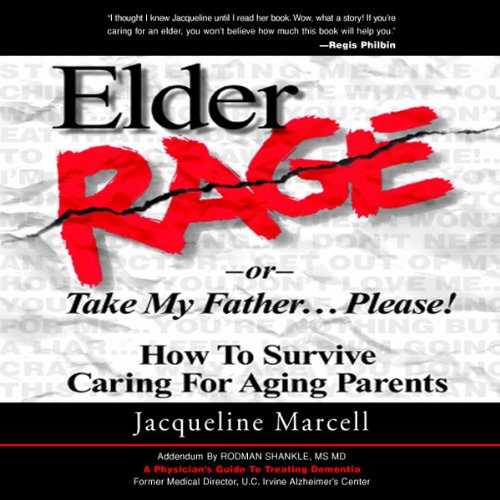
I listened to Elder Rage over the course of three evenings, initially because its subtitle, a riff on Henny Youngman’s classic line, signaled that this would handle one of the hardest subjects in adult life with something other than relentless solemnity. What I didn’t expect was how practically useful the audiobook would be alongside its emotional honesty. Most caregiving memoirs are one or the other: either deeply personal testimonies that offer catharsis but limited guidance, or how-to frameworks that stay at clinical distance from the actual experience of managing a parent with dementia. Marcell somehow does both, and the twelve hours and forty-three minutes are consistently worth the time.
The backstory is a true account of Marcell’s trials managing the care of her father, described in the synopsis as “challenging” and in the text as something considerably more specific, and her ailing mother. The father is a figure of both genuine menace and real pathos; one reviewer notes that the chapter titles alone capture the scope of what Marcell navigated, including the memorably titled “Jacqueline, You Ignorant Slut.” This is not a sanitized version of what advanced cognitive decline can do to a person’s personality and behavior. Marcell tells it straight.
The Practical Architecture Beneath the Memoir
What distinguishes Elder Rage from the typical caregiving memoir is that Marcell organized her experience into a genuinely usable framework. The audiobook answers the specific, difficult questions that adult children find themselves unable to get answered, how to persuade an obstinate elder to accept help, see a different doctor, give up the car keys, take medication, bathe regularly. These are not trivial questions, and the standard guidance tends to be either vague or optimistic in ways that don’t survive contact with a parent who spent eight decades being the person who told other people what to do.
Reviewer NancyD notes that Marcell leaves you feeling inspired by a daughter’s determination, but what strikes me about the structure is that inspiration is secondary to utility. The sections on managing siblings, handling healthcare professionals, and navigating the legal and financial dimensions of eldercare are addressed with the specificity of someone who made expensive mistakes so that readers don’t have to. The endorsements from institutions like Johns Hopkins Memory Clinic and Duke University Center for Aging reflect that the medical establishment found this content sufficiently credible to recommend to students.
The Dementia Behavioral Dimension
Marcell is particularly strong on the behavioral manifestations of dementia, the aggression, the paranoia, the personality changes that are, in many ways, harder for families to navigate than the memory loss. Understanding that these behaviors are symptoms rather than personal choices is cognitively accessible as information, but emotionally it takes something more to internalize when you’re in the middle of it. Marcell’s account provides the emotional scaffolding that clinical descriptions don’t. Her father’s behaviors are described with enough specificity that readers dealing with similar situations will recognize them, and more importantly, will recognize them as symptoms rather than attacks.
Reviewer Kate Harmond notes that although the book is American, the lessons travel. The specific institutions and resources are US-focused, but the interpersonal and behavioral navigation is universal. For international listeners, the practical chapters on legal and financial management will require translation to local context, but the core caregiving wisdom doesn’t.
Grief, Guilt, and What Comes After
Marcell addresses the emotional labor of caregiving directly, not just the physical and logistical exhaustion but the guilt, the grief, and the complex feelings that arise when a parent you’re caring for is also someone who has been difficult or even harmful. She does not pretend that love and frustration are mutually exclusive, which is among the most honest things about this audiobook. The sections on managing personal stress alongside the caregiving role are addressed with practical specificity rather than wellness platitudes, which is a relief.
Who should listen: Adult children in or approaching a caregiving role for an aging parent, particularly one with cognitive decline, behavioral challenges, or dementia. Healthcare and social work students, this is assigned reading at numerous universities for good reason. Anyone who found clinical eldercare resources emotionally unmoored from the actual experience.
Who should skip: Listeners looking for a straightforward memoir without practical content, anyone who needs lighter listening for a difficult period, the material is emotionally demanding even at its funniest, and the humor is gallows humor, not lightness.
Frequently Asked Questions
How does Marcell’s narration handle the sections about her father’s aggressive behavior, is it difficult to listen to?
Marcell narrates the difficult behavior with directness and a dark humor that makes it navigable without minimizing the genuine difficulty. She is not protective of the reader in these sections, but she is honest in a way that feels like solidarity rather than trauma performance. The result is harrowing and useful simultaneously.
Is the practical guidance in Elder Rage still current, given that the original publication predates some recent eldercare developments?
The core practical wisdom around managing obstinate elders, navigating family dynamics, and self-preservation as a caregiver remains fully applicable. Some specific legal, financial, and institutional references are US-specific and may have evolved, the book has received multiple updates, and the general framework is more durable than the specific resource details.
Does the audiobook address adult day care, and does it cover how to overcome a parent’s resistance to it?
Yes, adult day care is addressed specifically, and the National Adult Day Services Association gave Marcell their Media Award for how she handled this topic. The audiobook covers both the practical value of adult day care and strategies for persuading a resistant parent to accept it, which is typically the more difficult part.
At nearly thirteen hours, is Elder Rage structured so listeners can use it as reference material, or does it need to be listened to linearly?
The memoir structure works best linearly for the emotional arc, but the practical sections are organized thematically enough to return to as reference. The chapter structure covering specific challenges, driving, medication, hygiene, medical appointments, allows listeners to navigate back to relevant sections as their own caregiving situations evolve.