Quick Take
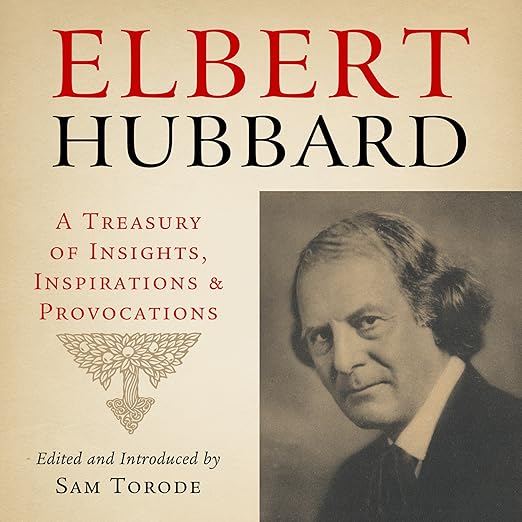
- Narration: Sam Torode narrates his own editorial compilation, which gives the performance a curatorial intimacy, he knows exactly why he chose each piece and that knowledge comes through.
- Themes: Free thought, women’s equality, work and craft, the arts and crafts movement, anti-war sentiment
- Mood: Provocative and warmly intellectual, the aphorism format makes it dense with ideas without being heavy
- Verdict: An ideal introduction to an unjustly forgotten American writer, delivered with care by an editor who has made a genuine study of his subject.
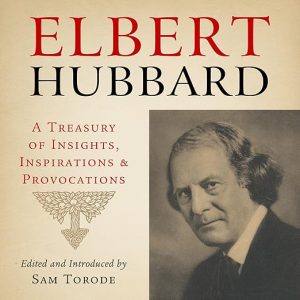
I came to Elbert Hubbard with essentially no prior knowledge, which is apparently the common experience, his name does not appear in most literary surveys, and his death on the Lusitania in 1915 seems to have drawn a curtain over work that was, by the anthology’s account, among the most widely read in America during his lifetime. Sam Torode’s anthology exists specifically to change that, and I listened to it across several mornings as something between inspiration reading and historical recovery.
The format is unusual: 120 short essays plus aphorisms, covering everything from women’s equality to the school system to the war machine to the nature of creative work. Hubbard wrote in short, punchy forms, and Torode’s comparison of him to a proto-blogger and proto-tweeter, someone whose natural unit was the paragraph or the pithy sentence rather than the chapter, is accurate and useful for understanding how to approach the listening experience.
Our Take on Elbert Hubbard: A Treasury
What makes Hubbard worth recovering is not nostalgia but relevance. His arguments about women’s equality, free thought as opposed to institutional religion, the failures of standardized schooling, and the moral costs of militarism are not relics of 1910, they are positions that remain contested and, in places, radical. One reviewer described him as far ahead of his time, which is accurate in the sense that his concerns remain current, though his specific political and social context was also specific to the Progressive Era.
The arts and crafts movement context is worth noting. Hubbard founded the Roycroft community in East Aurora, New York, which was one of the significant American expressions of that movement, the belief that handcrafted work had moral and aesthetic value that industrial production was destroying. One reviewer imagined working in his little shop, which captures something of the atmosphere Hubbard’s writing creates: a combination of idealism and practical craft that is not common in philosophical writing.
Why Listen to the Anthology Rather Than Individual Works
Torode’s editorial work is itself a contribution. Hubbard wrote extensively, novels, essays, little journeys, philosophical pieces across multiple decades, and most of it is difficult to find in accessible editions. The anthology selects and sequences the material with an eye toward breadth and representative quality rather than simply collecting his most famous pieces. For a first encounter with Hubbard, this is a more useful entry point than any single original work would be.
Sam Torode narrating his own compilation is the right choice. He is not performing Hubbard’s voice so much as contextualizing it, introducing each section with editorial perspective that anchors the historical material without condescending to it.
What to Watch For in the Listening Experience
The anthology format means the listening experience is episodic by design. At four hours and thirty-nine minutes, there is no single sustained argument being built, Hubbard’s mode is the essay and the aphorism, not the treatise. This makes it excellent for sessions of twenty to forty minutes where you want something that provokes thought without requiring sustained narrative investment. It is poorly suited to marathon listening sessions where you want to follow a story or argument over many hours.
Some of the theological and social positions will feel dated in specific ways while remaining provocative in others. Hubbard’s agnosticism and his critiques of institutional Christianity are delivered with the confidence of someone who lived through the American religious debates of the late nineteenth century, a historical context that differs from current religious discourse even when the questions are similar.
Who Should Listen to Elbert Hubbard: A Treasury
Readers interested in American intellectual and cultural history of the Progressive Era will find this a genuinely valuable recovery project. Those drawn to the arts and crafts tradition, to questions about work and meaning, or to the history of American free thought will find Hubbard relevant and often sharp. Anyone who enjoys aphorism-based listening, the kind of material you can carry with you in short quotable form, will find a working vocabulary here. Those who need sustained narrative or argument will find the format frustrating. Torode’s editorial framing makes this the right starting point for a writer who deserves far more readers than he currently has.
Frequently Asked Questions
Who was Elbert Hubbard and why is he not better known today?
Hubbard was a philosopher, entrepreneur, and leader of the American arts and crafts movement who was one of the most widely read authors of his era. His death on the Lusitania in 1915 at the outset of WWI effectively ended his influence, and his work fell into obscurity as literary taste shifted in the following decades. This anthology is an attempt to restore his readership.
Is this appropriate for listeners who hold religious beliefs, given the agnosticism and free thought content?
Hubbard’s critiques of institutional religion are forthright and were considered provocative in his era. The anthology is tagged under Agnosticism. Listeners who are committed to religious orthodoxy may find some of the content challenging, though the historical distance softens some of its edge.
Is the anthology format, 120 essays plus aphorisms, cohesive enough to work as an audiobook, or does it feel scattered?
The short-form nature is a feature rather than a flaw for the right listener. Torode’s editorial sequencing and narration provide connective tissue. The listening experience works best in shorter sessions rather than extended ones, it is built for reflection rather than momentum.
Does Sam Torode’s narration of his own compilation affect the authority of the content?
Positively, in the view of reviewers. One described Torode’s work, both editorial and performance, as worth at least one reading, probably more. His intimate familiarity with the material gives the narration a confidence that a hired reader might not bring to historical aphoristic content.