Quick Take
- Narration: Eckhart Tolle narrates his own retreat recording. His cadence and deliberate pacing are part of the teaching itself, not just the delivery mechanism.
- Themes: Present-moment awareness, releasing ego-identification, inner stillness as accessible practice
- Mood: Calm and spacious, with occasional dry humor that prevents reverence from becoming solemnity
- Verdict: A meaningful supplement to The Power of Now for those already familiar with Tolle's framework, less effective as a standalone introduction.
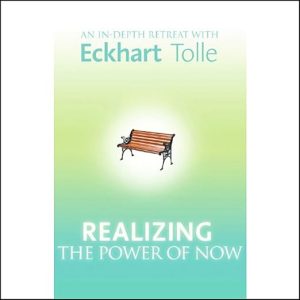
I put on Realizing the Power of Now during a particularly fractious week when I had too many things demanding attention and not enough capacity to attend to any of them well. Eckhart Tolle's live retreat recording was not the productivity tool I was reaching for, but it was the thing that actually helped. There is something almost paradoxical about that: a seven-hour recording about not being consumed by your thoughts, which I consumed while being consumed by my thoughts, and which managed anyway to create about forty minutes of genuine stillness in the middle of a Tuesday afternoon.
That is more or less what Tolle's work is designed to do, and it is worth saying plainly that Realizing the Power of Now is a different kind of audiobook from most of what I review. It is a live recording of a multi-day retreat, not a produced narrative with chapters and an arc. Tolle is teaching in real time, responding to the energetic presence of an audience, circling back to concepts he has introduced and extending them. The format asks something different of the listener than a standard nonfiction audiobook.
Where This One Lands
The content builds directly on Tolle's foundational text. Reviewer OregonBeaches offered the most useful framing: concepts discussed in the retreat are presumed known, and this is not the right entry point for someone encountering Tolle for the first time. That warning deserves to be taken seriously. The retreat does not define its terms from scratch. It explores them, deepens them, and extends them, and the depth is considerably greater for listeners who have already spent time with The Power of Now.
What the retreat adds that the book does not offer is Tolle's presence in real time. His discussion of acceptance, which reviewer OregonBeaches described as the most valuable section, benefits from the live context. He is not reciting a position. He is working through a concept in relation to the specific questions and resistances an audience raises implicitly simply by being present. That responsiveness is audible in the recording, and it changes the quality of what is being communicated.
Tolle's self-narration is not optional here. This is a live recording, and the sound of his voice, the German-accented English, the long pauses, the occasional quiet humor, is central to what the material is doing. Reviewer Scott specifically noted that he did not want a word-for-word reading of the text but rather deeper insights that only Tolle can bring, and that is exactly what this provides. It is not a companion piece in the sense of supplementary material. It is another expression of the same underlying teaching that opens different aspects.
At seven hours the recording covers substantial ground. The sections on the inner body and sense perception as portals to presence, on going beyond the stream of thought rather than suppressing it, and on acceptance as something other than passive resignation are particularly developed. Reviewer Lisette described the sense of spending time with Tolle as distinct from reading his books, and that quality of companionship is something the audio format uniquely enables.
What to Watch For in Realizing the Power of Now
The live recording format means the structure is associative rather than sequential. Topics are introduced, returned to, and extended across sessions rather than organized into discrete chapters with clear transitions. Listeners who need strong organizational scaffolding may find the accumulative quality more difficult to follow than a produced audiobook with chapter markers.
The production quality reflects the recording's origins as live retreat audio rather than studio-produced content. Background ambient sounds from the venue are occasionally audible, and the acoustic quality is not equivalent to a controlled studio environment. For most listeners in the Tolle audience this will not be an issue, but it is worth knowing before committing seven hours.
Recommended For
Readers who have already engaged seriously with The Power of Now and want to spend time in the teaching rather than revisit the text. Listeners who benefit from repetition and deepening of familiar concepts rather than encountering new frameworks. Not recommended as a first Tolle experience, and not recommended for listeners who find his speaking cadence and long pauses more frustrating than grounding. Those who find stillness in his delivery will find this seven hours genuinely valuable.
Questions Listeners Ask
Is Realizing the Power of Now the same content as The Power of Now book, just read aloud?
No. It is a live multi-day retreat recording, not a reading of the book. Tolle covers related concepts but in a teaching-discussion format rather than a structured text, and reviewer OregonBeaches notes there was no direct repetition between this recording and three other Tolle audio discussions they had already heard.
Can someone new to Eckhart Tolle start with this recording, or is prior familiarity with The Power of Now essential?
Prior familiarity is strongly recommended. Multiple reviewers specifically caution that the retreat presumes the listener already knows the core concepts. Starting with The Power of Now first and then returning to this recording is the intended sequence.
What is the audio quality like given that this is a live retreat recording rather than a studio production?
The recording is a live capture rather than a studio production, so the acoustic quality reflects that context. It is clear enough to follow comfortably, but listeners expecting studio-grade sound should adjust expectations.
Does Tolle use humor in this recording, or is it entirely solemn and reverential in tone?
Multiple reviewers mention humor as a consistent presence. Tolle uses it deliberately to prevent the teachings from becoming heavy or inaccessible. Reviewer Colleen Brit describes the humorous delivery alongside the wisdom, and reviewer Lisette mentions that his sense of humor shows the audience to themselves.