Quick Take
- Narration: Joel Richards delivers Dykes’ frameworks with measured clarity, keeping the pacing academic without becoming flat, a good match for structured nonfiction.
- Themes: Data visualization, narrative persuasion, organizational decision-making
- Mood: Methodical and motivating, like a very good conference keynote stretched across ten hours
- Verdict: If you regularly present data to people who need convincing, this book will change how you prepare.
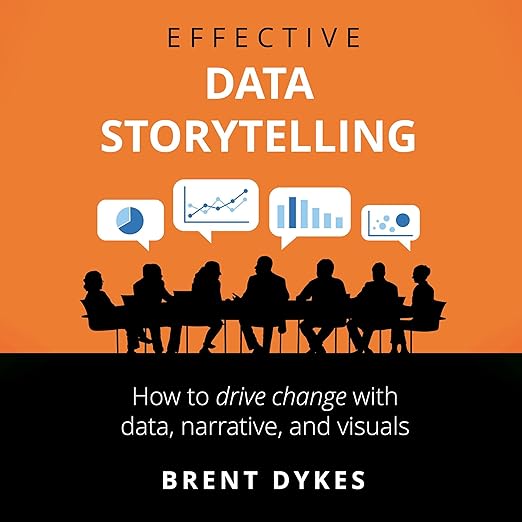
I picked this one up in the middle of a work stretch where I kept watching perfectly good analysis land with a thud in meetings. The charts were right. The numbers were solid. Nobody cared. Brent Dykes was recommended to me by a colleague who had read the print edition, and I decided the audiobook format would let me absorb it during my morning walks rather than waiting for a quiet evening at my desk. By the end of the first chapter, I understood exactly why I’d been struggling.
Dykes opens with a premise that cuts straight through the noise: data visualization is only one piece of the puzzle. The narrative framing around those visuals, and the psychological mechanisms that make stories stick where statistics don’t, is where the real work happens. He’s not the first person to say this, but he is unusually systematic about proving it.
The Science Behind Why Stories Outperform Statistics
What separates this book from most data communication guides is Dykes’ genuine engagement with the cognitive science underpinning his argument. He explains how the brain processes facts differently from narrative, and he does so without dumbing the research down or over-citing it. The distinction he draws between a chart that shows a pattern and a story that makes that pattern matter is one of the clearest framings I’ve encountered in this genre. One reviewer described the book as having changed how they prepare for meetings, how they speak at conferences, and how they connect with customers. That range speaks to how applicable the framework actually is, because Dykes never lets it become abstract.
The Four-Step Storyboarding Process
The practical core of the book is a four-step storyboarding process for structuring data findings as a narrative. Dykes walks through it methodically, and this is where Joel Richards’ narration earns its keep. The material is sequential and logical, and Richards reads it with appropriate steadiness, not injecting false drama into a chapter about audience analysis but keeping things brisk enough that you don’t drift. The companion PDF, available in your Audible library with purchase, is flagged in the synopsis as an important supplement. That caveat is worth taking seriously: the visual examples Dykes references become considerably more meaningful when you can see them, and some of the storyboarding exercises are difficult to fully absorb through audio alone. If you can listen with the PDF open on a second screen, that’s the ideal configuration.
The Seven Principles of Visual Storytelling
The second major framework, the seven principles of better visual storytelling, builds naturally out of the storyboarding section. Dykes’ approach here is less prescriptive than you might expect; he’s more interested in the reasoning behind each principle than in handing you a checklist. This is both a strength and a mild frustration. The book rewards analytical listeners who want to understand why a principle works, not just what it demands of them. The historical and modern examples he uses to illustrate common mistakes are some of the most entertaining stretches in the audiobook, because failure cases tend to be more instructive and more memorable than success stories, and Dykes seems to know this.
Who Gets the Most from This Audiobook
Reviewers cite backgrounds as varied as data scientists, salespeople, conference speakers, and marketing professionals. Dykes himself addresses the audience range in the book, noting that anyone who communicates regularly with data stands to benefit, from financial managers to educators. That’s accurate, but the material is most immediately useful if you’re someone who already works with data and already knows how to visualize it. If you’re still in the early stages of learning SQL or Tableau, this book sits one level above where you are right now and will make more sense once you have some presentation experience behind you. The overlap with books like Cole Nussbaumer Knaflic’s Storytelling with Data is real but not redundant; Dykes leans harder into the narrative theory and the psychological research, while Knaflic is more design-focused. They complement each other well.
I finished this on a Tuesday morning after four days of listening in twenty-minute increments, which is actually how books like this work best, with time between sessions to apply individual concepts before moving on. The clarity of Dykes’ argument held across that fragmented listening pattern without losing its thread, which is a meaningful structural achievement.
Frequently Asked Questions
Is the companion PDF essential for getting value from this audiobook?
It adds meaningful value, particularly for the storyboarding exercises and the visual examples Dykes references throughout. If you’re listening purely during commutes without access to a screen, you’ll still absorb the core frameworks, but you’ll miss some of the specificity in the visual storytelling principles. Download it from your Audible library before you start.
How does this compare to Cole Nussbaumer Knaflic’s Storytelling with Data?
Dykes puts more weight on narrative structure and cognitive science, while Knaflic is more focused on chart design and data visualization best practices. They target overlapping audiences but approach the problem from different angles. If you’ve read Knaflic, Dykes will feel like a useful complement rather than redundant ground.
Does Joel Richards’ narration suit this kind of structured nonfiction?
Yes. Richards is even and clear, which works well for a book that moves through sequentially numbered frameworks. He doesn’t dramatize the material, but the material doesn’t call for dramatization. The pacing is deliberate rather than slow.
Is this useful for someone who doesn’t work in a data-heavy field?
Partly. The narrative and persuasion principles transfer well to anyone who presents information professionally. But a significant portion of the book assumes you’re already producing data visualizations and analysis. If that’s not your context, some chapters will feel tangential.