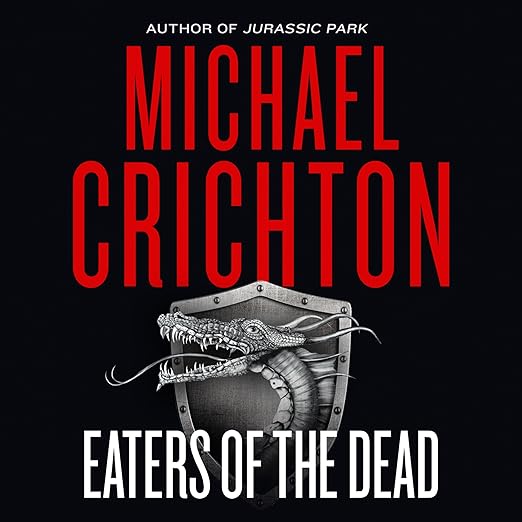
Ahmad ibn Fadlan was a real tenth-century Arab diplomat whose actual travel writing survives, and this audiobook's real craft trick is Michael Crichton grafting three genuine chapters of that historical account onto a full retelling of Beowulf, presented as if the whole thing were recovered scholarship rather than fiction.
Sent north from Baghdad by the Caliph al-Muqtadir, ibn Fadlan encounters a party of Viking warriors on their way to the north and finds himself appalled by nearly everything about them, their hygiene, their open sexuality, their cold-blooded human sacrifices, before circumstance conscripts him into their company as the expedition's thirteenth member, sent to help fight a nameless terror that slaughters the Vikings under cover of night.
The structural conceit deserves real credit. Crichton frames the entire novel as a scholarly commentary on an old manuscript, footnotes and academic hedging included, which gives Eaters of the Dead a texture unlike almost anything else in his catalog. Where his usual technothrillers explain themselves through characters lecturing each other, this one explains itself through the format of the document itself.
Simon Vance narrates with a career built substantially on literary and historical fiction, multiple Audie Awards and an AudioFile Golden Voice distinction among his real, well-documented credentials. None of the three reviews attached to this listing comment on narration specifically, so that broad reputation stands unconfirmed for this exact title, but it is a genuinely relevant one given the material's dense historical register and mock-academic framing.
At five hours and eighteen minutes, this is unusually compact for Crichton, whose technothrillers typically run considerably longer. That tightness works in the book's favor. The manuscript conceit does not overstay its welcome, and the pacing stays brisk enough that the Old English literary scaffolding never drags.
Crichton wrote this one in 1976, more than a decade before Jurassic Park made him a household name, and it stands somewhat apart from the medical and technological thrillers that would come to define his reputation. Readers who only know Crichton through Jurassic Park, The Andromeda Strain, or Congo are getting an earlier, differently curious version of the same writer here, one working in historical pastiche rather than speculative science.
Ibn Fadlan's real account, known to scholars as the Risala, is genuinely one of the most valuable surviving primary sources on Volga Viking funeral customs, including a famously detailed eyewitness description of a chieftain's ship burial that historians still cite today. Crichton's decision to build outward from that real, strange, well-documented material rather than inventing a purely fictional frame gives the novel's opening chapters an unusually solid historical foundation for what eventually becomes fantastical adventure.
Footnotes are ordinarily a print-only device, so it is worth noting how the audio format handles Crichton's extensive scholarly apparatus: rather than breaking the narrative to signal a footnote the way a printed page would, the audiobook folds that material directly into the flow of narration, which actually suits the book's mock-academic voice better than a print reader flipping to the bottom of the page ever could.
Why Listen to Eaters of the Dead
The film adaptation, The 13th Warrior, starring Antonio Banderas, gives this book a recognizable entry point for listeners who know the movie but never read the source material. The novel's structure and pacing differ enough from the film that fans of one genuinely have reason to check out the other.
Beowulf itself, the anonymous Old English epic Crichton retells across the novel's back half, is believed to have been composed sometime in the Anglo-Saxon period, and its monster, Grendel, becomes in Crichton's retelling something considerably more grounded and explicable, without losing the sense of genuine, encroaching dread the original poem built its reputation on.
One reviewer describes the book as launching an entire personal Beowulf obsession that continued well past finishing this one novel, a real testament to how effectively Crichton's blend of real historical travelogue and epic retelling opens a door into older literature for readers who might never have picked up a straight translation of the original poem.
The dual-source structure, three chapters of ibn Fadlan's actual documented travels followed by a full Beowulf retelling dressed as continued eyewitness account, is genuinely clever, and it rewards listeners who enjoy the specific pleasure of not being entirely sure where the real historical record ends and Crichton's invention begins.
What to Watch For in Eaters of the Dead
One reviewer's honest critique is worth repeating: the cultural contrast between Islam and Norse paganism running through the book stays somewhat superficial, an underground tone rather than a fully developed exchange of ideas. Do not expect deep theological or philosophical engagement between ibn Fadlan's worldview and the Vikings' own; the book is more interested in adventure and atmosphere than in that comparison.
A third reviewer's advice is worth taking seriously before pressing play: set aside expectations of typical Crichton style or a typical novel altogether going in. This reads closer to a mock-historical document than to Jurassic Park or The Andromeda Strain, and listeners expecting his usual technothriller register may be thrown by the shift.
Five hours and eighteen minutes is short enough that the book cannot fully develop every thread it raises, the ibn Fadlan travelogue material especially ends fairly abruptly once the Beowulf plot machinery takes over. Listeners wanting the historical travelogue elements explored at greater length should look for ibn Fadlan's actual surviving account directly rather than expecting Crichton's novel to linger there.
The number itself is not incidental. Norse custom in the novel requires exactly thirteen warriors for this kind of expedition, one of whom must not be a Northman, which is the specific mechanism by which ibn Fadlan, a cultured Baghdad diplomat with no combat experience and no interest in Viking custom, ends up drafted into a war party he wants no part of. That superstition-driven premise gives the novel's early chapters real narrative logic for why an outsider observer is even present for what follows.
Who Should Listen to Eaters of the Dead
Beowulf enthusiasts, fans of The 13th Warrior wanting the source material, and historical fiction listeners looking for something considerably shorter and more tightly constructed than the genre's usual doorstops are the ideal audience for this one.
Skip it if you came for typical Crichton technothriller pacing, or if a mock-scholarly framing device sounds more like a gimmick than a draw. This is Crichton doing something genuinely different from his usual register, and that difference is either the whole appeal or a real mismatch depending on what you came looking for.