
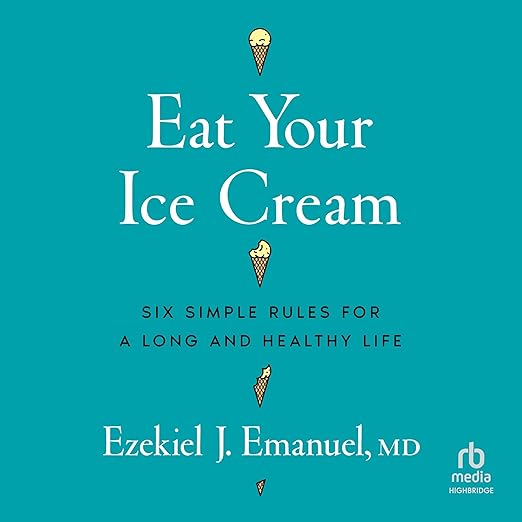
A useful thought experiment: think about the last three pieces of health advice you encountered this week online, then ask which of them was supported by large, replicated, long-term clinical studies rather than a single small study, an influencer's personal experience, or a supplement company's interpretation of preliminary research. Ezekiel Emanuel's Eat Your Ice Cream begins from precisely this kind of reckoning, and the audiobook, at six hours and fifty minutes with Emanuel narrating his own work, is the result. It is a book with a specific argument: that the wellness industrial complex has made health maintenance unnecessarily complicated, anxiety-inducing, and time-consuming, and that the behaviors most robustly supported by evidence are both simpler and more available than the industry requires its customers to believe.
Emanuel is a physician and bioethicist with a profile that extends well beyond clinical practice. As a public intellectual and health policy architect, he has spent years navigating the gap between what clinical evidence actually supports and what wellness media tells people they should be doing. He reads his own work with the slightly combative authority of someone who has fielded a large number of bad-faith objections and has run out of patience for them. That quality, which might be off-putting in some contexts, is quite entertaining in this one, and it lends the audiobook a directness that practitioners of the genre often sacrifice in favor of encouragement.
Ice Cream Symbolizes the Pleasure Longevity Sacrifices
The core of Emanuel's argument in Eat Your Ice Cream is that wellness should be invisible, integrated into a life rather than treated as a competing obligation to it. The title comes from this position: the ice cream is the pleasure you sacrifice when you treat longevity as the supreme value, and Emanuel argues that life is not a competition to live the longest but an experience to be lived with maximum quality, sustained by behaviors that support health without consuming the life they are meant to protect.
A retired cardiologist who reviewed the audiobook noted that after forty-one years of practice, he still learned from it and made changes in his own behavior. That is a meaningful data point. Emanuel is not writing for the general public at the expense of rigor. The coverage of social engagement and mental acuity alongside the more expected material on diet and exercise is, as one reviewer flagged, a genuine strength. Loneliness and isolation as major health risks get serious treatment here rather than a token chapter, which reflects a serious engagement with what the evidence actually shows about health determinants beyond the purely biological.
Emanuel Argues Like a Seasoned Debater
Emanuel's narration has a quality that makes the audiobook format work better than the print edition might for many listeners. He is a natural debater, and the way he voices his own sentences carries the argumentative structure more clearly than a trained narrator reading unfamiliar text would. When he dismisses a particular wellness trend, the dismissal lands with the weight of his professional conviction rather than an actor's interpretation of it. The dry humor comes through consistently, particularly in sections dealing with the more absurd corners of the longevity industry and the motivational gymnastics required to sustain some popular dietary regimens.
The education in how to evaluate health claims is arguably as valuable as any specific recommendation in the book. Emanuel explains the hierarchy of evidence in clinical research, what distinguishes a study that warrants behavioral change from one that warrants a single news cycle, and how to assess the difference between a statistically significant result and one that matters at the individual level. For listeners who consume health information regularly and want to become better judges of what they encounter, this framework is a genuinely useful tool that will outlast any specific recommendation in the book.
Bluntness Replaces Warmth Across This Short Survey
Emanuel's register is confident to the point of occasional bluntness. He is not writing wellness encouragement. He is writing a corrective, and some passages have the flavor of a distinguished physician explaining to a patient why the thing they read online is not worth pursuing. Listeners who want their health content wrapped in warmth and affirmation may find his directness alienating. Listeners who find the endless hedging and qualification of mainstream wellness media exhausting will likely find it refreshing and somewhat overdue.
The six-hour runtime means Emanuel cannot do deep dives into any single topic. This is a survey and an argument, not a comprehensive guide to any one area of health. Listeners who need specifics on nutrition protocols or sleep optimization should treat this as an orientation rather than a manual and seek out more specialized sources for follow-through. The book's ambition is to clear the landscape rather than to fill it.
Fatigued by Wellness Noise, Wanting Real Evidence
Strong recommendation for anyone who has found themselves fatigued by the volume and contradictory nature of wellness content and wants a guide to what the evidence actually supports. Also well-suited to listeners who already have basic health literacy and want a framework for evaluating the constant stream of new studies and wellness claims that appear in the media. Less useful for listeners wanting detailed practical protocols in any specific domain, where the audiobook's survey approach limits depth. At under seven hours, this is an efficient investment for the clarity and calibration it provides, and Emanuel's willingness to be specific about what the evidence shows and does not show is a genuine service to listeners who want honest guidance rather than motivated reasoning dressed up as wellness advice.







