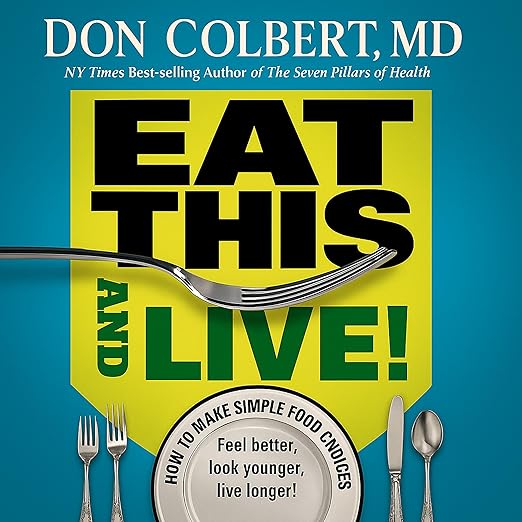
Don Colbert organizes food into three simple categories in this audiobook: eat heartily, eat in moderation, avoid entirely, and builds his entire case for each placement on scripture rather than a food pyramid or a calorie count. Eat This and Live is explicitly a Bible-based nutrition guide, the latest entry from an author who has already sold more than ten million books across titles like The Seven Pillars of Health and What Would Jesus Eat? Colbert's premise is straightforward: he treats biblical dietary guidance as a genuinely practical framework for modern eating, not just a historical curiosity, and narrator Gordon Klassen delivers that argument with the same measured authority he brings to long-form faith-based nonfiction generally.
Three Tiers That Avoid All-or-Nothing Eating
Scripture, not clinical trials, drives the food guidance here, and Colbert is upfront about that framing rather than dressing biblical dietary law up as peer-reviewed nutritional science. That said, Colbert is a practicing physician by training, and the book's recommendations generally track with mainstream nutritional common sense, less processed food, more whole ingredients, even when the justification offered is scriptural rather than clinical. Listeners expecting rigorous citation of nutrition studies should recalibrate: this is a faith-first framework that happens to align with a lot of conventional healthy-eating advice, not a scientific text that happens to reference the Bible.
One listener, partway through the book, describes it as reshaping her food choices day to day and specifically credits it with helping her 'spiritually' alongside the practical guidance, which captures the dual register Colbert is going for throughout. Another reviewer frames it more simply as a resource for learning about foods, drinks, and building better daily habits, evidence that the book functions for at least some listeners as straightforward practical guidance regardless of how much the spiritual framing lands for them personally.
The underlying three-tier system, foods to enjoy freely, foods to enjoy sparingly, and foods to avoid altogether, functions less like a strict elimination diet and more like a permission structure, which distinguishes it from stricter frameworks that ban entire categories outright. Nothing in Colbert's model requires perfect compliance or treats a moderate-tier food as forbidden; the middle category specifically exists to prevent the all-or-nothing thinking that derails a lot of other faith-adjacent and secular diet plans alike, a structural choice that reads as more sustainable than it might first sound given the book's religious framing.
Klassen's Even Register Across Scripture and Food
Gordon Klassen's delivery stays measured and consistent whether he's reading a scripture passage or a practical food recommendation, never dramatically shifting register between the devotional and the instructional material. That evenness serves the book well; Klassen has built a reliable track record narrating long evangelical nonfiction without letting doctrinal passages tip into an oversold, sermonic tone, and the same steadiness carries through here even at a much shorter runtime than his usual multi-biography projects.
Colbert's own bibliography, referenced throughout the book's framing, includes Toxic Relief, Deadly Emotions, Stress Less, and multiple entries in his Bible Cure series, and listeners familiar with any of those will recognize his consistent throughline: physical health and spiritual health treated as inseparable rather than parallel concerns. That consistency across a large catalog gives Eat This and Live a kind of institutional credibility within its specific niche, even for listeners encountering Colbert's work for the first time here.
Klassen's even pacing also makes specific sections easy to return to later, which matters for a book more likely to be referenced repeatedly than heard start to finish once and shelved. A listener trying to remember which category a specific food falls into can navigate back to the relevant chapter without the jarring tonal whiplash a more theatrically performed narration might create between visits, since Klassen's steady register stays consistent whether you're hearing a section for the first time or the fifth.
Colbert's medical framing throughout leans on his standing as a practicing physician rather than a nutritionist or dietitian specifically, a distinction worth knowing since board-certified physicians and registered dietitians train differently and sometimes disagree on dietary specifics even when both operate from a scientific base. That doesn't undermine Colbert's credibility so much as clarify what kind of expert is speaking; a doctor's general medical training on how food affects disease risk is real expertise, even when the book chooses to present its conclusions through a scriptural lens rather than a clinical one. Listeners who want a second, more conventionally credentialed opinion alongside Colbert's faith-based framework might pair this with a registered dietitian's more standard nutritional guide.
Color-Coded Charts Don't Survive the Format
The print edition is described as full-color throughout, which strongly suggests visual food lists, charts, or categorized tables sorting specific items into the heartily, moderately, and avoid tiers Colbert builds the book around. None of that visual sorting carries over into audio, so listeners who want the at-a-glance reference value of seeing an entire food category color-coded at once will need the print or ebook edition alongside, or instead of, the audiobook.
At four hours and forty-four minutes, this runs considerably shorter than several of Colbert's other titles, which suggests a more focused, single-topic treatment rather than the sweeping health philosophy of a book like The Seven Pillars of Health. That's worth knowing going in: this is a practical, applied companion to Colbert's broader body of work rather than a standalone introduction to his overall approach to faith-based wellness.
Nothing in the available material suggests this book includes detailed recipes or a structured meal-planning calendar, and if it does, that's exactly the kind of content, ingredient lists, step-by-step instructions, exact measurements, that audio narration handles worst of any nonfiction subgenre. Listeners hoping to actually cook from this book rather than simply absorb its underlying philosophy should treat the audiobook as an introduction to Colbert's thinking and plan to source specific meal ideas from the print edition or Colbert's other more recipe-forward titles.
Fits Naturally Into an Existing Bible Study
Christian listeners already comfortable with a faith-first framework for health decisions are the clearest audience, especially existing fans of Colbert's other books who want a food-specific companion to his broader wellness catalog. Anyone looking to replace vague willpower-based dieting with a structured, values-driven system, regardless of how strictly they follow the scriptural reasoning behind it, may find the heartily-moderately-avoid framework genuinely useful as an organizing principle.
Listeners who already keep a physical Bible nearby while working through devotional nonfiction will find Eat This and Live fits naturally into that same daily rhythm, more a repeatable reference companion than a single beginning-to-end story. Small group Bible studies built around faith and health topics could reasonably use short sections of the audiobook as discussion prompts, another practical use case beyond solo listening.
Clinical, peer-reviewed nutrition science is not what drives this book's authority; scriptural interpretation is, even with Colbert's medical credentials lending some credibility to individual recommendations. The full-color print charts that apparently anchor much of the book's practical reference value also don't translate to audio, so treat this narration as a companion to the visual edition rather than a complete replacement for it.
Key Details
- Performance: Gordon Klassen's measured, consistent delivery handles scripture and practical advice with the same even authority.
- What it covers: Biblical dietary guidance, faith-integrated health, structured eating without calorie counting
- Feel: Steady and instructional, faith-forward
- Our call: A focused, scripture-based food guide best suited to listeners already comfortable with a faith framework for health decisions.
Frequently Asked Questions
Is this audiobook based on scientific nutrition research or biblical interpretation?
Biblical interpretation primarily. Colbert, who is also a physician, builds his food categories around scripture rather than peer-reviewed studies, though his recommendations generally track with conventional healthy-eating advice.
Do the full-color food charts in the print edition matter if I only get the audiobook?
They likely do. The print edition's full-color format suggests visual charts sorting foods into categories, reference material that doesn't carry over into audio, so listeners wanting that at-a-glance format should consider the print or ebook edition too.