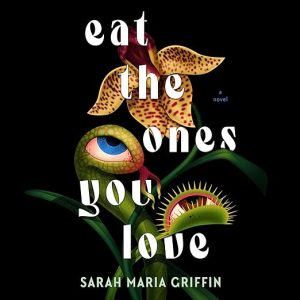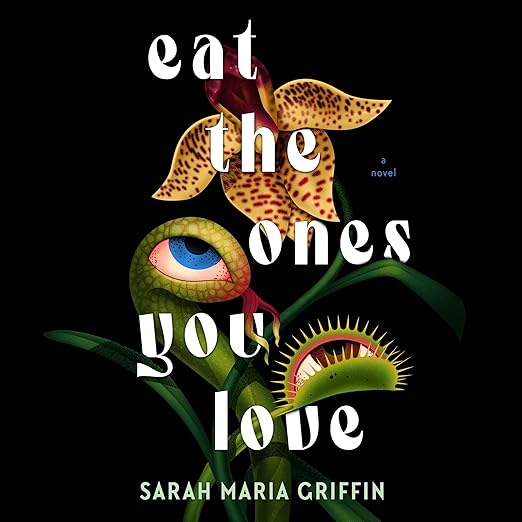
Sarah Maria Griffin's audiobook has a premise that sounds, in a short summary, like it should not work: a failing mall flower shop, a heartbroken woman named Shell Pine who takes a retail job to reassemble her life, her shop manager Neve who may be too good to be true, and in the back room a young sentient orchid named Baby who actually runs the show, is perpetually hungry, and has a plan for everyone. Eat the Ones You Love works, not despite its absurdity but because Griffin and her two narrators treat the premise with exactly the right combination of dread and longing. AudioFile called it a chilling performance. Library Journal said it produces an unsettling atmosphere that audio horror fans everywhere will appreciate. Both assessments are correct.
Where This One Lands
Griffin is an Irish writer working in a horror-adjacent mode that owes something to the tradition of domestic uncanny: the terror lives in ordinary settings, ordinary desires, and the specific vulnerability of someone whose life has recently come apart at every seam simultaneously. Shell loses her job and her fiance and moves back to her parents in fairly rapid succession, which gives Baby's implicit promise of belonging a grip on her that would not exist without that preceding loss. The flower shop as setting is sharp. Retail work as a contemporary purgatory, the mall itself as a site of modern economic and social decay, flowers as symbols so overdetermined in the romance context that pivoting them toward horror feels simultaneously obvious and genuinely fresh. One reviewer compared the book's tonal range to something as horrific as an episode of The Boys and as sweet as a season finale of Bridgerton, which is a chaotic comparison that is nonetheless accurate. The horror and the romance are not in competition with each other. They are the same thing: desire as the mechanism of danger, longing as the lever that Baby pulls. Griffin gives the sapphic romance between Shell and Neve real warmth and real stakes, which is what makes Baby's manipulation of it genuinely disturbing rather than merely plot-functional.
Why Eat the Ones You Love Works as an Audiobook
The formal construction of this audiobook is unusually tight for the genre. McStay voices Baby across the entire narrative: his performance has the quality of measured, inhuman interest that a printed page cannot fully convey. Baby perceives humans the way a gardener perceives soil: as a medium, as a resource, as something to work with and transform. That perspective, delivered in McStay's register, gives Baby an intelligence and a strangeness that is scarier than most horror audiobook antagonists achieve through more conventional means. O'Leary voices Shell and every other human character, bringing a register that is warmer, more readable, more emotionally transparent. The counterpoint between the two voices makes the asymmetry between Baby and the humans feel structurally present rather than merely described. You hear the difference between a consciousness that wants and a consciousness that observes wanting and knows how to exploit it. At eight hours and twenty-three minutes, Griffin has room for the slow accumulation of wrongness that atmospheric horror requires: the dread builds through suggestion and through the widening gap between what Shell perceives and what the listener, with access to Baby's narration, knows.
What Gives Us Pause
Reviewers are fairly consistent on the pacing. The beginning runs long, the middle is compressed relative to the setup it follows, and the ending is abrupt in ways that have frustrated listeners who invested significantly in the story's buildup. One reviewer described caring more about Baby's fate than about the human characters, which reflects a genuine structural imbalance: Baby is the most fully realized consciousness in the book, and Griffin distributes significantly more sympathy and specificity to him than to Shell or Neve. For a horror romance, that imbalance is a meaningful problem: the human stakes need to feel as real as the creature's agenda for the ending to land with full force. Listeners looking for a foregrounded sapphic romance should know that the horror architecture keeps the Shell-Neve relationship somewhat constrained throughout: the book centers Baby's perspective, and the romance is filtered through his observations and manipulations rather than fully inhabiting Shell's point of view. This is primarily a horror novel that contains a romance, not a sapphic romance that contains horror, and the distinction matters for expectation management.
Should You Listen to Eat the Ones You Love?
Audio horror fans who prioritize atmospheric performance and formal ambition over conventional scare mechanics will find this one of the more distinctive offerings in recent genre audio. Listeners who enjoy horror that operates through domestic strangeness, through desire as danger, and through the specific vulnerability of someone whose life has made them susceptible to any offered belonging will be in the book's intended audience. LGBTQ+ horror readers who want a story that treats its sapphic romance as real and meaningful within a genre framework will find Griffin's handling respectful and warm, even if the relationship is not the book's primary focus. Skip this one if you need your horror narratives to be tightly plotted with satisfying structural closure: the atmospheric strengths are more consistent than the pacing, and the ending's abruptness has genuinely frustrated a portion of the audience. The sentient plant premise requires real commitment to the conceit. Readers who cannot get there will find the remainder of the book hard to access. For everyone willing to commit, the dual-narrator performance alone makes this an argument for the audiobook format as the ideal home for this kind of material.
Before You Press Play
- Performance: Barry McStay and Lauren O'Leary split the narration with precise formal purpose. McStay voices Baby the sentient orchid, O'Leary voices every human character. The division is the structural spine of the entire audiobook.
- What it covers: Desire and dependency, the horror of belonging, queer longing as a survival strategy and a vulnerability
- Feel: Slow-burning and increasingly surreal
- Our call: A horror audiobook that earns its unsettling atmosphere through craft and dual-narrator performance, with AudioFile and Library Journal both calling it required listening for audio horror fans.
Common Questions
How does the dual-narrator structure with Barry McStay and Lauren O'Leary work in this audiobook?
McStay voices Baby, the sentient orchid who narrates, while O'Leary voices Shell and all other human characters. The formal split mirrors the central dynamic: an inhuman consciousness observing and manipulating human ones. Both AudioFile and Library Journal singled out this performance as the audiobook's defining achievement.
What do reviews say about the pacing of this audiobook?
Multiple reviewers note that the beginning runs long, the middle is compressed, and the ending is abrupt. The atmospheric buildup is the book's consistent strength, but the structural imbalance between the setup and the resolution is a genuine complaint worth knowing about before committing to eight-plus hours.
Does this audiobook work for listeners who are new to horror as a genre?
Griffin's mode is atmospheric and literary rather than relentlessly scary, making this a reasonable entry point for readers more comfortable with literary fiction than traditional horror. The domestic setting, the character-driven premise, and the sapphic romance element all function as bridges between the horror genre and a broader literary audience.