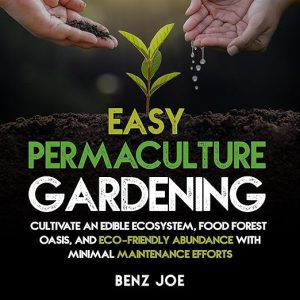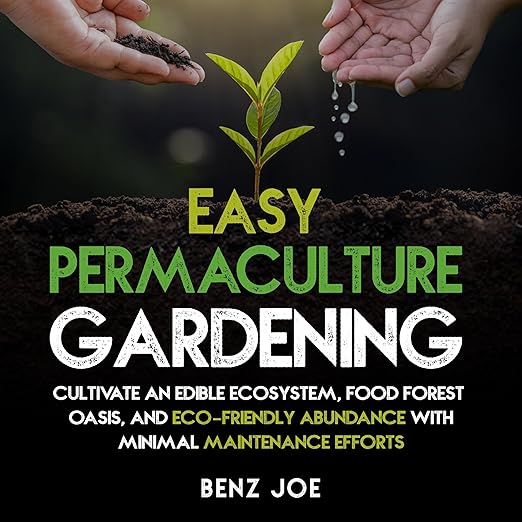
I have a raised bed in my backyard that I treat with an ambition that consistently outruns my follow-through. Last spring it produced excellent weeds and one truly impressive courgette, and then I got busy. When a neighbor mentioned she had started converting her yard to permaculture principles and her maintenance time had dropped dramatically, I became curious in the way that only someone who has failed at conventional gardening can become curious. Easy Permaculture Gardening sat in my queue for about three weeks before a long drive gave me the time to start it.
Benz Joe's guide is aimed squarely at beginners who feel overwhelmed by gardening methods and want a simplified path to growing their own food. The framing throughout is explicitly encouraging: you do not need a large plot, you do not need prior experience, and you do not need to spend significant money on inputs. The permaculture approach Joe describes draws on rainwater harvesting, composting and organic waste, companion planting principles, and the design of garden ecosystems that support themselves over time rather than requiring constant human intervention. The goal is abundance through working with natural systems rather than against them.
Mycorrhizal Networks Explained Without the Jargon
The book's strongest sections are the ones on soil health and garden design. Joe's approach to soil vitality, the argument that most conventional gardening practices degrade the soil biology that actually feeds plants, is delivered with enough clarity that listeners who have never thought about mycorrhizal networks or microbial activity will come away with a genuinely altered understanding of what healthy ground looks like. The eco-inclusive design material, which covers attracting beneficial insects, welcoming animal life into the garden ecosystem, and using what you already have rather than purchasing solutions, has a similar quality of expanding the listener's frame of reference.
One reviewer with years of organic gardening experience noted picking up very useful tips and information they expected to already know. That's a fair measure of a beginner-to-intermediate guide: if experienced gardeners are still finding value, the material is substantive enough. Multiple reviewers specifically cite the framing around low-maintenance and minimal effort as the quality that made permaculture feel achievable rather than aspirational. One reader described it as showing you don't need a huge plot of land to get started, which is precisely the access barrier Joe seems to be targeting.
Erickson Reads This While You Walk the Yard
Keaton Erickson's narration is appropriately paced for a how-to guide. He reads with the kind of clarity that lets you keep the core principles organized as you listen, which matters for a subject that requires building a mental model of interrelated systems. There is no dramatization here, and none is needed; the material's appeal is in its practical applicability, not in narrative tension. Erickson delivers it without embellishment, which is the correct approach.
The audio format works particularly well for this subject in contexts where you might actually be gardening or planning a garden space. Listening while walking your yard, assessing what you have and what you might change, is a different experience than reading a physical copy at a desk, and permaculture's emphasis on observation and site-specific design makes the ambient listening mode genuinely useful. Several of the principles around resource maximization, particularly around using existing materials and organic waste, are straightforward enough to internalize during a first listen and implement immediately.
Ethics Before Technique Can Feel Like a Detour
One reviewer noted that the book covers sustainability in general terms beyond just gardening, which is accurate. Some listeners may find the scope broader than expected, with sections that feel more philosophical than practical. The permaculture ethic framework that opens the book requires the listener to accept a particular orientation toward ecological relationships before the specific garden techniques make their full case, and that sequence can feel slow if you came primarily for actionable tips.
The title's promise of complexity made accessible is substantially delivered, but experienced permaculture practitioners or readers with significant organic gardening backgrounds should calibrate their expectations. This is an introduction, and it reads like one: clear, encouraging, and deliberately not exhaustive. Listeners wanting a comprehensive technical manual on food forest design, water systems, or zone planning will need to supplement with more specialized resources.
Low-Maintenance Curiosity Is the Right Entry Point
People new to gardening who are drawn to low-maintenance, ecological approaches will find this a welcoming entry point. Experienced gardeners curious about permaculture principles but unfamiliar with the specifics will get genuine value. Skip if you are looking for advanced technical detail on specific permaculture applications or regional growing conditions. The four-hour-and-forty-one-minute runtime is well-suited to a single long listen or a few commutes, making the time investment low relative to the conceptual territory it covers.
Before You Press Play
- Performance: Keaton Erickson reads in a clear, unhurried style that suits the beginner-friendly tone of the material without feeling condescending.
- What it covers: Food sovereignty, low-maintenance ecological design, soil health and self-sustaining systems
- Feel: Encouraging and grounded
- Our call: A solid entry-level introduction to permaculture principles that delivers on its promise of accessibility, even if it won't satisfy readers looking for technical depth.