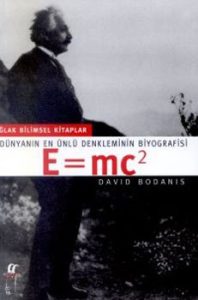
David Bodanis built his reputation on the kind of science writing that refuses to settle for surface explanation, and this audiobook presents one of his most focused achievements. E=mc2 narrated by Dan Cashman runs nearly seven hours, carrying Bodanis's study of the equation from the intellectual ancestors who made Einstein's insight possible through to the equation's darkest application in the weapons programs of the Second World War. Anyone who has heard the equation without quite understanding what it actually claims will find this audiobook an unusually patient and precise companion through one of modern science's most consequential ideas.
Where This One Lands
Bodanis's organizing insight is that an equation this consequential cannot be understood in isolation from the scientists who built the conceptual vocabulary it depends on. So before Einstein appears in any real depth, Bodanis works through the contributions of Faraday, Maxwell, and Lavoisier, showing how each discovered or clarified something essential about the relationship between energy and matter. Faraday's field experiments established that forces could propagate through empty space. Maxwell unified electricity and magnetism into a single mathematical framework. Lavoisier's meticulous accounting of chemical reactions laid the groundwork for conservation principles that mass-energy equivalence would eventually extend. Bodanis treats each predecessor not as a footnote to Einstein's story but as a necessary chapter in the argument the equation ultimately makes.
The central explanation of what the equation actually asserts is handled with real skill. Bodanis describes mass as condensed or concentrated energy, and energy as what billows out as an alternate form of mass under the right circumstances. That phrasing sounds almost poetic on the page, but Cashman's narration gives it weight by not rushing through it, letting the formulation settle before the next idea builds on it. The cosmological context Bodanis adds toward the end of the book, the idea that the universe's current dominion of matter will one day slide back to energy in a state of great stillness, gives the whole argument an almost philosophical dimension that lingers well after the audiobook ends.
Bodanis is also careful not to turn this into a conventional Einstein biography, though the biographical material is thoughtfully woven in. He covers Einstein's background, his idiosyncratic approach to theoretical physics, his visual imagination and his unconventional relationship with institutional science. But the biographical material serves the equation rather than the other way around, which keeps the focus where it belongs: on the claim that mass and energy are interconvertible, and on the extraordinary consequences of that claim for nuclear physics, cosmology, and the fate of the mid-twentieth century.
Why E=mc2 Works as an Audiobook
The audiobook format works particularly well for this kind of layered argument because Bodanis writes in a cumulative style, where each chapter builds directly on what came before. Listeners who might skim in print will find that Cashman's pacing does much of the structural work, carrying the thread from Faraday's field experiments to the Trinity test without losing the causal chain. At under seven hours, this is not an exhausting commitment, and Bodanis avoids the padding that afflicts many popular science titles that run twice as long without covering more ground.
The sections covering the Manhattan Project and the weapons programs carry real weight, and Bodanis does not sentimentalize them. The equation's connection to the destruction at Hiroshima and Nagasaki is treated as a genuine moral problem rather than a triumphalist narrative of scientific progress, and that section of the audiobook is notably darker in register than the earlier scientific history. Cashman navigates the tonal shift between the wonder of discovery and the horror of application with restraint, which is the right call for material of this weight. Listeners who pick up this title as pure scientific celebration should know that Bodanis refuses to let the physics exist apart from its human consequences.
What Gives Us Pause
Listeners who want deep mathematical treatment will not find it here. Bodanis is a science writer rather than a physicist, and his explanations work through analogy and narrative rather than through formal derivation. This is intentional and appropriate for the target audience, but if you are hoping for a rigorous walk through the mathematics of special relativity, this audiobook will feel more like an excellent entry point than a destination. It is an excellent entry point, worth being clear about what it is.
The sequence of predecessor scientists before Einstein arrives may feel slow to listeners who came specifically for Einstein. Bodanis spends a meaningful portion of the audiobook on Maxwell, Faraday, and Lavoisier because the argument genuinely requires that foundation, but listeners with low patience for historical setup may find the early chapters feel like delay. Those who stay with the structure find that the payoff, when Einstein's specific insight clicks into place against the backdrop that was already established, is considerably more satisfying than a direct biography would have produced.
Who Should Listen to E=mc2
This audiobook suits science enthusiasts who want more than the standard popular account of Einstein's genius, and anyone interested in the history of ideas as a chain of human effort rather than a series of isolated breakthroughs. It works well for listeners new to physics who want a framework before moving to more technical accounts. Those who want mathematical rigor or a conventional full-length biography of Einstein should look elsewhere, but for the listener who wants to understand what the equation actually says and why it matters, this remains one of the better audiobooks in the popular science genre.
Good to Know
Do you need a physics background to follow this audiobook?
No. Bodanis writes deliberately for general readers, using analogy and narrative throughout. The explanations build on each other across the audiobook's chapters, so listening in sequence is recommended, but no prior knowledge of physics is required.
Does this audiobook cover the development of the atomic bomb?
Yes. A significant portion of the audiobook addresses the Manhattan Project and the weapons applications of Einstein's equation, treated as a morally serious episode rather than a triumphalist narrative.
How does Dan Cashman's narration handle the scientific content?
Cashman maintains an engaged, steady pace throughout and avoids over-performing the more dramatic sections. His delivery gives the conceptual explanations room to land without rushing, which suits Bodanis's cumulative argumentative style well.
Is this audiobook more about Einstein personally or about the equation itself?
The equation is the primary subject. Bodanis covers Einstein's background and character, but always in service of explaining why his insight was possible when and where it was. Listeners expecting a full personal biography will find the biographical material present but selective.