Before You Press Play
- Performance: Jeff Hays is exceptional here, handling Carl's deadpan voice, Princess Donut's imperious feline delivery, and the game-show narration with distinct energy for each register.
- What it covers: performance and survival, the commodification of violence, found family in catastrophe
- Feel: Propulsive and darkly comedic, with genuine stakes beneath the absurdist surface
- Our call: Dungeon Crawler Carl is one of the sharpest LitRPG entry points available in audiobook form, and Jeff Hays's performance transforms an already inventive premise into something genuinely hard to put down.
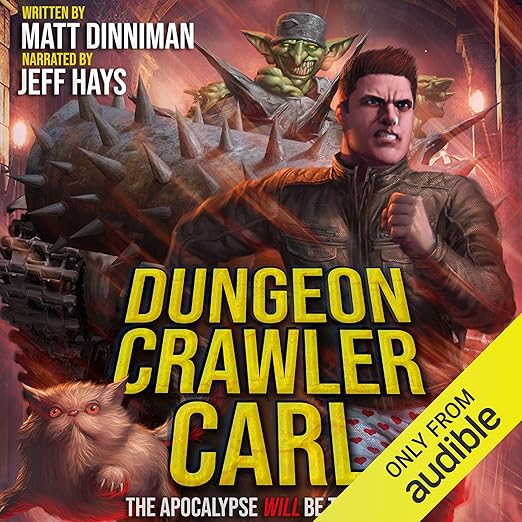
Carl and Princess Donut enter the dungeon on what should be the worst morning of Carl's life, which is saying something given that every building on Earth has just been atomized and converted into a global labyrinth. The cat, an insufferably aristocratic ex-girlfriend's Maine Coon named Princess Donut, makes it through the collapse with Carl. The dungeon keeps going down eighteen levels. The clock is already running. This is the opening situation of Dungeon Crawler Carl, Book 1 of Matt Dinniman's series, narrated by Jeff Hays, and it establishes with remarkable economy exactly what kind of audiobook this is: one where the absurdity is deadly serious.
The LitRPG genre, which blends video game logic with traditional fantasy worldbuilding, has a consistent flaw: many of its entries are more interested in their stat systems than in their characters. Dinniman sidesteps this by giving the dungeon a purpose that is not merely mechanical. Dungeon Crawler World is a television show broadcast across the galaxy, and Carl's survival depends not just on his combat effectiveness but on his ability to entertain the alien audience watching from light-years away. The loot boxes that sustain him come from viewer donations. The dungeon's rules are as much about good television as they are about killing monsters. That shift, from survival game to survival performance, is the conceptual move that lifts this first book above its genre peers.
Princess Donut Steals a Deadly Serious Debut
At thirteen hours and thirty-one minutes, the pacing is tight. Dinniman does not linger in the first book, partly because the level timer creates a genuine structural urgency: find the staircase down before the current floor resets, or it is over. Carl's progression through the early dungeon floors has the satisfying shape of a video game learning curve translated into prose, with each new threat teaching him something about both combat and performance that he carries to the next challenge. Princess Donut, whose name becomes the source of increasingly elaborate comedic payoff throughout the narrative, is not merely a mascot. She is a fully realized character with her own agendas, grievances, and unexpected competencies.
The reviewer who described this as "the best book I have read in a very long time" before immediately purchasing the rest of the series was not being hyperbolic in the way online reviews often are. The book earns that response by engineering its ending around the specific emotional investments it has built over thirteen hours: you want to know what happens next not because a cliffhanger forced you to, but because Dinniman has made the characters matter enough that the dungeon's next level feels genuinely dangerous. The Bookwyrm Speaks review correctly notes that the hits in the LitRPG genre can stand alongside the best of traditional fantasy, and this is one of the hits.
Jeff Hays Voices Carl, Donut, and the Dungeon
Jeff Hays's performance is the reason to choose the audiobook over print for this particular title. The novel has at least three distinct vocal registers running simultaneously: Carl's first-person narration, which is dry and exhausted and occasionally furious; Princess Donut's speech, which is imperious and condescending and secretly vulnerable; and the dungeon's game-show overlays, which include in-world broadcasts, announcements, and the kind of reality television narration that Dinniman skewers with affectionate precision. Hays handles all three registers distinctly and consistently across the full runtime.
Princess Donut in particular benefits from audio delivery. The comedy of her character, a cat who is simultaneously unbearable and the most competent individual in any given crisis, relies on the contrast between her self-presentation and her actual situation. On the page, that contrast requires a reader to supply the tone. Hays supplies it in the narration with a vocal performance that manages to be genuinely funny without becoming a joke character. That discipline is harder than it sounds and is part of why listeners who have read the print version often report that the audiobook is the superior experience for this series.
Genuine Horror Behind Carl's Comic Dungeon
The series mythology that Dinniman builds into Book 1 rewards careful attention on a first listen. The alien viewership, the mechanics of the game show format, and the hints about who built the dungeon and why are not background decoration. They are load-bearing elements that the later books in the series, which expand considerably in scope, rest upon. Listeners who track these elements through the first book will find their investment in the longer series arc paying returns that casual listeners miss.
Watch also for how Dinniman handles the violence. This is a book set in a dungeon where the game show premise requires entertaining kills, and Dinniman does not shy away from the implications of that setup. The violence is purposeful rather than gratuitous, but it is present and occasionally dark in ways that pure comedy LitRPG often avoids. The balance between the humor and the genuine horror of Carl's situation is where the book's literary seriousness lives, and it is what distinguishes this from entries in the genre that choose only one register.
LitRPG Readers Ready for Dark Comedy
This audiobook is essential for LitRPG and GameLit readers who have found other entries in those genres disappointing, because Dinniman prioritizes story quality and character depth over the stat optimization that dominates lesser work in the genre. It also works for listeners who have never encountered LitRPG before, because the game mechanics are integrated into the narrative logic rather than presented as separate mechanical systems to track.
Skip it if you are not comfortable with violence as a plot element or with dark humor applied to genuinely catastrophic situations. The blend of comedy and horror is integral to the book's design, not a tonal inconsistency. Skip also if you need a fully self-contained story: Book 1 ends at a natural stopping point but clearly belongs to a larger series, and the most satisfying emotional arc of the full Dungeon Crawler Carl sequence is available only to listeners who continue into subsequent volumes.
Does the Dungeon Crawler Carl audiobook work as a standalone, or do I need to commit to the full series?
Book 1 works as a standalone in the sense that it has its own complete arc and resolves its central crisis. However, the series mythology Dinniman builds here is designed for a longer payoff, and most listeners who finish Book 1 report immediately pursuing the rest of the series. Consider it a complete chapter of a larger work.
How does Jeff Hays handle Princess Donut's voice in the audiobook?
Hays gives Donut a distinct vocal register that is imperious and self-assured while remaining recognizably feline in its obliviousness. The comedy of her character, which depends on the gap between her self-perception and her actual situation, lands considerably better in Hays's audio delivery than it would in print. It is one of the more memorable narration choices in the LitRPG audiobook space.
Is Dungeon Crawler Carl appropriate for listeners who have never read LitRPG before?
Yes. Dinniman integrates the game mechanics into the narrative rather than presenting them as a separate system to track. The stat progressions and game-show elements are explained through Carl's experience, making the premise accessible without prior genre knowledge.