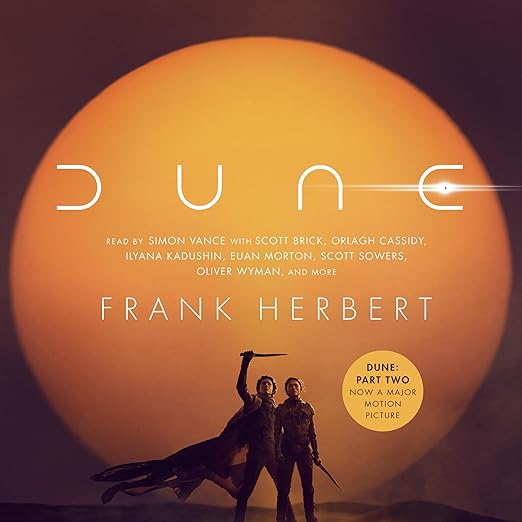
Twenty-one hours is a serious commitment, and this audiobook asks for every one of them before the boy Paul Atreides finishes becoming the man known as Muad'dib. Scott Brick is the only reader credited, Macmillan Audio is the publisher, and the 2008 Audie Award attached to the title belongs to the recording rather than to the novel. What the record never supplies is a single written account of what those twenty-one hours actually sound like, which is an odd gap on a title this famous.
Twenty-One Hours, One Voice, Three Names
Kaan Vural's June 2011 response contains the most useful sentence anywhere in the pool: Frank Herbert's novel is "simultaneously one of the most sublime and frustrating works of literature ever produced." The grade still lands at five stars, for two stated reasons. It is a favorite worth rereading, and it is a book that should be read once by anyone interested in science fiction, fantasy, history, political science, economics, mysticism or narrative. Both halves of that verdict matter when the format costs you twenty-one hours rather than a weekend of skimming.
Jacket copy compresses the whole novel into a handful of clauses: the desert planet Arrakis, a traitorous plot against a noble family, a son who would avenge it, and a blend of adventure and mysticism with environmentalism and politics. It notes the first Nebula Award and a shared Hugo. What none of that tells you is how the prose behaves hour by hour, and hour by hour is the only unit that counts once you have pressed play.
Arrakis, Atreides, Muad'dib: three invented proper nouns inside one sentence of jacket copy, and Herbert keeps that rate up for a long time before the plot repays the effort. A single credited voice has to hold every house, title and honorific apart without an ensemble to help, and twenty-one hours gives that approach room to become either fully immersive or genuinely tiring. The listing offers no way to predict which of the two you will get.
Rereading Is Where This Recording Earns Its Keep
The January 2026 five-star makes the strongest practical argument for the format. The novel, it says, never ceases to amaze no matter how many times it is read or viewed, and its content stays relevant both to the era that produced it and to whatever moment you meet it in. Rereading is exactly the situation where a recording earns its keep, because it takes away the option of skimming the chapters you believe you already remember. On a third pass through Arrakis, that constraint is a feature.
Then the Audie. Awards from that body go to recordings rather than to the books behind them, so the 2008 win is a judgment on this production and not on Herbert, and it is the only audio-specific quality signal anywhere in this record. Given how little else the page says about the reading, one professional verdict on the recording carries more weight here than it usually would.
Film credits occupy a chunk of the description too, which lists Denis Villeneuve as director alongside Zendaya, Rebecca Ferguson, Javier Bardem, Josh Brolin and a long supporting cast. For anyone who arrived through the movies and wants the source, audio is a sensible route: the novel front-loads succession, ecology and religious engineering rather than spectacle, and a reader who has already seen the shapes of these characters has an easier time holding the political machinery in mind while walking, cooking or driving.
Wrong Publication Date Undercuts One Enthusiastic Review
Read the December 2015 entry carefully before you give it weight. It sits under one handle and is signed inside its own text by a different name, opening "A book review by Nathan Poulson," and it reads like a school assignment rather than a purchase note. It also asserts that Herbert wrote the novel in 1959, a date nothing else in this record supports. Take its enthusiasm and its sales figures with the appropriate caution; a signature that disagrees with its own byline is a reason to check everything else it claims.
Production detail is thin to the point of being unhelpful. No second voice is named, nothing is credited as bonus material, and no abridgement note appears anywhere. The runtime and the publisher are the whole of what you are told about the object you are buying. If you care whether anything beyond the novel proper is included in the file, this record will not settle it, and neither will the responses.
Then the obvious risk: length. Twenty-one hours and two minutes is roughly three hours a day across a full week, and Herbert's opening stretch is slow by design, all court politics and prophecy before Arrakis starts killing people. Listeners who bail on long books in the first two hours should treat that as the real hazard here, not the plot.
Reread Skipped Chapters, or Start Completely Fresh
Yannick's September 2024 entry, filed in Belgium, is the most practical note in the pool despite having nothing to do with the recording. It describes a hardcover edition paired with Dune: Messiah from the same publisher and warns that Children of Dune is not part of that set. If what you actually want is a shelf, that response is telling you which package delivers two books and which one leaves you short. It also tells you something about this listing, where a print-set note and an audio product live under one rating.
Listen to this if you have never read Herbert and want the scale delivered at a pace you cannot accelerate, or if you have read it before and want a version that forces you through the chapters you once skipped. It suits long solo stretches, repetitive manual work, and anyone who genuinely enjoys political fiction with a religious engine underneath it. Series readers get a clean starting point: the catalog places this first in the sequence, and the story it describes is Paul's alone.
Pass on it if you want a quick entry into science fiction, if invented terminology wears you down, or if you came to the book purely from the films and expect the pacing to match them. Nothing here tells you how a narrator handles Herbert's naming, and on a twenty-one-hour purchase that gap is worth a sample before you commit.
Quick Take
- Narrator: One credited reader for twenty-one hours, and a 2008 Audie Award that attaches to this recording rather than to Herbert's novel.
- Subjects: Ecological brinkmanship, dynastic betrayal, messianic myth-making
- Tone: Vast, unhurried, and dense with names
- Bottom line: The foundational science fiction epic in a format that will not let you skim the political chapters, provided you can give it twenty-one hours.