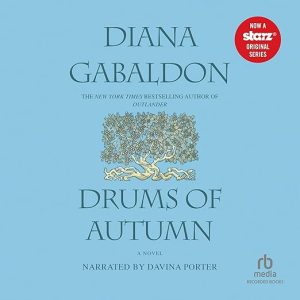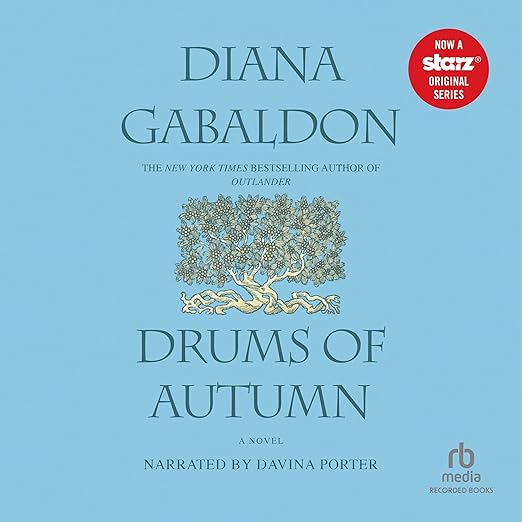
Gabaldon's fourth Outlander novel arrives here as forty-four hours and fifty minutes of audio, which is less a purchase than a season. The audiobook came from Recorded Books in March 2008 with Davina Porter credited as the reader, and it holds a 4.7 across forty-nine ratings. What it does not hold is a single word about the recording. Five written responses sit on the page and every one of them grades the novel, the printed volume or the parcel it turned up in, which leaves a very long listening commitment supported by a column that has nothing at all to say about the thing you are actually buying.
From Reunion to Maintenance in the Wilderness
Porter carries the whole of it alone, and the scale of that job deserves stating. Forty-four hours in one voice means holding Claire, a Scottish warrior, a wilderness of colonial American speech and a daughter living in the 1960s apart from one another, and keeping every one of them stable across what amounts to a month of daily listening. This page offers no verdict on how that goes. It is the kind of commitment where a mismatch between listener and voice turns expensive fast, so the sample is not optional here. Half an hour of trial costs nothing weighed against a month of company, and the trial is the only evidence available.
Claire and Jamie in pre-Revolutionary America is the pitch, and the December 2025 response states the appeal plainly: the perfect mix of historical fiction and sizzling romance, from someone who calls the series one of the very best they have read. That combination is what the fourth volume settles into. The couple is building a life in the wilderness rather than being torn apart by history, which shifts the register from tragedy toward endurance, and moves the romance from reunion to maintenance. For a listener that means fewer cliffs and more weather, which at this length reads as mercy rather than as a complaint about the plotting.
Forty Years of Genealogy Confirms the Migration
Heritage is what the April 2015 five-star came for, praising vastly poetic descriptions and characters developed to the point where simply following them is the pleasure, and declaring a personal stake: a quarter Scottish, recognizing words, phrases and habits from family. That entry also admits the opening felt slow, while blaming its own habits rather than the book, having spoiled some of the action by skipping ahead through a preview feature. Both halves of that verdict are worth having. The book does start slowly, and the descriptive writing is the reason people stay, which is a different contract from a thriller-paced opening chapter.
Genealogy produces the most unusual endorsement on the page. The December 2017 four-star reports forty years of family research and finds the novel tracing the same migration its own family made, out of London to North Carolina in 1768, with an eight-times great-grandfather clearing land of wolves for farmers and later serving as a North Carolina regular in the Revolutionary War. When somebody who knows a period at that level of detail says a novel matches it, the historical claim in the description stops being marketing copy. That response also mentions being impatient for the next volume, which is how a buyer learns the story continues, because the record never mentions it.
Spoilers for Three Novels, Silence on the Reading
Spoilers are baked into the description, and anyone new to this series should stop reading it immediately. In four sentences the copy gives away that Claire has traveled twice, that she found love with a Scottish warrior, that she went back to the 1940s to save an unborn child, that she returned twenty years later, and that she left a daughter behind when she did. That is the plot of three novels, disclosed in the sales copy for the fourth. The series field says Outlander, book four, while the record offers no reading order, no link to the first volume and no warning of any kind.
Delivery, cover art and condition are what two of these responses actually assess. One filed from Italy praises the plotline and the cover, then reports that the book arrived on schedule and in perfect condition. Another, filed in the Netherlands, runs to four words. Neither could tell you anything about a reading of this length, and neither was written to. Pooling print and audio grades under one badge is standard practice and usually harmless, but on a record where the performance is the product, it means the 4.7 is measuring the novel rather than the file you are about to download and live inside for weeks.
One Credit Buys a Month of Daily Listening
Saga readers working through the series in order are the audience, and specifically the ones who have already decided they enjoy living in this world. Long-haul listeners get exceptional value, since the runtime works out to something like a month of ordinary daily listening for the price of a single title. The historical fiction crowd gets a period fiction rarely visits: the colonial backcountry before the Revolution, with settlement, land and survival as the subject rather than battles and generals. The tag says historical fiction, and for once the tag is the most accurate field on the entire page.
Stamina is the honest last word. This is a book to schedule rather than to start, and the practical plan is an hour a day for six weeks or a long project with something shorter running alongside it for variety. Sample the opening chapter before committing, because the voice you choose here is the voice you will keep company with for a season. And if the three earlier books are still ahead of you, close the description now, begin at the beginning, and come back once Claire has made both of the journeys this copy has just given away.
- Voice: One reader for the entire saga, which makes the free sample the most important half hour of this purchase.
- Big ideas: Time travel as inheritance, a marriage rebuilt in the colonial backcountry, a daughter trying to change history.
- Atmosphere: Immersive, domestic and very long.
- Worth it?: The right volume for a listener already inside the series, and a poor place to enter it.