Before You Press Play
- Read by: Rival journalists trading lines for eleven and a half hours, on a record that will not say how many voices deliver them.
- At its heart: Enemies to lovers, newsroom rivalry, a dead author's buried scandal, forced proximity against a deadline
- Vibe: Sharp and comic with a heavier undertow than the premise advertises
- Short version: A smart rivalry romance with genuine investigative bones, sold under a credit that names half its cast.
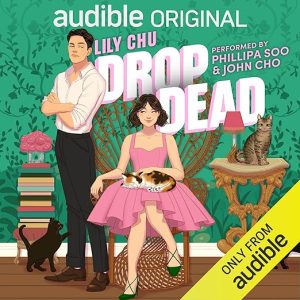
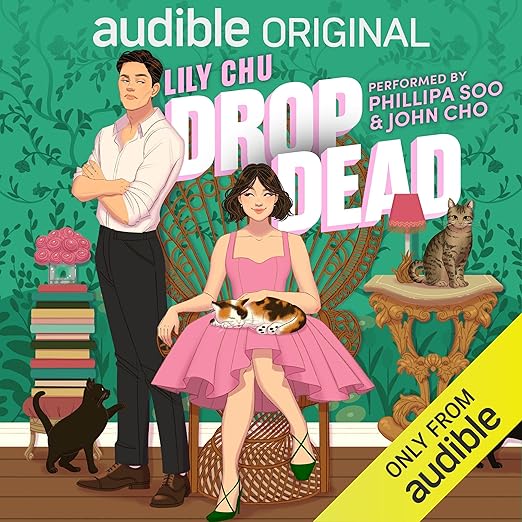
An obituary runs for a famously reclusive author who turns out to be extremely alive, and the romantic comedy audiobook that follows spends eleven hours and twenty-five minutes on the consequences. Nadine Barbault writes obituaries for the Toronto Herald and does not mind being called Lady Death, since it suits the ice queen persona she built to survive the place. Filing Dot Voline's death notice early is the mistake that brings her rival Wesley Chen, of the competing Spear, no end of joy. Then Dot dies for real, and the estate's executor hands them both three weeks inside the mansion.
Where This One Lands
Lily Chu is writing enemies to lovers with the enemies part taken seriously, which is rarer than the trope's popularity suggests. The four-star from 1 March 2026 puts it well: this is a book stocked with characters you genuinely detest, and the detestable ones exist to push the leads into motion. Nadine and Wes have been rivals since journalism school, and the rivalry is professional long before it turns romantic, built on real scarcity, since only so many stories exist and only one reporter files first.
What lifts it past the premise is the mansion. Three weeks of forced proximity inside a dead author's sprawling wonderland supplies a container, a clock and a reason for two people to keep talking, while the scandal buried in Dot's past supplies an actual investigation rather than a pretext for banter. The comedy arrives from the newsroom instead of from misunderstanding, which is the smarter choice by a distance. The romance is built on demonstrated competence, and competence makes an excellent engine. Chu gives the mystery its own architecture too. Dot's estate, the three-week deadline and the conditions set by the executor all work as plot machinery rather than as scenery, which keeps the investigation moving on its own schedule instead of pausing whenever the romance wants room.
The Best Parts of Drop Dead
Now the record and the description disagree, and a buyer should know which one to believe. The description announces a romantic comedy performed by Phillipa Soo and John Cho. The narrator field on this listing carries one of those two names. A publisher's own copy names two performers for a book with two rival journalists at its center, while the catalog credits a single reader, so a buyer hunting the second performer never arrives here, and a buyer reading the credit field assumes a solo recording.
That matters well beyond bookkeeping. A dual-lead romance where the antagonism is the whole point wants voices that can hold a scene against each other, and a production casting two performers is making a specific promise about how the banter will land. Nothing on the record states how the parts are divided, and guessing would be worse than useless. What the description does commit to is two names, and that is the version of the product a buyer is being sold.
Tone is the other reason to take this in audio. The five-star from 1 December 2025 arrived expecting less and found family material sitting alongside the romance and the mystery, which is an accurate account of the book's range. That range is where a recording earns its keep, since a comic register carrying grief underneath it depends on delivery in a way that a printed page leaves entirely to the reader.
What Gives Us Pause
One response addresses the listening directly, and it is the least happy one in the column. The three-star from 11 October 2024 took two months to finish, observes that a book on audio should not have taken that long, and describes getting confused repeatedly and having to pause. That same response liked the ending and the way the central relationship developed, and still found the middle hard going. It also flags, in its own words, a mother who wants badly to date her son, and reports relief when he finally puts his foot down. Useful as a content note.
An edition problem sits in this column too. The five-star from 14 June 2025 opens by disclosing a copy received courtesy of Sourcebooks and NetGalley, a print and digital review channel, on a record whose publisher field reads Audible Originals. Advance readers of one edition are grading another. Nothing dishonest is happening and the response is thoughtful about the book, but the 4.2 across a hundred and ten ratings is pooled across formats that were experienced very differently.
Categorization is the last problem here. The single tag on this record reads Multicultural, and it is doing no work for anybody. A Toronto newsroom romantic comedy with two leads and an inheritance mystery has a dozen more useful shelves available, and a reader browsing for enemies to lovers, workplace romance or slow burn will never reach this page through the category system. The tag is not wrong. It is simply too broad to function as a route to the book.
Who Should Listen to Drop Dead
Enemies-to-lovers readers who want the rivalry to carry stakes are the core audience. The four-star from 8 February 2026 frames it as competition turning dangerous and romantic at the same time, with two journalists forced together over a scandal attached to a literary reputation, and that is exactly the pitch. Listeners who enjoy newsroom settings, closed-house mysteries and a slow accumulation of mutual respect will get eleven and a half hours of all three.
Readers with low tolerance for cringe comedy should be careful, because the book leans into social discomfort as a source of humor and does not always pull back from it. Anybody wanting a light, uncomplicated romance should look elsewhere, since the family material runs heavier than the cover suggests. Listeners who need to know exactly what they are buying should read the description's cast line rather than the credit field, which tells only half the story.