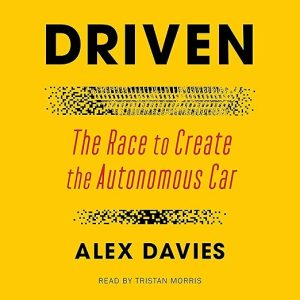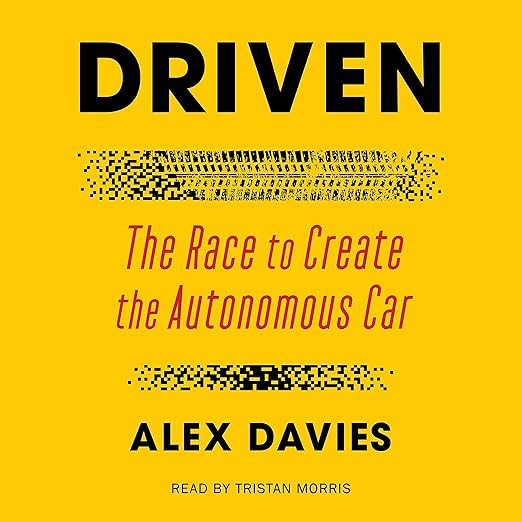
A land war contractor's research budget is an unlikely place to trace the origin of Google's self-driving car project, but that is exactly where Alex Davies starts this audiobook. Driven runs nine hours and forty-two minutes tracing the Defense Advanced Research Projects Agency's Grand Challenges, the desert and urban races that pulled amateur roboticists and students into a technology race that would eventually pull in Google and Uber, and narrator Tristan Morris carries that long arc with a measured authority that never oversells the drama already built into the material.
Levy Calls It Illuminating and Important
Davies structures the book as a relay of key players rather than a single protagonist's story, following the DARPA Challenge veterans as they get recruited into Google's early self-driving skunkworks, then scatter into rival startups and Uber's competing program once the technology looked commercially viable. Steven Levy, author of Facebook: The Inside Story, called it an 'illuminating and important narrative' in his blurb, and that word choice is accurate: this reads as history being assembled while its subjects are still mid-career, not a retrospective written after the dust settled.
Reviewer Chris Anderson, who says he was waiting for exactly this book, praised how Davies had 'the right access' to the industry's key figures, and credited the narrative structure with making dense material move at a real clip.
The Double Meaning Behind the Book's Title
The book's title carries a deliberate double meaning: driverless cars as the technology, and the specific, often difficult personalities driven enough to chase an outcome the rest of the industry considered implausible for over a decade. Davies gives real space to how traditional automakers eventually entered the race too, some building programs independently and others partnering with the tech companies that had gotten there first, reshaping an industry that had barely changed its underlying business model in a century.
The DARPA chapters early in the book are some of its most vivid, tracing how a government-funded competition meant to keep soldiers out of harm's way in war zones ended up seeding an entire commercial industry almost by accident. Davies profiles the mostly unknown students and amateur engineers who treated the earliest Grand Challenges as a strange, underfunded hobby years before Silicon Valley took any of it seriously, and that origin story carries real underdog energy without Davies needing to oversell it.
That relay structure, following people rather than a single company's press releases, is also what keeps the book from feeling dated even as the industry itself has kept moving past the specific events Davies describes.
Greenberg's Epic Tale of Underdogs and Comradery
Andy Greenberg, author of Sandworm, described the book in his own blurb as 'the epic tale of competition and comradery, long odds and underdogs, all in service of a world-changing moonshot,' and the personality-driven chapters back that framing up. Reviewer Noelle S. specifically praised how the book balances technical explanation with the human dynamics between engineers, executives, and rival companies, noting it stayed engaging despite covering plenty of policy and regulation alongside the personalities.
That balance is the book's real skill: Davies explains just enough about sensor arrays, mapping software, and the limits of current machine learning to make the engineering setbacks comprehensible, without turning any chapter into a technical manual. Reviewer Amazon Customer, who bought a copy for a brother working in a related industry, noted that two very different readers, one technical and one not, both found entry points into the same material.
One Sensor's Confusion Between Obstacle and Alarm
Chris Anderson's review specifically credited the book's narrative, story-driven structure with making dense material move briskly rather than reading like a trade publication retrospective, and that structural choice is really the throughline of Davies's whole approach: he consistently returns to specific individuals making specific decisions rather than letting the story drift into abstract industry trends.
Noelle S. described coming into the book with almost no vehicle knowledge and still finding it engaging precisely because Davies explains just enough of the underlying technology to make the industry's specific failures comprehensible; a sensor that couldn't reliably distinguish an obstacle from a false alarm, for instance, becomes a concrete, memorable illustration of a much larger engineering problem rather than an abstract statistic.
Morris Slows Down for the Technology Stack
The book's back half tracks the growing awareness that fully autonomous vehicles were further from commercial reality than the industry's own hype suggested, and listeners expecting a triumphant conclusion about driverless cars finally arriving should recalibrate: Davies is honest that the technology, as of this book's reporting, was not ready for ordinary rush-hour traffic, and the story ends on that sober note rather than a victory lap.
Tristan Morris's steady, evidence-forward delivery style, the same register that has served him well on policy-heavy nonfiction elsewhere, is well matched to Davies's narrative sections but works hardest during the more abstract passages explaining the underlying technology stack, where the pacing slows slightly compared to the personality-driven chapters.
Reviewer Amazon Customer bought a second copy specifically for a brother working in a related industry, drawn to the policy and regulation angle Davies weaves throughout, and that thread runs deeper than a casual reader might expect: expect real attention to how regulators in different states and countries responded to autonomous vehicle testing, not just the corporate competition angle.
Because the book spans roughly a decade and a half of industry history, from the earliest DARPA competitions through Uber's later controversies and Google eventually spinning its self-driving unit out as its own company, the middle chapters cover a lot of corporate maneuvering in fairly quick succession. Listeners who prefer to track every executive by name may want to occasionally rewind rather than let the corporate reshuffling wash past them.
Demo-Day Promises and What Actually Shipped
Anyone curious about how Silicon Valley actually builds and races toward a hyped technology, not just the self-driving car industry specifically, will find this a well-told case study in competitive innovation, corporate rivalry, and the gap between demo-day promises and shipped products.
Business and tech journalism fans who enjoyed narrative nonfiction about a single industry's formative years, in the mold of a founding-story book about any major tech shift, will recognize the format immediately and likely enjoy the pacing here.
Anyone who works in or follows the broader tech industry and wants a case study in how a hyped technology's timeline almost always runs longer than its early boosters promise will find the pattern described here recognizable well beyond just self-driving cars.
Pure technical depth on autonomous vehicle engineering is not the goal here, since Davies keeps his focus on people, competition, and business strategy throughout, so readers craving an engineering deep dive should look to a more specialized title. If you already work in the industry and lived through these events firsthand, some of the origin-story material may feel familiar rather than revelatory.
Key Details
- Performance: Tristan Morris brings measured, evidence-forward authority that suits the narrative chapters, with slightly more deliberate pacing through the technical stretches.
- What it covers: Silicon Valley competition, the DARPA Grand Challenges origin story, the gap between hype and shipped technology.
- Feel: brisk and personality-driven, grounded by honest technical stakes.
- Our call: a well-reported industry history that will satisfy readers curious about competitive tech innovation more than those wanting an engineering deep dive.
A Few Questions About Driven
Does this audiobook explain how self-driving car technology actually works?
It explains enough of the underlying sensor and software concepts to follow the industry's setbacks and breakthroughs, but the focus stays on the people and competitive strategy rather than a deep technical tutorial on autonomous vehicle engineering.
Is this audiobook only about Google's self-driving car program?
No, it traces the story from the DARPA Grand Challenges through Google's early efforts and into the rival programs at Uber and various automakers, following the same people as they moved between companies rather than staying inside one corporate story.
How does narrator Tristan Morris handle the more technical sections of this audiobook?
He keeps the same measured, evidence-forward delivery throughout, which serves the narrative chapters well; the pacing reads a touch more deliberate during the passages explaining sensor and mapping technology compared to the personality-driven sections.