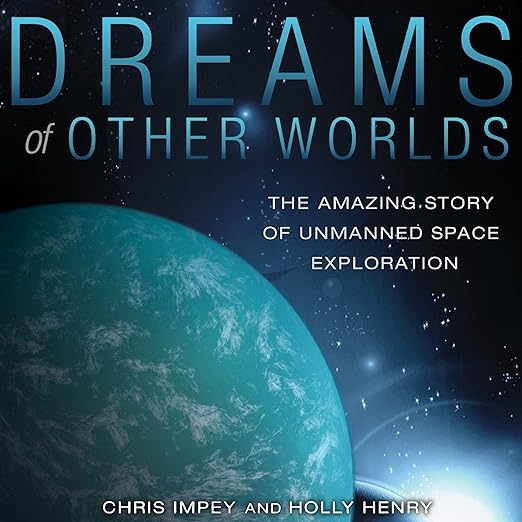
Eleven robotic missions, four decades of results, and not one human being aboard any of them: that is the premise of this audiobook, and it is a sharper premise than the crewed-spaceflight books it will sit beside on the shelf. Chris Impey traces Viking and the Mars rovers, the Voyager probes and Cassini among the moons of Saturn, Stardust's round trip to a comet, the SOHO and Hipparcos missions, then Spitzer, Chandra and Hubble, closing with WMAP. Matthew Josdal narrates the fifteen-hour, eighteen-minute recording. Twenty-five ratings put it at 4.7, and the reviews are unusually specific about both what it does well and where it slips.
A Hidden Coauthor Named Holly Henry
The organizing idea is that the unmanned program, not the astronaut program, is what actually rebuilt our picture of the universe, and the book demonstrates it through structure rather than through argument. Each mission gets its own extended treatment, and the sequence is deliberate: begin at Mars, where the question is habitability, move outward to the gas giants and their moons, drop in on a comet, turn back toward the Sun and the local stellar neighborhood, then reach the great observatories and finally the earliest light in the universe. By the end you have travelled from a planet next door to what the copy calls "the dawn of creation", and the journey is the argument.
One thing the product page does not tell you is that the book has two authors. Michael R. Nofi's five-star review names the second directly: "Coauthor Holly Henry's touch is evident throughout the book", adding that he suspects she did most of the writing. The suspicion is a reader's guess rather than a fact, but a listing credited to one name while a reviewer discusses a coauthor throughout is worth knowing about before you buy. Nofi also supplies the best summary of the reading experience on offer, reporting that he read the whole thing in two sittings and found it wonderfully informative, which for a fifteen-hour survey of planetary science is a real compliment to the pacing.
Josdal Keeps SOHO and WMAP Consistent
What lifts this above a mission-by-mission chronicle is what Impey does with the results. The copy's closing line is the thesis: these missions have redefined what it means to be "the temporary tenants of a small planet in a vast cosmos". That is a cultural claim as much as a scientific one, and the book keeps returning to it, tracking how each discovery landed outside the observatory as well as inside it. Math Student, another five-star reviewer, values the book for a plainer reason, calling it "a great introduction to the value of Space based telescopes" and pointing to the bibliography for anyone who wants to follow a topic further.
For audio specifically, this subject suits a single narrator and punishes a careless one. Fifteen hours of mission names, spacecraft acronyms, instrument nomenclature and astronomical distances demand consistency above everything: SOHO, Hipparcos and WMAP have to sound the same in hour twelve as in hour two, and figures with a great many zeroes need to be delivered slowly enough for a listener to hold them. Matthew Josdal reads it. No review on this listing comments on the performance, so I have nothing to report about the delivery itself, only that the text places a heavy pronunciation and clarity load on whoever takes it on, which is exactly what a sample will reveal in five minutes.
Uranus Placed Thirty Astronomical Units Off
The most substantial caution is accuracy, and two of the three reviewers raise it independently. Nofi, at five stars, mentions errors in the astronomical data before his sentence breaks off in the source. The four-star reviewer, olderguysrule, is more specific: "But it needs a proof read", and by ninety-five pages in had already found at least three mistakes considered glaring by anyone who knows the field, citing a passage that places Uranus thirty astronomical units from the Sun. The correction that followed is cut off mid-word, so you get the objection without the fix. Read it as a caution about details rather than about the sweep of the book.
Format is the second issue. The copy describes a "stunningly illustrated" book, and illustration is not decoration in a volume about missions whose entire output was pictures. Audio cannot deliver the images these eleven spacecraft existed to collect, and no companion PDF is mentioned on this listing. Notice too that every review here was written from the printed edition, one counting progress in pages and another citing a page number, so the 4.7 average is a judgment on the text rather than on the recording. And note the copy's own tense: it describes Cassini's exploration of Saturn's moons as ongoing, which fixes the book at a particular point in the history of the program.
Story Shape Over Equations and Astronaut Politics
This suits the listener who reads popular science for the shape of a story rather than for equations. No mathematics is required, the structure is episodic enough to pick up and put down across weeks, and each mission arrives with its own cast of problems, failures and surprises. It suits anyone who followed the Mars rover coverage in the news and wants the four decades of context sitting behind it, and it suits the listener who suspects, correctly, that the robots have been doing most of the interesting work while the crewed program got the headlines.
Skip it if you want astronaut narrative, spaceflight politics or a technical treatment of instrument design, since none of that is the subject here. Approach with mild caution too if small factual errors bother you out of proportion, because two reviewers found some and one of them counted. Pair it with images from any source you like while you listen, since the one thing this recording cannot do is show you what these eleven missions were built to see, and the gap between hearing about the moons of Saturn and looking at them is the whole reason the missions were funded.
Does the Dreams of Other Worlds audiobook include the illustrations?
No. The description calls the print edition stunningly illustrated, and no companion PDF is listed with the audio. For a book about missions whose output was imagery, that is a real loss. Listening with a phone or tablet beside you, ready to look up the relevant mission photographs, recovers most of what the format removes.
Which space missions does the book actually cover?
Eleven of them, in a deliberate outward sequence: Viking and the Mars Exploration Rovers, the Voyager probes, Cassini at Saturn, the Stardust comet encounter, the SOHO and Hipparcos missions, the Spitzer, Chandra and Hubble observatories, and WMAP. Every one is uncrewed, which is the organizing argument of the book rather than an accident of selection.
Is this audiobook approachable without a science background?
Yes. Impey writes for general readers, no mathematics is required, and the mission-by-mission structure means each section starts fresh with its own problem and payoff. One reviewer read the whole thing in two sittings. The cultural framing, about what these discoveries did to our sense of ourselves, carries the parts where the science gets technical.