
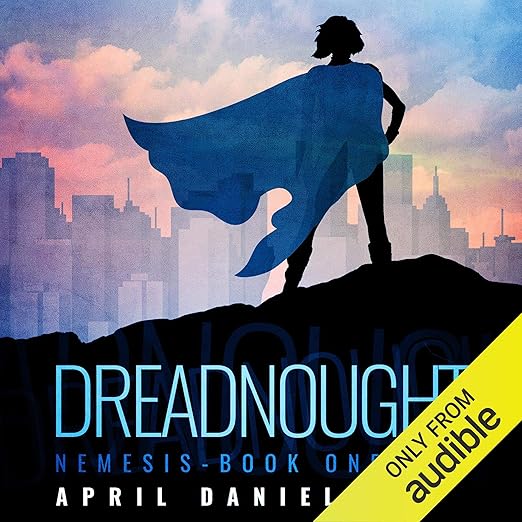
Danny Tozer inherits the powers of the world's greatest superhero because he falls out of the sky and dies at her feet, and the transformation that arrives with them rebuilds her body into the one she has always known was hers. That is the premise of the first Nemesis book, and it does two jobs in a single stroke: a cape story, and the fastest imaginable version of a transition. Eleven hours and twenty-eight minutes of audiobook follow, and the hardest thing in Danny's week is not the cyborg.
One rating. That is the number this page prints, under an average of 4.7 and beneath five written responses. A lone vote can only be a whole number of stars, which rules out 4.7 before anybody counts anything else, and five people cannot have graded a book that has been graded once. Neither field is describing the other, and a browser using the counter as a confidence signal is reading a broken instrument.
Somebody writing in January 2020 gave it four stars and the most analytical entry in the pool, calling it a power fantasy done well and reading the instant transformation as the fulfillment of a wish a great many transgender people carry. That entry also writes the protagonist's name as Danielle Trozer where the description says Danny Tozer, which is the kind of slip that happens when a book is being described from memory rather than with the page open, and it is worth noticing only because the pool is small enough for one voice to carry weight.
April Daniels built a cape novel for teenagers in which the superhero apparatus is the least dangerous thing on offer. Danny's father treats her girlhood as a condition to be cured. Her best friend decides that proximity entitles him to a relationship. The established heroes convene to debate whether she counts. The cyborg named Utopia is a deadline, not a theme.
Why It Works in Audio
A response filed from Italy in June 2023 is the pool's most direct testimony, and it opens by naming its own stake: a trans girl who grew up on superheroes, arriving at a book that was aimed squarely at her. What follows is weeping, laughing, cheering and anxiety about characters, and a closing admission that the writer's English had stopped cooperating under the weight of it. Nothing in a marketing paragraph reaches that.
Natasha Soudek carries the recording alone, and the assignment has a wrinkle worth naming. Two separate responses value this book specifically for a first-hand accuracy they believe only a trans writer could produce, which means the thing being praised is the closeness of the voice to the experience. Audio then places a professional reader between the listener and that voice for the length of the book, giving a hired performer the job of sounding like the person it happened to. Every first-person memoir-shaped novel faces this, and a novel whose whole subject is a body finally fitting faces it harder.
What to Watch For in Dreadnought
Somebody who opens by ruling himself out of the audience, in an entry dated October 2, 2021, describes himself as a sarcastic and grumpy man in his forties who arrived only because a book channel recommended the series, and then reports that the writing is descriptive and flows naturally enough to keep the scenes in view. Take that as the useful data point it is: the novel travels beyond the readership it was built for, and it does so on craft rather than on subject.
The listing itself has been assembled from parts. Two entries came in from outside the United States, one from Italy and one from Canada, which means grades collected on separate storefronts are stacked under a single average. The description closes with a copyright line for original cover art belonging to a print publisher, a leftover from another edition that has no meaning at all for somebody buying a recording.
Content is the last flag, and the description does not hide it. A parent campaigning to cure his daughter, a friend who converts friendship into entitlement, and colleagues holding a committee meeting about a teenager's right to exist are all distressing in ways a cape plot usually is not. This is filed as teen and young adult, and it earns the shelf, but not gently.
Who Will Get the Most From It
Five stars on October 15, 2021, filed from Canada under a default account name, put the case in a sentence: the book depicts the raw emotions of being transgender with a level of accuracy the writer believes only a trans person could reach, and it does it with expert writing, with the superhero material woven through to keep the whole thing moving. That is precisely the balance the book is trying to strike.
It belongs with readers who want a young adult superhero novel that treats identity as the plot rather than the garnish, who can take domestic cruelty alongside the flying, or who have been waiting for a cape story where the power fantasy and the personal stakes are the same event. Give it a miss if you want an uncomplicated origin story, if you need the villain to be the hardest problem, or if a book about a teenager under sustained pressure from her own family is not what you want in your ears for an evening.
Nine years on from its release, this recording sits under a rating block that counts one vote and displays an average no single vote could produce. The book underneath deserves better bookkeeping than the page it is sold on.
Before You Press Play
- Narrator: Natasha Soudek is the only credit on a book that has to hold a high school, a superhero committee and a cyborg in one register.
- Subjects: Transition and self-recognition, inherited power, family hostility, the cost of being debated
- Tone: Fierce, bruising and finally exhilarating
- Bottom line: A superhero origin worth the shelf space, sold on a page whose numbers cannot be trusted.







