Quick Take
- Read by: Matt Godfrey handles Brite's dense, sensory prose without smoothing out its edges, the right choice for material this deliberately transgressive.
- At its heart: Inherited trauma and the houses that hold it, queer identity and chosen family, art as a way of reaching or repeating the past
- Vibe: Atmospheric and claustrophobic, with a current of eroticism running beneath the horror
- Short version: Essential Brite for readers who respond to the intersection of queer experience and Southern Gothic horror, though it shows its 1990s origins in ways that require some adjustment.
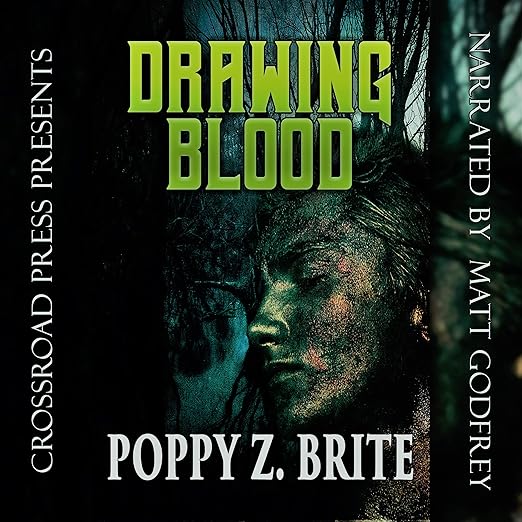
I encountered Poppy Z. Brite years ago through Lost Souls, which introduced me to a writer working in a tradition I didn't quite have vocabulary for yet, something between Anne Rice and the more abrasive end of the New Wave, filtered through a deeply queer Southern Gothic sensibility. Drawing Blood, published in 1993 and now available in audio through Crossroad Press, represents Brite at the height of that particular mode: maximally atmospheric, explicitly sexual, and genuinely concerned with the relationship between art, violence, and the houses where terrible things happened.
The premise involves Trevor McGee returning to the house on Violin Road in Missing Mile, North Carolina, where his cartoonist father killed most of the family and spared only Trevor, then took his own life. Trevor returns in the company of Zach, a New Orleans hacker on the run from the law. The house hasn't finished with either of them.
What separates Brite from less interesting horror writers is the seriousness with which she takes her characters' interiority. Trevor is not a vehicle for plot. He's a young man who has been living at a safe distance from his own history, and his return to Violin Road is less about confronting a haunted house than about confronting the legacy of violence that shaped him and the art he's trying to make. The cartooning subplot, Trevor losing himself in lines and images that begin to blur with the past, is where the novel is most formally interesting. Art as a way of approaching what can't be approached directly is a rich subject, and Brite handles it with more sophistication than the horror packaging might suggest. One early reviewer described the novel as having "everything a great horror novel should have", likeable characters, excellent back story, moody atmosphere, and a sense of reality. That assessment holds, with the caveat that Brite's definition of reality includes explicit sexuality and violence that some readers find more challenging than others.
What Poppy Z. Brite Gets Right
Matt Godfrey's narration is attuned to Brite's prose style, which is dense and sensory and occasionally purple in the way that serves atmospheric horror rather than working against it. He doesn't over-dramatize the more extreme passages, which is the right call, Brite's horror is most effective when it's delivered without theatrical emphasis, letting the content do its work rather than performing it. The Missing Mile setting, which Brite developed across multiple books, has an accumulated specificity that audio rewards: you hear the sound of the town as well as see it. At fourteen hours, the pacing does stretch, particularly in the middle sections, which is a fair criticism that appeared in several reviews.
Where Poppy Z. Brite Loses Some Ground
This is a book that was written in the early 1990s, and it reads that way in both its best and less successful qualities. The "toxic yaoi" designation one reviewer used is precise, the queer relationship at the center of the novel has an intensity that occasionally tips into melodrama by contemporary standards. One returning reader who loved the book the first time found it had dated in some respects, the edginess that felt fresh in the nineties has a different quality now. That experience is not universal: other readers who came to Drawing Blood recently found it completely gripping. Your mileage will depend substantially on how much you respond to the gothic-Southern-queer-horror register Brite invented and, to a significant extent, still owns. The haunted house mechanics are genuinely effective; the cyberpunk subplot around Zach's computer hacking feels more dated.
Who Should Pick Up Drawing Blood
Readers already in Brite's orbit will want this, one reviewer reported buying every Brite book they could find after finishing it, which is the appropriate response to discovering a writer who owns a particular register completely. Horror readers comfortable with explicit sexuality and graphic content will find it rewards the investment. Those new to Brite should probably start here rather than with the later Liquor books, which represent a different creative direction. Listeners who prefer their horror restrained or their LGBTQ fiction without the horror component should look elsewhere. For the right reader, Drawing Blood remains exactly what the best of its reviewers said: gritty, sexy, visceral, and entirely its own thing.
How explicit is Drawing Blood in terms of sexual and violent content?
Quite explicit on both counts. Brite is writing in a tradition that treats transgression as thematically meaningful rather than gratuitous, but the content is not softened. Listeners with sensitivities around graphic sexuality or violence should read a content summary before committing.
How does Matt Godfrey's narration handle the novel's tonal range, from horror to eroticism to character interiority?
With appropriate restraint. Godfrey doesn't overplay any of it, which suits Brite's approach, the writing delivers its effect through accumulation and atmosphere rather than theatrical emphasis, and the narration respects that.