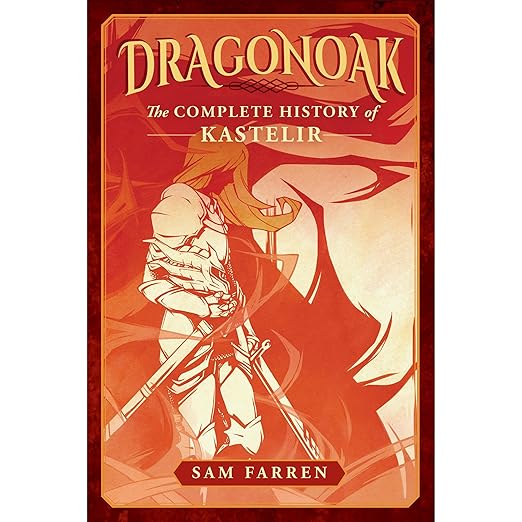
I will say upfront what the listing does not emphasize enough: Dragonoak is narrated by Virtual Voice, Amazon's AI narration system. That matters for a book like this. Sam Farren has written something genuinely literary, a character-driven slow-burn fantasy where the emotional texture of the prose is doing most of the heavy work. An AI voice that cannot modulate for feeling, for the particular quality of a moment of connection or dread, is not a neutral choice for this material. It is worth knowing before you press play, because the book itself is considerably better than the narration format it has been given.
The story follows Rowan Northwood, a necromancer who has been exiled to farmland outside her village because of powers the community cannot accept. Her chance at escape arrives with a passing knight, Sir Ightham, who neither welcomes Rowan's company nor rejects it outright, which is a more interesting dynamic than the familiar reluctant-hero setup. What unfolds from there is a slow journey across kingdoms and through mountains toward Kastelir, a country living in the shadow of a long-dead queen described as all tusks and claws and great spiraling horns. The fantasy architecture here is original and specific, and Farren's commitment to it is evident from the opening chapters.
Most fantasy fiction treats unusual powers as a form of privilege, even when they come with consequences. What Farren does differently with Rowan's necromancy is to frame it primarily as the source of her isolation rather than as her advantage. The powers that burn within her are the reason she has been excluded from her community, the reason Sir Ightham keeps a measured distance, and the reason the journey has stakes that go beyond adventure. Rowan is not discovering her power. She is learning whether there is any context in which her power will not mark her as other.
That psychological framing gives the story a quality that one reviewer described as like dreaming, a steadiness of pacing where you are never given too much or too little information, where the story plods in the best sense, immersing rather than rushing. Another reviewer, describing it as a Fantasy Tour de Force, singled out the third race in the book, the Pane, as particularly well-realized, noting that Farren handles gender and species with genuine creativity and without the condescension that can accompany such ambitions in lesser hands. The pane exist outside binary gender categories, and the book treats this as simply part of the world rather than as a subject for explanation or admiration.
What Makes Dragonoak: The Complete History of Kastelir Worth Hearing
The synopsis is upfront that there is plenty of lesbian romance throughout. What it does not adequately convey is how slow that burn is. This is not a romance where the emotional payoff arrives in the middle third. Farren is playing a very long game with the relationship between Rowan and Sir Ightham, and the first book is primarily about establishing the conditions under which connection becomes possible rather than delivering that connection. Readers who want romance to be a plot driver rather than an undercurrent should adjust their expectations accordingly. Readers who appreciate the slow-build approach will find Farren's restraint part of the book's considerable appeal.
Multiple reviewers note that the book deals with gender in explicitly non-binary ways, and one reviewer who identified as agender described the representation as a significant part of why the book worked for them personally. That specificity matters: Dragonoak is doing something more careful than token representation, and it does it without fanfare, which is the most effective way to do it.
Things to Know Before Starting Dragonoak: The Complete History of Kastelir
I have listened to enough AI-narrated audiobooks at this point to assess them fairly, and Virtual Voice remains a tool better suited to nonfiction than to literary fiction. The challenge for Dragonoak specifically is that Farren's prose has a rhythm and a particular emotional temperature that requires a human voice to transmit. The show-don't-tell craft that reviewers praise, the way the book communicates feeling through action and detail rather than explanation, depends on a narrator who understands what is happening beneath the surface of the words. AI narration reads the surface. The story's strengths still come through, but they come through at reduced resolution, which is a real cost for writing this good.
Who Should Pick Up Dragonoak: The Complete History of Kastelir
Dragonoak is the first book in a trilogy, and all three volumes are now available. Patient listeners who love slow-paced, character-driven fantasy with LGBTQ central relationships will find this a deeply rewarding read in any format. The AI narration is a real limitation for the audio specifically, but the prose quality is high enough that even filtered through Virtual Voice, the story's strengths come through. If you are sensitive to AI narration, the free audiobook version gives you access to the story, but consider reading the print or ebook edition if the narration becomes a barrier. For anyone willing to work with the format, this is an impressive debut fantasy that has built its audience for good reason.
- Performance: Virtual Voice AI narration is a significant limitation for a character-driven story this dependent on emotional register. The prose quality deserves better, and listeners sensitive to AI narration should note it before committing.
- What it covers: Exile and chosen belonging, the burden of powers others fear, slow-burn connection between unlikely companions
- Feel: Dreamlike and deliberate, rich in atmosphere rather than event
- Our call: A beautifully written LGBTQ fantasy with a slow, literary pace that rewards patient listeners, though the AI narration is a genuine obstacle to the emotional experience the prose is trying to create.
A Few Questions About Dragonoak: The Complete History of Kastelir
How does the Virtual Voice AI narration affect the listening experience for this particular book?
It is a meaningful limitation for a character-driven literary fantasy. The prose quality is high, but AI narration cannot modulate for the emotional register the story depends on. Readers sensitive to AI narration would do better with the print version.
How does Farren handle non-binary gender representation in the book?
The third race, the pane, exists outside binary gender categories, and the book treats this as simply part of the world rather than as a subject for explanation. Multiple reviewers have noted the author's apparent comfort with gender complexity as one of the book's distinctive qualities.