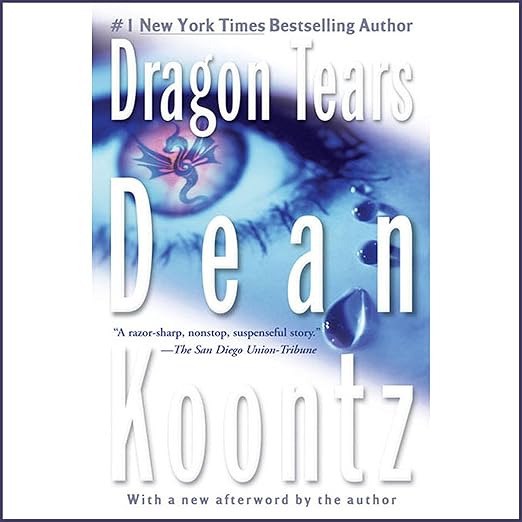
Sixteen hours. Dead by dawn. That countdown is the entire engine of Dragon Tears, and Dean Koontz knows exactly what he is doing by announcing it in the first pages. I came to this audiobook already a reader of Koontz's longer, more architecturally ambitious novels, but Dragon Tears is a different kind of project: tighter, stranger, propulsive in a way that bypasses the usual genre conventions in favor of something harder to categorize. Jay O. Sanders narrates, and the pairing of Koontz's particular brand of suburban dread with Sanders' controlled intensity turns out to be a very effective combination. I finished this one in two long sessions and found myself checking the clock at roughly the same intervals Harry Lyon does.
Harry Lyon is a detective. He is rational, careful, protective of his own emotional equilibrium in the way that people who work around violence often are. When a homeless stranger with bloodshot eyes tells him 'ticktock, you'll be dead in sixteen hours,' Harry does not entirely believe it. But something in that utterance lodges under his skin, and over the next twelve-plus listening hours, Koontz builds out what that countdown actually means. The horror here is not purely supernatural, though the supernatural is absolutely present. It is the horror of a rational person being forced to confront the limits of rationality, being dragged into a reality that his professional training has no category for. Reviewers have called it 'an old-fashioned horror story with humor and charm' and 'a real rollercoaster,' and both descriptions are accurate. Koontz's ability to modulate between genuinely creepy sequences and moments of sardonic warmth is one of his most underrated skills, and this novel uses it throughout.
The structure of the countdown serves Koontz's tonal aims well. By committing to a sixteen-hour deadline within the story, he locks Harry into a compressed timeline that forces confrontation with the supernatural threat before rationalism can reassert itself. Characters in most horror novels have the luxury of denial for long stretches. Harry does not, and his inability to step back and analyze creates urgency that the audio format amplifies further. Sanders' pacing never lets the narrative breathe too long in any one register.
Why It Works in Audio
Jay O. Sanders' narration is the element that elevates this audiobook above the print experience. He handles Harry Lyon with exactly the right degree of controlled tension, keeping the character's rationalism credible even as the plot systematically dismantles it. Sanders reads fear the way a good character actor plays it: as a physical state that keeps trying to surface through careful professional composure. He also manages the humor without winking at the audience, which matters enormously in Koontz's tonal register. When a passage is both funny and disturbing, Sanders finds the note that holds both at once rather than tilting toward one at the expense of the other.
One listener mentioned that the book 'took me for a loop' at first before settling into something deeply rewarding. That disorientation is intentional. Koontz is deliberately crossing genre conventions here, mixing police procedural with supernatural horror with a strain of almost mythological weirdness, and the opening chapters make demands on the listener's patience before the design becomes legible. The payoff is worth it. The character of Woofer, a dog who becomes integral to the story, drew particular affection from multiple reviewers. In Koontz's fiction, dogs mean something specific in his moral universe, and their presence here is no accident. Woofer functions as an emotional anchor in a narrative that otherwise moves through increasingly dark territory.
Before You Commit to Dragon Tears
The countdown structure that makes Dragon Tears so propulsive also places unusual demands on plausibility. A sixteen-hour deadline means everything happens fast, and Koontz is making rapid narrative decisions throughout that some readers find satisfying and others find compressed to the point of strain. The supernatural elements, while consistently strange and effective, are not fully explained in the way that more systematically constructed horror tends to be. Koontz is after atmosphere and momentum more than a tidy mythology, and listeners who need their genre mechanics worked through completely may find the resolution less conclusive than they would like. The tonal variety, which is a genuine asset, can also feel slightly uneven in the middle sections, where the comedy and the horror are not always perfectly balanced.
Koontz is also doing something interesting with place in this novel. Harry's world is suburban Southern California, the kind of landscape that genre fiction often treats as a backdrop rather than a character, but Koontz uses its ordinariness as part of the horror. The supernatural intrudes into spaces that should be safe precisely because their familiarity offers no protection. A parking garage, a diner, a residential street at 2 a.m.: these are not haunted house settings, and that is the point. Sanders' narration gives these spaces a kind of heightened normalcy before the countdown clock strips that away, and the transition from ordinary to uncanny happens in the audio version with a sharpness that the pacing of reading at one's own speed would likely blunt.
Best Suited For
Koontz readers who have not encountered this particular novel will find it an interesting variation on his usual range. Thriller and horror fans who enjoy countdown structures and protagonists being forced out of their comfort zones by events they cannot explain will find a great deal to appreciate. Those who want tightly plotted, fully explained supernatural mechanics should look elsewhere in the genre. But for listeners who enjoy Koontz's distinctive blend of dread, humor, and genuine warmth toward his characters, and who want a narrator who can hold all of that in the air at once, this audiobook delivers consistently across its twelve-hour runtime.
Quick Take
- Read by: Jay O. Sanders gives Harry Lyon's rational skepticism exactly the right weight, handling comedy and dread with equal precision.
- At its heart: Rational mind vs. supernatural reality, countdown under pressure, the moral weight of survival
- Vibe: Tense and propulsive, with unexpected humor threaded through the dread
- Short version: A sharp, fast-burning Koontz thriller made more unsettling by a narrator who knows exactly when to apply the brakes.
Good to Know
Does Jay O. Sanders' narration work for a male-led thriller audiobook of this kind?
Very well. Sanders keeps Harry Lyon's professional composure credible throughout, which is essential for a protagonist defined by rationalism being dismantled by irrational events. He also handles the tonal shifts between horror and comedy with skill.
How does the supernatural element work in this audiobook?
It is present throughout but not systematically explained. Koontz is after atmosphere and momentum more than a structured mythology. The countdown of sixteen hours provides the narrative scaffolding, while the supernatural force driving it remains deliberately strange and not fully categorized by the end.
Is the audiobook suitable for listeners who are not regular horror readers?
Yes. Dragon Tears mixes police procedural with supernatural horror in a way that gives thriller fans a comfortable entry point, and Koontz's persistent streak of warmth and humor means the experience never becomes purely oppressive. Several reviewers who are not horror regulars reported finding it engaging and even funny in places.