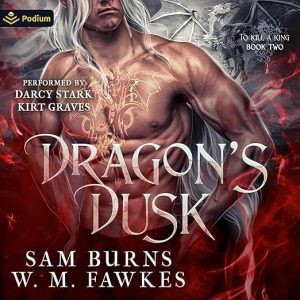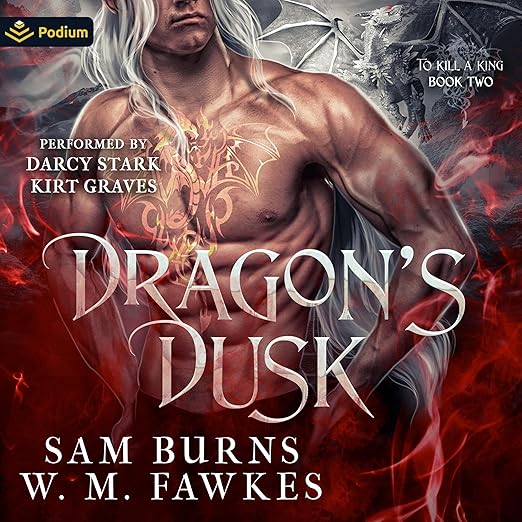
I picked up Dragon's Dusk on a recommendation from a reader who had binged both books in the To Kill a King series over a single weekend. I came in without having read book one, which is probably not the ideal entry point, there are relationships and world details that carry more weight for readers who arrived with prior context. But Sam Burns writes Dragon's Dusk with enough internal coherence that a first-time reader can orient themselves, even if certain emotional payoffs land with less force than they would for returning listeners.
The premise is the kind of high-concept fantasy setup that either works completely or collapses under its own logic. A dragon, locked away after a vicious attack left a princess blind, is transformed into human form by a witch's magic. His bonded rider, Kostya, does not recognize him. The dragon, now simply a man, without scales or claws or any physical marker of what he was, must navigate a world that suspects him while trying to reach the prince he loves. Burns frames this in the protagonist's first-person voice with the synopsis's opening lines: I have been a runt, a disappointment, and a monster. Now, I am simply a man. It is a strong beginning, and the book sustains that voice effectively across nine hours.
Our Take on Dragon's Dusk
The central structural choice in this series, which at least one reviewer found genuinely troubling, is that bonded rider and dragon do not communicate directly. In most dragon fiction, from Anne McCaffrey's riders to Philip Pullman's daemon bonds, the paired connection involves some form of inner communication. Burns has made the deliberate decision to deny this to her characters, and that choice drives the plot of Dragon's Dusk entirely. If Kostya and his dragon could simply speak mind-to-mind, there is no book.
One reviewer found this the critical failure of the premise, arguing that the entire plot hinges on what they called an artificial misunderstanding. That reading is not unfair. But another reviewer raised a more interesting question: if dragons have human-level intelligence, is it moral to soul-bond them at all? Or is it through the bond that dragons develop self-awareness? The book does not resolve these questions, and I suspect that is intentional. Burns is working with ethical ambiguity rather than around it, which distinguishes Dragon's Dusk from romance fantasy that treats its own mythology as mere decoration for the central pairing.
Why Listen to Dragon's Dusk
Kirt Graves is a narrator who specializes in MM fantasy and romance, and his work here demonstrates why he has become a trusted voice in the genre. The challenge in this particular audiobook is rendering a protagonist whose interiority is that of a dragon but whose body is suddenly human, a character who must learn to navigate social interactions, physical sensation, and emotional expression in a form he has never inhabited before. Graves handles this with what I can only describe as calibrated wonder. The dragon-turned-man is not awkward in a broad comedic way but genuinely disoriented, and Graves finds the register for that without overdoing it.
His performance of Kostya, heard through the narrator's perspective rather than directly, is equally careful. The prince's grief at believing his dragon was stolen is rendered with enough weight that the reunion plot, when it finally moves in that direction, feels genuinely earned rather than convenient.
What to Watch For in Dragon's Dusk
Dragon's Dusk is book two in the To Kill a King series, and the reviewers who engaged with it most thoroughly had read book one. One reviewer who binged both books noted a continuity question around character ages that nagged at them throughout, an inconsistency between what book one implied and what book two required. That kind of cross-book logic problem is a risk in fantasy romance series, and Burns has not entirely avoided it.
For new listeners, the self-contained nature of the central romance, a dragon who loves his prince and must find a way to be recognized as himself, makes the book emotionally accessible even without prior context. The synopsis's list of features captures the register accurately: one forlorn dragon-riding prince, a dragon who just wants to kiss the boy, two incredibly self-sacrificing doofuses. This is a book that knows what it is and delivers it with real craft. The rating of 4.4 across over seven hundred listeners speaks to a readership that found it delivered on its promises. At nine hours and three minutes with Kirt Graves narrating, it is a satisfying free audiobook listen and a strong entry point into a series that its fans clearly return to with enthusiasm.
Who Should Listen to Dragon's Dusk
What separates Dragon's Dusk from many MM fantasy romances is that Burns takes the implications of her own world-building seriously. A dragon who has lived for decades with only his bond to Kostya as meaningful connection, who then must prove his identity to the person whose recognition matters most, is not just a romantic obstacle. It is a genuine question about what constitutes personhood and what we owe to those we love. Burns does not answer it definitively, but she builds a story that keeps the question active, and that is the mark of a fantasy writer doing the work rather than using the trappings.
A Few Questions About Dragon's Dusk
Do I need to listen to book one of the To Kill a King series before Dragon's Dusk?
It is not strictly required, the central romance of Dragon's Dusk is self-contained enough to follow without book one. However, at least one reviewer who read both noted that certain character relationships and world details carry significantly more emotional weight with prior context. If you enjoy this, going back to book one is recommended.
How does the book handle the ethical complexity of the soul-bond between dragon and rider?
Burns leaves it genuinely open. Reviewers have raised the question of whether bonding a sentient creature is moral at all, and the book does not resolve it. The dragon's perspective, he values the bond deeply, coexists with the structural problem that the bond does not allow communication, which drives all the plot's conflict.
Is the romance between Kostya and the dragon explicit, and does it handle the man-animal boundary in a way that most readers will find acceptable?
One reviewer acknowledged initial discomfort with the premise but found that the dragon's human-level intelligence, combined with the fact that all romance occurs in human form, made it readable. The book is aware of the line it is walking and keeps the romantic content in the protagonist's human state. It is an adult MM romance with some explicit content.
Does Kirt Graves differentiate the voices of the various characters effectively?
Yes. Graves is an experienced narrator in this genre, and his performance differentiates the dragon-protagonist's internal voice from the other characters he encounters with clear tonal markers. The emotional range required by this particular story, wonder, grief, suspicion, tenderness, is handled with precision.