- Narrator: Hayley Atwell is the sole name in the credit field, while the description names twelve performers for this full cast production.
- Subjects: Oral history structure, a mother searching for a missing son, institutions improvising against an unfamiliar threat.
- Tone: Fragmented, urgent and uneven.
- Bottom line: The interview format is both the reason to listen and the reason the low grades exist, and the split column is honest about it.
One response to this audiobook actually rates the reading. Andrew O gives three stars under the headline Good Listen and opens with four words: solid story and voice acting. What follows is the reason for the two missing stars, namely that the author is a liberal. That is the whole assessment. On a six and a half hour production assembled around a cast of screen actors, the only verdict anyone has offered on the performance is favorable, and the grade sitting next to it was decided by something else entirely.
Is Dragon Day Worth Your Time?
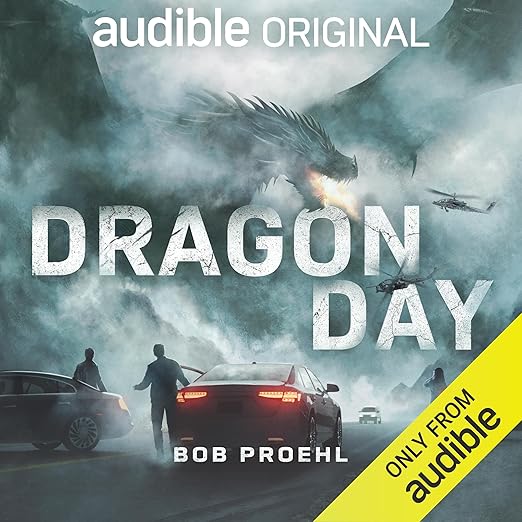
Neve Pride is a journalist compiling an archive. Dragons have emerged on earth, the months since have produced wreckage and improvised communities, and she moves through it with her young daughter Bex, recording interviews with scientists, military leaders and people hunting for the missing. Her own son is among the missing. The book is built entirely out of those recordings, an oral history in the shape the copy names outright: for fans of World War Z and Sleeping Giants. Bob Proehl holds the byline, and the form does most of the work. The description credits the producers of the Maze Runner trilogy, which is the only production lineage the page bothers to supply.
Twelve performers are named in the description, and one appears in the narrator credit. Hayley Atwell heads a list running through Michael Chiklis, Aldis Hodge, Greta Lee and Jimmi Simpson, which then continues into a second sentence naming Richard Tatum, Chioke I'Anson, Gail Shalan, Rez Kempton, Judy Gold, Piper Goodeve and Gregory Connors. That second list opens with the word include, so it may not even be complete. The credit field on this page holds the first name and stops. Anyone choosing on the strength of the cast has to read the description to find it.
Six hours and twenty-nine minutes is brief for a book covering a global emergency one interview at a time, and the compression cuts both ways. Nightgaunt, at four stars, describes the effect as binging a good fantasy podcast, which catches the rhythm exactly: short segments, changing voices, a threat assembled out of fragments. The same brevity is what LJLee attacks, calling the complete lack of a coordinated military response ridiculous. Both are describing one structural choice from opposite sides of it.
The Best Parts of Dragon Day
Ten votes produce the 3.2 badge, and the arithmetic behind it is unusually firm: those ten votes total exactly 32 stars out of a possible 50. The five grades you can read for yourself run 5, 4, 1, 3 and 2, which comes to 15 between them. Those five readable grades cover every value from one to five, with no two alike, which is a rarer shape than a low average and a more useful one. Whatever else the production is, it divides people sharply, and choosing on the strength of the average here means choosing on the strength of an argument.
Format is the entire selling point, and Kenneth W. Myers states it plainly: dragons without the medieval trappings, an interview structure letting each survivor reveal a different angle on the same event. The listing is described in that response as an audiobook exclusive, which fits, since this is an Audible Originals production. The appeal is procedural. You hear testimony instead of watching a battle, and the dragons reach you through other people's accounts of them.
Dolby Atmos gets a line of its own at the foot of the description, the only technical claim the page makes about the production. Nothing states what the mix does on a standard download, and no respondent mentions spatial audio anywhere. Anyone shopping specifically for an immersive presentation should treat that line as a promise made by marketing copy and check it against the format they plan to use, because the column confirms nothing either way.
Before You Commit to Dragon Day
LJLee, whose single star is the lowest grade posted, warns of mild spoilers and then supplies several. The objection is not the premise, which that review calls fantastic, but the execution: interviews stacked on interviews, plot holes, and a revelation about when the dragons really arrived, stated outright. Kindle Customer does the same, flagging spoilers ahead before explaining that the dragons stay invincible long enough to drain the tension out of a large stretch. Two entries here will spoil the book if you take them first.
Filed under literature and fiction with a lone tag reading Action and Adventure, this page carries no fantasy or science fiction label at all, on a book whose premise is dragons landing on earth. The genre fields are the least reliable part of the listing. Browsing by category will not surface it where the story belongs, and arriving through the literary filing sets you up for a novel of interiority when what waits is closer to a disaster procedural. One response reaches past the fields entirely for a frame of reference, naming the film Reign of Fire and the oral history of World War Z side by side.
Vocabulary on this page needs untangling before you read the column. Kindle Customer refers to the narrator, Neve, meaning the journalist compiling the archive inside the story, not any of the people reading it aloud. One word covers two jobs on an audiobook listing, and that response uses it in the fictional sense only. Scanning the column for opinions about the performance will send you down that path once, and the payoff at the end of it is a plot complaint.
Should You Listen to Dragon Day?
Oral history fans are the natural audience. If World War Z worked for you as a structure and not merely as a story, and if the podcast comparison Nightgaunt reaches for sounds like a feature, six and a half hours of testimony from scientists, soldiers and survivors will hold your attention. The screen names in the description are the other draw, though the page never says who voices whom, and matching actor to interviewee is left to your ear. Runtime helps as well, since six hours and twenty-nine minutes is a weekend, not a commitment.
Look elsewhere if you want a conventional novel with a protagonist you stay beside, since the format cuts away every few minutes by design, or if invincible antagonists frustrate you, which is exactly the complaint behind the two lowest grades. Handle the written responses carefully as well, because the most informative among them give away the central reveal. The cast list is the reason to try this one, and the credit field is not where you will find it.