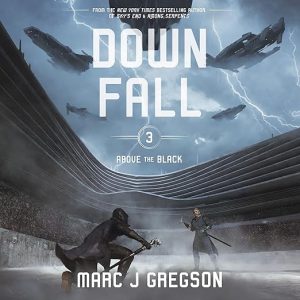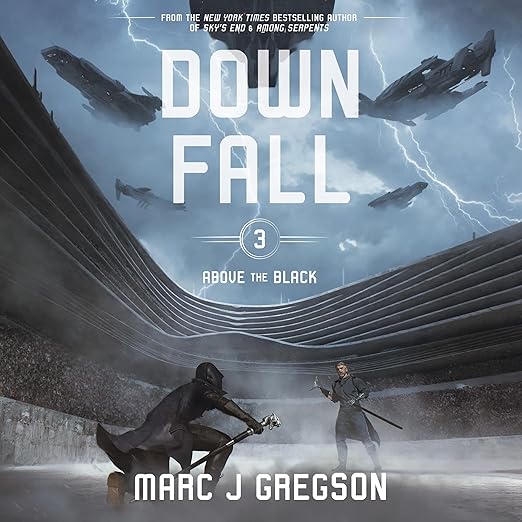
I started Downfall on a Friday night, which was, in retrospect, a poor decision if I had any other plans for the weekend. Marc J Gregson's Above the Black trilogy takes place in a world of Skylands floating above an uncharted Below, governed by a Meritocracy that is, by Book three, visibly crumbling under the fist of a despot the characters call Uncle. Conrad, the teenage hero who was disowned, exiled, and eventually left for dead on a near-impossible mission, arrives in this finale having shed his identity entirely. He is living under a false name on a faraway island, training with the King's enemies, bleeding in dueling pits to build the status he needs to challenge a man who controls a nation.
Gregson is working with familiar YA fantasy materials: the fallen prince, the cruel ruler, the morally gray system that cannot simply be burned down because too many ordinary people depend on it. What makes Above the Black worth reading is less the plot's originality and more the specific texture of the Skylands world and the care Gregson takes with Conrad's internal life. This is not a story about a chosen one discovering his destiny. It is a story about a teenager who has been repeatedly abandoned by the structures that were supposed to protect him, and who must figure out whether he wants to rebuild those structures or replace them.
A Closer Look at Downfall
The synopsis promises gory monster battles and fierce duels alongside empathetic characters and a morally gray dystopia, and Gregson delivers all of it without letting any element overwhelm the others. The dueling pit sequences have genuine physical stakes because Gregson has taken time to make you understand what winning means and what losing would cost. The sky pirate escape is kinetic but not gratuitous. And the question of whether a dead prince can rise again without simply becoming a new version of the tyrant he opposes is the thematic spine that keeps the action from feeling like pure spectacle. The single available review at time of writing calls it a total banger that ends perfectly, which is the kind of enthusiastic brevity that suggests a reader who finished it in one sitting.
What Makes Downfall Worth Hearing
Vikas Adam's narration is the right choice for a book this physically intense. Adam has a quality that works well in YA fantasy with high stakes: he sounds present in the scene, not performing it from a distance. Conrad's arc requires a narrator who can carry the specific combination of exhaustion, determination, and controlled fury that characterizes a character who has been written off and is choosing to treat that as an advantage. Adam handles the transition between Conrad's assumed identity and his real one with enough subtlety that you register the psychological complexity even when the story is moving fast.
Things to Know Before Starting Downfall
This is a series finale, and the emotional payoff is calibrated for readers who started with Book one. The Skylands worldbuilding, the Meritocracy's internal politics, and the relationships that define Conrad's loyalties all carry weight that accumulates across three books. New listeners will find it perfectly readable but will miss the specific satisfaction of watching a set of threads finally resolve. Gregson also commits to the morally gray framing promised by the synopsis: Uncle is not simply evil, the Meritocracy is not simply corrupt, and Conrad's victory does not come with clean hands. Listeners who need their YA dystopias to deliver uncomplicated triumph may find the conclusion more ambiguous than they wanted.
Who Marc J Gregson Is Writing For
Listeners who found the first two Above the Black books worthwhile should come directly here without hesitation. For readers new to the series, Book one is the right starting point. Fans of Sky in the Deep, An Ember in the Ashes, or any YA fantasy where political structures are as much the antagonist as any individual villain will find Gregson's Skylands a well-built addition to that tradition. Skip it if you want your finales to be comfort reads; Gregson earns his ending, but he charges admission in the form of real losses along the way.
Does Conrad's assumed identity in Downfall create meaningful sustained tension, or is it resolved quickly?
It sustains the first half of the book. Conrad's training under a false name on the Eastern Airs island is where much of the character development happens, and the question of when and how his real identity re-enters the story is part of what keeps the narrative uncertain.
How graphic are the monster battles and dueling pit sequences for a YA title?
The publisher's own synopsis describes them as gory, and that is accurate. Gregson does not sanitize the violence, though it remains purposeful rather than gratuitous. Listeners who are sensitive to detailed physical combat descriptions should be aware before starting.
Is the Meritocracy presented as genuinely complicated, or does it serve as a simple dystopian backdrop?
Genuinely complicated. Gregson's point across the trilogy is that the Meritocracy's problem is Uncle's corruption rather than the system itself, which creates the specific moral challenge Conrad faces: overthrowing a despot without becoming one. The finale engages that question seriously.
How does Vikas Adam's narration handle Conrad's psychological complexity under the assumed identity sections?
Adam is strong on differentiating Conrad's internal states across those sections, conveying the cost of performing a false self while carrying the real one. His primary strength is presence and urgency rather than broad character-voice range, which is the right call for a story this kinetically driven.