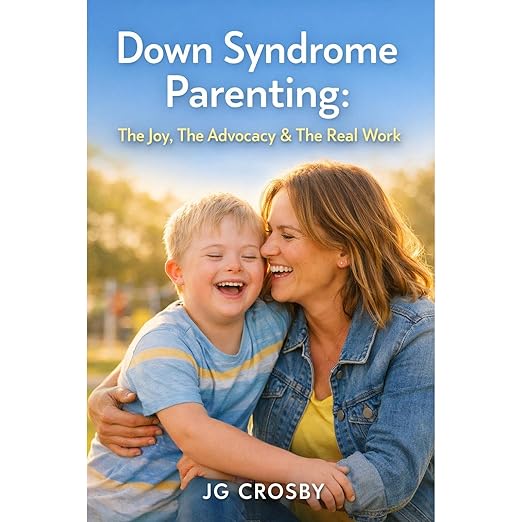
- Performance: Virtual Voice narration is functional and clear; adequate for structured practical content, though human warmth would have served this subject better.
- What it covers: Strengths-based parenting, IEP advocacy, preparing for adulthood and independence, the specific and real joy that lives alongside the real difficulty.
- Feel: Honest, grounded, and compassionate; written for parents who need orientation rather than uplift, and delivers both without conflating them.
- Our call: A well-organized fifty-four-minute audiobook introduction for parents navigating a Down syndrome diagnosis; honest about scope and valuable within it.
Picture the moment a parent first hears the words Trisomy 21. The room shifts. The stack of medical paperwork arrives. The well-meaning but sometimes devastating comments from people who do not know what they are saying begin. JG Crosby's Down Syndrome Parenting: The Joy, The Advocacy & The Real Work opens from inside that moment, and this audiobook, at under an hour, is specifically designed for parents who are in the thick of it and need orientation rather than a comprehensive treatise. Crosby is writing for the overwhelmed, and the format matches the intention.
Fifty-Four Minutes Covers Five Big Topics
At fifty-four minutes, this is an introduction, not an encyclopedia. Crosby is upfront about this. The guide covers early intervention frameworks, IEP meeting preparation, inclusion advocacy strategies, approaches to the teenage years, and realistic preparation for adult life and independence. Each of these areas deserves its own book, and other books exist that go deeper into each one. What Crosby offers is a coherent, values-driven framework for approaching them all: her organizing principle is that the child's strengths lead, that the parent's own wellbeing matters, and that the joy she names in the title is real rather than a polite fiction.
AI Narration Suits This More Than Memoir
The Virtual Voice narration is consistent and clear. For a guide of this type, where the content is organized around practical frameworks rather than personal narrative, the AI narration works adequately. Listeners who have encountered Virtual Voice in memoir or fiction contexts, where human emotional range is essential, will find it less disruptive here because the material is structured rather than expressive. That said, given that this guide addresses parents at an emotionally significant moment, a human narrator would have added genuine warmth to the delivery.
The section on IEP meetings is particularly practical. Crosby frames the meeting not as a confrontation with a system but as a collaboration with specific leverage points, and she identifies the most common ways that parents underutilize their rights in those meetings. The section on responding when the world underestimates your child is brief but honest: it acknowledges the frustration without pretending that strategies make it easy.
Strengths Come First, before Any Diagnosis
The strengths-based framing is what distinguishes this guide from resources organized primarily around deficits and clinical limitations. Crosby writes from the position that a child with Down syndrome has a particular profile of strengths and needs, and that the parent's job is to understand that profile with specificity rather than to manage against a general diagnosis. That framing matters most in the early chapters, where the alternative, the deficit-first approach, does the most damage to a family's sense of what the future holds.
The chapter on unexpected joy is the most personal in the guide and worth the runtime alone. Crosby does not perform optimism. She describes specific experiences of connection, growth, and surprise that she would not have had without her child's particular way of being in the world, and she does so without dismissing the difficulty. The combination of honesty about the hard parts and specificity about the joyful ones is what gives that chapter its weight.
For grandparents, aunts, uncles, educators, or friends who want a quick, well-organized orientation to what parents of children with Down syndrome are navigating, this guide's short runtime makes it a practical recommendation. A single commute covers the material, and the conceptual framework Crosby lays out is a better foundation for supportive conversation than a Google search provides.
This Introduction Skips the Legal Specifics
Fifty-four minutes cannot cover this territory comprehensively. Parents who are past the initial orientation phase and need detailed guidance on specific IEP scenarios, legal advocacy strategies, medical care coordination, or employment and housing planning for adult children will need resources that go significantly deeper. Crosby's guide is a starting point, and it points toward the questions that require more extended investigation rather than pretending those questions are simple.
The guide is not specific to any single country's legal or educational system. IEP rights, inclusion mandates, and adult services vary significantly by jurisdiction. Parents should use Crosby's frameworks as conceptual orientation and then identify the specific rights and resources available in their region before acting on any of the advocacy strategies she describes.
Virtual Voice Warms Up Most for IEP Tips
The Virtual Voice narration, while functional, may feel slightly clinical at a moment when parents are looking for human warmth. Crosby's writing carries empathy, but the delivery cannot fully convey it. This is worth knowing before starting the listen, particularly for parents who are still in the early, most emotionally vulnerable stages of processing the diagnosis.
At under an hour, the guide does not have space to address the full range of medical considerations, therapy types, or specialist resources that parents typically need to navigate. Consider this one piece of a larger orientation process rather than a single comprehensive resource.
The section on IEP meetings in particular benefits from being listened to before attending one for the first time. Crosby identifies the procedural points where parents most commonly lose ground, not because they are wrong but because they do not know the process well enough to use their rights effectively. She does not turn this into a confrontation framework; her approach is collaborative rather than adversarial, which reflects both practical wisdom about how to get results in those meetings and a genuine orientation toward partnership with educators and specialists. That balance is harder to get right than it sounds, and it is one of the guide's most useful contributions.
Efficient Enough for a Nervous First Listen
Parents who have recently received a Down syndrome diagnosis and need a coherent, strengths-based framework for the next steps will find this the most efficient possible starting point in audiobook form. Family members and educators who want to understand the landscape a parent is navigating will find the runtime manageable. Parents of older children with Down syndrome may find the early sections familiar but will likely find value in the framing of adult life planning. At under an hour, the barrier to a first listen is minimal, and Crosby's guide delivers something more useful than most online resources available in the same amount of time.
Before You Listen
Does this audiobook address the adult years and long-term planning?
Yes, briefly. Crosby covers realistic preparation for adulthood and independence as one of the guide's key areas, though at the introduction level. Parents who need detailed guidance on adult services, housing, employment, or legal planning will need to supplement with more comprehensive resources.
How does this audiobook approach the emotional experience of parenting a child with Down syndrome?
Crosby uses a strengths-based frame throughout and includes a chapter specifically on the unexpected joy that parents describe. She does not minimize the difficulty but documents the specific, genuine pleasures alongside the real challenges, which distinguishes the guide from resources focused primarily on clinical management.