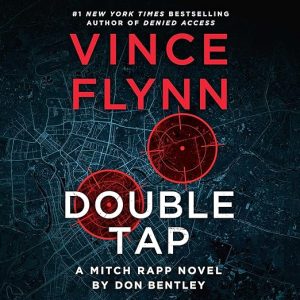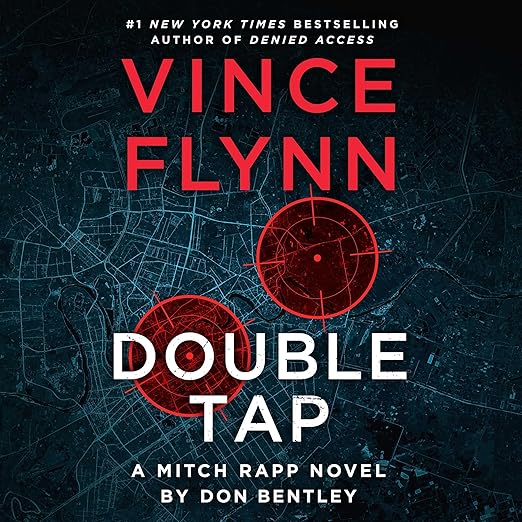
A Pakistani chemical weapons scientist for hire is taken off a street in Verona, and a young Mitch Rapp, sent out on a first deep cover assignment, has to reach the cell that took the target before that expertise gets used. That is the setup, and the audiobook Simon & Schuster Audio UK has dated 15 September 2026 gives it ten hours.
Don Bentley Writes the Sentences Vince Flynn Sells
Two names carry this book, and only one of them is on the byline. That byline reads Vince Flynn. The description, three lines in, says the book is written by Don Bentley. Both statements are true in the way series publishing has made them true: the name that sells sits above the title, the name that wrote the sentences sits inside a subordinate clause. A buyer who wants to know whose prose they are committing ten hours to has to read to the end of the first paragraph to find out.
Series numbering is missing entirely. Both fields sit blank on a book whose own copy calls it the latest installment in a number one bestselling series and, in the same breath, places it inside the American Assassin storyline with a young Rapp on a first deep cover mission. Publication order and internal chronology are two different reading orders, and the record carries neither number. Anyone trying to work out where this falls has the title and nothing else to go on.
This is also a UK listing wearing an American thriller's clothes. The publisher line reads Simon & Schuster Audio UK, the copy spells organisation with an s, and the praise block quotes The Times and the Guardian alongside Dan Brown. None of that changes the book. It does tell you which market's edition the file belongs to, which matters on a series that runs parallel editions whose dates and credits do not always line up.
The Kidnapping That Forces a Young Rapp Undercover
The kidnapping is the engine rather than the point. The copy is unusually specific about what follows: the scientist represents an existential threat, alliances fray, enemies are pushed onto common ground, and long settled vendettas come back up. That describes a second half spent on politics rather than pursuit, which is a genuine distinction inside this genre and the thing most likely to decide whether ten hours holds together.
A young Rapp is the other draw. The copy promises a first deep cover assignment, which means infiltration rather than direct action, and a protagonist obliged to be somebody else for most of the runtime. Whatever else this series does well, that is a different set of demands: patience, a maintained lie, and a hero who cannot solve the problem the moment he identifies it.
Verona's Jurisdiction Gap Justifies a Ten-Hour Runtime
Verona is a small detail doing real work. Thrillers in this line usually open in a capital city or a war zone, and a snatch off an Italian street puts the first act somewhere nobody involved holds jurisdiction, where local authorities are a complication rather than a resource and where a captured specialist has to be moved across borders before the capture is worth anything. The copy passes over the geography in half a sentence. The geography is where the pressure in the opening hours comes from.
Ten hours is the right length for that shape. Long enough to build a cover identity and then watch it fray, short enough that a hunt reaching across the Middle East does not turn into a tour of it. Genre readers know the failure mode of the long thriller, which is a middle third of surveillance and briefing rooms, and the cascade of consequences the copy advertises suggests this one is built to keep moving.
Series Praise, but Still No Narrator Credited
The praise block is labeled honestly and still misleads. Its heading reads Praise for the Mitch Rapp series, and the three quotes underneath, from Dan Brown, The Times and the Guardian, are about the series rather than about this book. None of them can be about this book, because publication is still a month away, on 15 September 2026. With no ratings and no reader responses of any kind, three borrowed endorsements are doing every bit of the persuading.
The narrator field is empty. A month out from publication that is not unusual, and it is still the most consequential blank on the page, because a Rapp novel lives on pace and on keeping the several agencies and factions the copy promises distinct across ten hours. Buyers who follow this series by its reader rather than by its author will want to wait for the credit to appear before committing.
Content is exactly what the genre advertises. A weapon of mass destruction, a kidnapping, a jihadi cell and a scientist selling expertise to the highest bidder is a premise that puts real-world politics on the table, and this one is written from a clearly American vantage that the copy states rather than hides. Readers who want their thrillers geopolitically neutral will know from the first paragraph that they are in the wrong aisle.
Newcomers Can Start With This Young Rapp Prequel
Series readers are the obvious buyers, and the ones served best are those who want the early years rather than the present-day sequence. The copy places this inside the American Assassin storyline, so the pleasure on offer is watching a character who is not yet what he becomes, working without the reputation that usually does half his job for him.
Newcomers can start here more easily than the missing numbering suggests, since a first deep cover mission is by definition an early entry. Anyone who insists on knowing which author wrote the book they are buying should read the description before the byline. Buyers who pick their thrillers by the reader have a second reason to wait for September, when that credit should finally appear.
A Few Questions About Double Tap
Is Double Tap an audiobook you can start without reading the earlier Mitch Rapp books?
Yes, with one caveat. The copy sets it early in Rapp's career on a first deep cover mission, so it works as an entry point rather than a continuation. The record's series slots are blank, though, so reading order has to be confirmed somewhere other than this page.
What is the threat at the center of the plot?
A Pakistani chemical weapons scientist for hire, snatched from the streets of Verona by a jihadi cell that wants what that expertise can build. The copy frames the scientist as an existential threat whose kidnapping fractures alliances and revives old vendettas across the region.
Does the audiobook run long at ten hours?
Ten hours is standard for the genre and modest for a series entry of this scale. The copy's second half is political rather than a straight chase, so expect the pace to shift once the initial hunt gives way to the consequences of it. Plan on four or five sittings.