In Brief
- Voice: Zachary Zaba handles both Tru and Dare with distinct enough registers to keep the dual-POV structure clear across nine-plus hours of emotionally heavy material.
- Big ideas: Shame and self-punishment, first love and betrayal, the cost of closeted identity
- Atmosphere: Intense and emotionally bruising, with a genuine earned resolution
- Worth it?: Double Dared is a high-angst M/M romance that earns its redemption arc, though readers with low tolerance for prolonged bullying dynamics should go in knowing what they face.
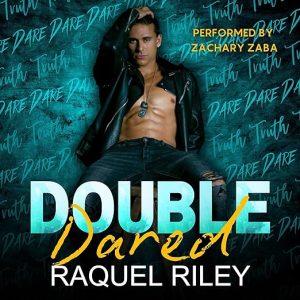
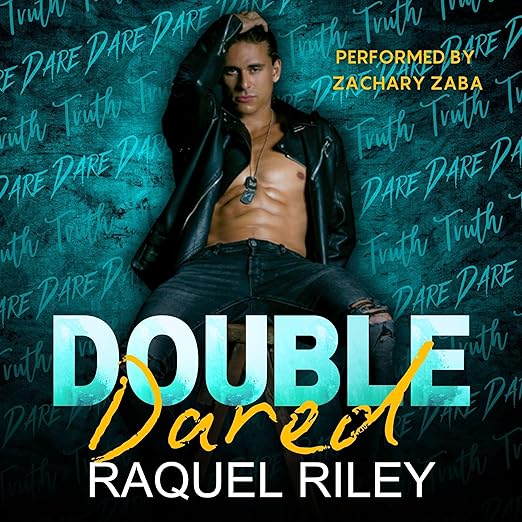
I started Double Dared on a Tuesday evening and finished it somewhere past one in the morning, which tells you something about its pacing and something about my poor judgment with weeknight audiobooks. Raquel Riley's standalone M/M romance has been circulating in the community with significant word of mouth, and coming in without much prior context I understood within the first hour why it has generated such strong reactions: this is a book that is genuinely trying to do something emotionally rigorous with its central relationship, and it does not flinch from how ugly that relationship gets before it resolves.
The setup is familiar to readers of the enemies-to-lovers tradition: Tru and Dare are best friends as children, a kiss at thirteen breaks something open, and Dare responds by weaponizing their friendship against the person he kissed. They become stepbrothers. They go to college and end up roommates. The premise stacks its complications deliberately, and Riley commits to every one of them without retreating into the safety of soft conflict.
Dare's Deliberate Cruelty Tests Reader Patience
The dual-POV structure is the book's most important formal choice. We get Tru's perspective, the bewilderment and loss that reviewer CS described as emotionally stunning, and we get Dare's interior, which is the harder and more interesting piece of writing. Dare knows exactly what he is doing. He is not a confused teenager who accidentally hurt someone; he is a young man who burned a bridge deliberately and spent years maintaining the fire because admitting the truth required more than he was capable of. Riley does not let him off the hook for this, and she also does not make him a simple villain. That balance is genuinely difficult to achieve, and the book mostly achieves it.
Reviewer Meli raised the honest concern that roughly forty-five percent of the book is bullying, and that at a certain point nothing Dare does seems like sufficient penance. That concern is valid and worth naming. Riley's approach asks the reader to hold Dare's interiority alongside his behavior, to understand the source of the cruelty without excusing it. Whether that ask feels fair or whether it tips into romanticizing harm will vary significantly by reader.
Zachary Zaba Shifts From Lightness to Weight
Zachary Zaba's narration manages the tonal range that this book requires. The opening chapters, where the story establishes Tru and Dare as children and follows the trajectory of their friendship, need a lightness that the later sections do not, and Zaba calibrates across that shift credibly. The dual-POV structure in audio requires genuine differentiation between two first-person voices, and Zaba achieves enough distinction that the transitions do not create confusion across the nine-hour-plus runtime. His performance of Dare's interior monologue, which carries more defensiveness and self-recrimination than Tru's, is where the narration is most tested and most effective.
Belinda Zamora Wanted Tru to Leave Dare
This is emphatically not a soft-angst romance. Reviewer Belinda Zamora put it directly: the book put her through the wringer emotionally before redeeming Dare, and she actively wanted Tru to find someone else for a significant portion of the listening experience. That response represents a real segment of the readership. If you need your romantic leads to be sympathetic from the start, Dare is going to be a significant obstacle for a long stretch of the book.
The resolution is real and earns its emotional weight because of how thoroughly Riley establishes the damage. The happily-ever-after lands because it is not handed to the characters but extracted from them at considerable cost, which is the only way a redemption arc of this scale can feel honest rather than convenient.
High-Angst Readers Ready for a Redemption Arc
High-angst, slow-burn M/M romance readers who are prepared for a redemption arc that takes its time will find this delivers on its premise. Listeners who bounced off bullying dynamics in other romances should go in knowing this element occupies substantial real estate across the full nine hours. Those who have read other Raquel Riley titles will find the emotional ambition consistent with her reputation. New listeners to M/M romance looking for a gentler entry point should look elsewhere first and return to this one once they know the genre suits them.
How much of Double Dared actually involves bullying, and does the book treat it seriously?
One reviewer estimated roughly forty-five percent of the book involves Dare's cruelty toward Tru. Riley treats the bullying seriously in the sense that she writes Dare's interiority without excusing his behavior, but the book does ultimately ask readers to accept his redemption, which not everyone found satisfying given the extent of the damage.
Does the dual-POV structure work in audio, given both narrators are male characters?
Zachary Zaba provides enough tonal distinction between Tru and Dare that the transitions are generally clear. Dare's voice in particular carries more defensiveness and self-recrimination in the performance, which helps differentiate the two perspectives across nine-plus hours.
Is Double Dared a standalone, or does it require knowledge of other Raquel Riley books?
It is a fully standalone M/M romance. No prior knowledge of other Riley titles is needed, though readers who have encountered her other work will recognize the emotional ambition and willingness to sit with difficult character dynamics before resolving them.
Does the stepbrother element play a significant role in the plot beyond the initial setup?
Yes. The fact that Tru and Dare become stepbrothers while their relationship remains unresolved adds a layer of forced proximity that Riley uses deliberately. They also end up as college roommates, which stacks the situation further and keeps the tension from deflating during the time jump between their teen years and early adulthood.