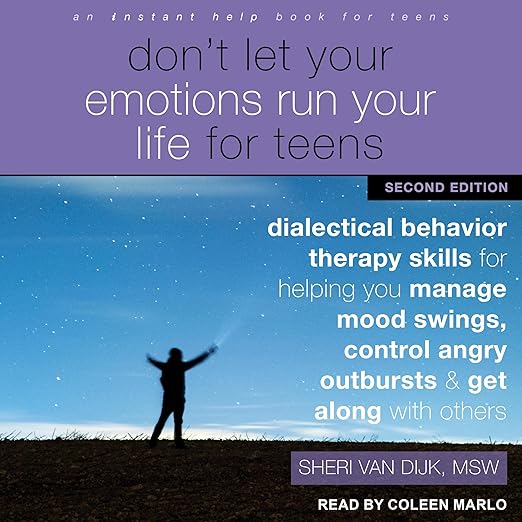
- Read by: Coleen Marlo brings a warm, credible authority built across a long career of AudioFile Earphones Award-recognized work, striking the right balance for teen listeners between compassionate and clinical.
- At its heart: Dialectical behavior therapy, emotional regulation, adolescent mental health
- Vibe: Supportive and practical
- Short version: A genuinely useful DBT primer for teens and the adults supporting them, best paired with the print worksheets for full effect.
Sheri Van Dijk opens with a scene every parent of a teenager will recognize: a slammed door, a phone hurled across a bedroom, a fight that escalated far past whatever started it. The Don't Let Your Emotions Run Your Life for Teens, Second Edition audiobook is built around exactly that gap, the space between a normal teenage feeling and a reaction that spins completely out of proportion. Van Dijk, a clinical social worker, structures the book around dialectical behavior therapy, or DBT, a therapeutic approach originally developed for adults with intense emotional dysregulation and now widely adapted for teenagers navigating the ordinary chaos of adolescence layered on top of school stress, shifting friendships, and family conflict.
The premise is refreshingly non-judgmental from the start: anger, sadness, fear, and frustration are treated as legitimate responses to a genuinely difficult stage of life, not problems to be suppressed. What the book actually offers on top of that validation is a structured skill set, drawn from DBT's core modules, mindfulness, distress tolerance, emotion regulation, and interpersonal effectiveness, translated into language a teenager can use in the moment a fight is happening rather than only in hindsight. That structure is part of why the book has stayed in print long enough to reach a second edition, now part of the broader Instant Help Book for Teens series aimed at giving adolescents practical coping tools.
DBT itself was originally developed by psychologist Marsha Linehan in the late 1980s, initially for adults managing borderline personality disorder and chronic suicidality, before its evidence base expanded into broader use for emotion regulation difficulties across ages and diagnoses. Van Dijk's adaptation for teenagers sits within that broader clinical lineage rather than inventing a new framework, which is part of why school-based mental health professionals trust it enough to build coping-skills groups around it instead of treating it as another untested self-help trend.
What Sheri Van Dijk MSW Gets Right
Coleen Marlo narrates with the warm, steady authority of someone who sounds like she has read a great deal of psychologically demanding material before, an audiobook veteran recognized with multiple AudioFile Earphones Awards across a long career spanning both fiction and nonfiction. That range serves this book well: Marlo never slips into a clinical, lecture-hall register, but she also does not oversell the material with false cheerfulness. For a workbook aimed at teenagers who may already feel talked down to by adults in their lives, that balance, credible without being cold, matters more than it might in a straightforward self-help book for grown readers.
Audio also solves a real access problem for the intended reader. A teenager working through anger or panic in the moment is far more likely to put in earbuds than to sit down and read a workbook cover to cover, and hearing DBT concepts explained aloud, in something closer to a calm coach's voice than a textbook's, lowers the barrier to actually absorbing the material during a hard week rather than only when things are calm enough to sit and study. The three hour and forty-eight minute runtime is also short enough that a teenager could realistically get through the whole thing during a handful of car rides or a single restless week.
Where Sheri Van Dijk MSW Loses Some Ground
The one real limitation worth naming directly is the one built into any workbook adapted to audio: this book was designed around exercises and worksheets, and a listener cannot fill those out mid-chapter the way a reader holding the physical book can. One of the professional reviewers attached to this listing, a school social worker who has used both editions with coping-skills groups for years, praises how clearly DBT gets broken down, but that endorsement is rooted in classroom use of the print or workbook format alongside guided discussion. Listeners who want the full benefit of the structured exercises will likely want to pair the audiobook with the print edition or companion worksheets rather than relying on audio alone.
What stands out about the reviews on this listing is who is writing them: a school social worker running coping-skills groups, a parent who bought a copy for herself and her fifteen-year-old daughter to use between therapy sessions, and a licensed clinical social worker praising its usefulness for practical self-care discussions. That is a notably credentialed group of reviewers for a teen self-help title, and their consistent praise for how the material breaks down complex therapeutic concepts carries real weight precisely because they are professionals with a basis for comparison, not just satisfied browsers.
Who Sheri Van Dijk MSW Is Writing For
This audiobook is best suited to teenagers already dealing with emotions that feel unmanageable, along with the parents, school counselors, and therapists supporting them, especially anyone already familiar with DBT or looking for an accessible introduction to it. It works well as a companion to therapy rather than a replacement for it, giving a teenager language and structure to bring into a session rather than trying to substitute for one. Families already using the first edition in counseling groups, per the reviews here, will find the second edition a natural continuation rather than a reason to start over.
Teenagers or parents hoping for a purely narrative listen, something closer to a memoir about emotional struggle than a structured skills program, should look elsewhere, since this is fundamentally an instructional workbook wearing an audiobook's clothing. Listeners who need the physical exercises and worksheets for full value should budget for the print or digital companion alongside the audio. But as an accessible, non-judgmental introduction to real therapeutic tools for an audience that often resists traditional self-help framing, Van Dijk's book and Marlo's narration make a genuinely useful case for meeting teenagers where they already are.