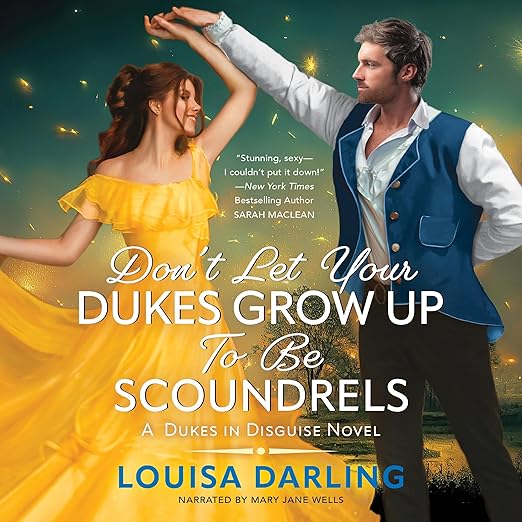
- Read by: Mary Jane Wells calibrates Gemma's desperation-beneath-composure and Hal's warmth with period-appropriate precision; the banter lands consistently.
- At its heart: Economic survival versus personal feeling, identity performance under constraint, whether love is a luxury or a necessity.
- Vibe: Comic and warm, with genuine edge to the romantic friction; Regency wit without excessive period ornamentation.
- Short version: A stronger series opener than its premise suggests; Darling earns the identity-reversal conceit through genuinely textured characters on both sides.
Can a woman who has decided she needs a rich husband fall in love with a man she believes has no money? Don't Let Your Dukes Grow Up to Be Scoundrels launches Louisa Darling's Dukes in Disguise series with this question at its center, and the answer is handled with enough wit and structural elegance to make the reading experience considerably more satisfying than the premise's familiarity might suggest. This audiobook delivers what historical romance readers have been missing: Regency-era banter with actual edge, a heroine whose mercenary motives are rendered sympathetically, and a hero whose secret is genuinely complicated rather than merely convenient.
The Review
Lady Gemma Lively is not a soft protagonist. She has been left with nothing after her father's death, responsible for her family, facing a future at a dilapidated coaching inn called Five Mile House at what feels like the literal end of the Earth. Her decision to husband-hunt aggressively is not vanity; it is survival, rendered with enough economic specificity to feel genuinely urgent rather than merely convenient for the plot. Darling gives Gemma's mercenary instincts a foundation that makes them comprehensible even when they are not entirely sympathetic.
Hal Deveril, a Duke who has taken up residence behind the bar of the local pub to conceal his identity while he deals with his own crumbling estate, is the novel's other structural element. His reasons for hiding are not entirely clear to Gemma or to the reader in the early chapters, which generates productive uncertainty. He is not simply performing modesty; he is managing a complicated situation, and the novel's middle section develops his circumstances with enough detail to make him feel like a person managing real constraints rather than an aristocrat playing at common life for reasons of whim.
The identity confusion at the heart of the novel operates on multiple levels. Gemma is hiding her desperation under the performance of confident fortune-hunting. Hal is hiding his title under the performance of a barkeep. Both of them are attracted to what the other is presenting while suspecting something remains hidden from them. Darling uses this double concealment to generate a romantic tension that has more psychological texture than the single-secret formula usually produces.
The banter is genuine. Readers who noted that Darling 'captures all of the fun banter and swoon-worthy moments that I miss from when historical romances were more popular' are identifying something specific about how the novel's dialogue functions. The exchanges between Gemma and Hal have the quality of two people who are attracted to each other and are not going to admit it, rendered with enough wit that the reader is consistently two steps ahead of the characters while still finding the delays satisfying rather than frustrating.
The scheme Gemma devises to entice eligible gentlemen to Five Mile House and seduce one into marriage provides the novel's comic engine and gives Hal an excuse to interfere that is both self-interested and principled. His investment in preventing her from making a mistake that would make her miserable is complicated by the fact that he is attracted to her himself, and that he is not, technically, the wealthy Duke she is hoping to land. The revelation when it comes is handled cleanly: not a single dramatic scene but a gradual dawning, which is the more realistic approach and also the more emotionally satisfying one.
Darling's prose is efficient and warm. She does not linger in period detail for its own sake, but the historical setting is rendered with enough specificity to anchor the story without overwhelming it. The coaching inn itself is a vivid supporting character, its shabbiness and its potential both clearly established.
Mary Jane Wells is a narrator whose facility with period fiction has been demonstrated across multiple historical romance series, and her performance here suits the material well. Her Gemma has the particular combination of desperation and humor that the character requires: you can hear both the urgency beneath the composure and the genuine wit that makes her company worth seeking despite her agenda. Wells's Hal is warmer and less sardonic than he might have been in a heavier performance, which is the right calibration: this is ultimately a comedy, and the hero should be in on the joke even when he is the butt of it.
Weak Spots in Don't Let Your Dukes Grow Up to Be Scoundrels
The novel is first in a series, and while it resolves completely as a romance, the world of Five Mile House and the Lively family is clearly being established for further entries. Readers who enjoy series that develop supporting characters across multiple volumes will find the setup rewarding; those who prefer entirely self-contained stories should know this is a series opener, though it functions satisfyingly as a standalone.
The identity reversal plot requires some suspension of disbelief about how thoroughly Gemma fails to investigate the apparently penniless barkeep who is somehow very well-informed and extremely well-spoken. Darling addresses this with enough humor to soften the contrivance, but it does require readers to accept the convention without too much scrutiny.
Who It's For
Historical romance readers who have been looking for something with genuine Regency wit and a heroine who is allowed to be both mercenary and sympathetic will find Gemma Lively a welcome protagonist. Fans of Julia Quinn's Bridgerton series or Tessa Dare's Spindle Cove books who want something with a slightly harder comic edge will find Darling working in a compatible register that takes its characters seriously even while finding them genuinely funny. Mary Jane Wells's narration makes this an audiobook worth prioritizing over the print edition, and the series setup suggests that Five Mile House has more entertaining seasons ahead of it.
Questions Listeners Ask
Is Don't Let Your Dukes Grow Up to Be Scoundrels audiobook appropriate for readers new to historical romance?
Yes. Darling's prose is efficient and the historical setting is sketched with enough specificity to anchor the story without overwhelming readers unfamiliar with Regency conventions. The central situation is accessible regardless of prior genre experience.
Does this audiobook work as a standalone?
Completely. The romance between Gemma and Hal reaches a satisfying resolution, and nothing essential is left unresolved. The book does establish a series world, and the supporting characters suggest further volumes, but this entry tells a complete story.
What romance tropes does this audiobook use?
Identity concealment on both sides, enemies-to-lovers dynamic, forced proximity at Five Mile House, and the classic situation of the heroine not recognizing her hero because she is looking past him for someone with a different social position. Darling handles these conventions with self-awareness rather than sincerity, which is what gives the book its distinctive tone.