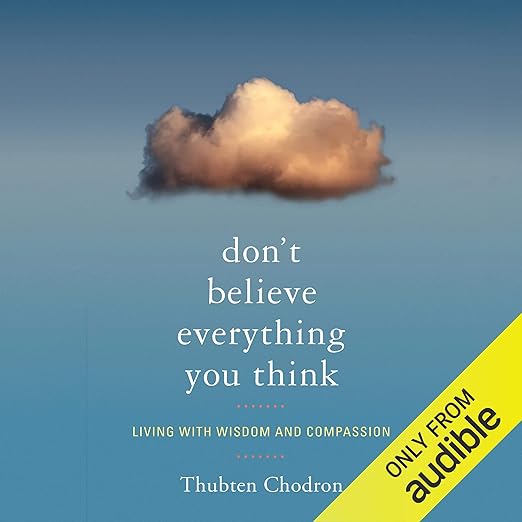
Bhikshuni Thubten Chodron's commentary on the Thirty-Seven Practices of Bodhisattvas delivers something genuinely difficult to accomplish: it makes 14th-century Buddhist teachings from Togmay Zangpo feel applicable to the specific absurdities of contemporary life without trivializing either the teachings or the contemporary life. Don't Believe Everything You Think as an audiobook rewards the format because Graeme Malcolm's narration carries the reflective pace that this kind of philosophical instruction requires - not so slow that it performs contemplation, but unhurried enough to let the material actually settle rather than just pass through at listening speed.
At eight hours and twenty-three minutes, this is a substantial engagement with a classical text. Chodron does not simply gloss Zangpo's thirty-seven practices; she integrates first-person accounts from her students and colleagues who describe the ways specific practices changed their lives in concrete, recognizable situations. The range is deliberately wide - from making genuine peace with an enemy prisoner of war to managing something as ordinary as waiting for a delayed flight or coping with a minor physical injury. That range is pedagogically intentional: Zangpo's text addresses the full spectrum of human reactivity, not only the dramatic crises.
The book's core pedagogical move is to take a classical Tibetan text seriously as both philosophy and psychology without requiring that listeners accept the full metaphysical framework of Mahayana Buddhism to benefit from it. Chodron works through each of the thirty-seven practices, explaining not just what the instruction says but why the practice is structured the way it is - what the underlying model of mind and suffering generates, and what that means for someone trying to manage anger in a difficult relationship rather than in a hermitage.
One reviewer described the book as giving tremendous insight into one's own thoughts and helping to create distance from thought patterns that are ultimately harmful toward achieving inner peace. That psychological framing is accurate and is the specific dimension of Chodron's approach that makes her work accessible to listeners coming from secular or non-Buddhist backgrounds. She does not require that you be convinced of rebirth to find the instruction on cultivating equanimity useful. She explains the Buddhist rationale, applies it to contemporary situations, and lets the listener decide how much of the metaphysical framework they want to carry forward.
The contemporary applications she chooses are specific and sometimes striking. The synopsis excerpt - about the obscurity of the line While the enemy of your own anger is unsubdued, though you conquer external foes, they will only increase when you are trying to figure out which cell phone plan to buy - captures the book's characteristic move: taking a statement that could sound remote and demonstrating why it is more precise than any contemporary self-help formulation for the same underlying problem.
Malcolm Keeps Three Registers Distinct for Eight Hours
Malcolm's narration is a genuine contribution to the audiobook experience rather than simply functional delivery. Buddhist philosophy instruction in audio format can easily collapse into monotone recitation or performative serenity. Malcolm avoids both. He handles the quoted student testimonials differently from Chodron's direct commentary, and the classical verse differently from either - three distinct registers that keep the format legible across the long runtime. The movement between Zangpo's verse, Chodron's explanation, and a student's first-person account creates a rhythm that is harder to feel on the printed page and that Malcolm navigates with real skill.
One reviewer noted that Chodron deftly mixes practical application for real-life issues with a solid foundation in Mahayana Buddhist thought, describing the balance as remarkably hard to strike. That balance is partly a function of the source material and partly a function of Chodron's decades of teaching experience, but Malcolm's narration allows it to come through rather than flattening the distinctions that make the three-register structure work. The line from the synopsis lands differently when spoken aloud with the right weight behind it. Malcolm gives it that weight without overstating it.
Theology You Can't Skip, in Sequential Order
Chodron's commentary is grounded in Mahayana Buddhist thought and does not shy away from its theological dimensions. The compassion training at the heart of the bodhisattva path, the teaching on the absence of a fixed self, the understanding of suffering as arising from mental fabrication rather than from circumstances - these are not metaphors in Chodron's framing. They are the actual theoretical architecture. For listeners who want Buddhist practices without Buddhist metaphysics, some of the instruction will be more directly applicable than others, though the psychological utility of most practices does not require accepting the full framework to be put into use.
The Thirty-Seven Practices is a classical text with a specific sequential structure, and Chodron moves through it systematically. Listeners expecting a more loosely organized mindfulness guide may find the practice-by-practice format more rigorous than anticipated. The rigor is a feature for the right listener, and it is worth knowing what format you are getting before you begin the eight-hour commitment.
Deeper Than Most Contemplative Listening Reaches
This audiobook is for listeners who want genuine engagement with Tibetan Buddhist practice rather than a surface adaptation of mindfulness concepts for wellness purposes. It works well for practitioners already familiar with Buddhist basics who want a deeper treatment of the bodhisattva path and the Thirty-Seven Practices specifically. It also works for curious general listeners drawn to the psychological dimension of classical Buddhist mind training who are willing to engage with the theological framework alongside the practical instruction. It is not the right entry point for someone looking for a general stress-reduction or relaxation guide. For listeners willing to engage with what Chodron is actually offering, this audiobook holds up at a depth that most contemplative listening does not reach.
Quick Take
- Read by: Graeme Malcolm brings a thoughtful, unhurried quality to Thubten Chodron's commentary on Togmay Zangpo's text. His voice creates the kind of calm that allows the material to actually land rather than just pass through.
- At its heart: Buddhist mental training, Mahayana philosophy in contemporary life, the relationship between thought patterns and suffering
- Vibe: Quietly transformative, accessible without being simplified or stripped of rigor
- Short version: Chodron's genuine achievement is making 14th-century Tibetan Buddhist instruction feel immediately applicable to someone who is simply trying to get through the day.
Do you need to be a practicing Buddhist to get value from this audiobook?
No. Chodron structures her commentary to make the psychological and practical dimensions of the Thirty-Seven Practices accessible to listeners without a Buddhist background. The metaphysical framework is present and explained, but the instruction is applicable without requiring full theological assent.
How does Graeme Malcolm's narration handle the mix of classical verse, commentary, and personal testimony in this audiobook?
Malcolm differentiates the three registers clearly - Zangpo's classical verse, Chodron's explanatory commentary, and the first-person student accounts - which keeps the format legible and gives each element its appropriate weight across the eight-hour runtime.
Is this audiobook more accessible to general listeners than other Tibetan Buddhist philosophy texts?
Yes, by deliberate design. Chodron consistently grounds abstract Buddhist concepts in contemporary, everyday situations - from social media arguments to cell phone decisions to minor physical setbacks - making the instruction feel immediately applicable rather than historically distant.
Is this audiobook appropriate for someone already familiar with Tibetan Buddhist practice?
Yes. Reviewers with Buddhist backgrounds found the combination of rigorous doctrinal grounding and practical application genuinely valuable. Chodron balances accessible framing with solid Mahayana foundations, so the book serves both newcomers and established practitioners without condescending to either.