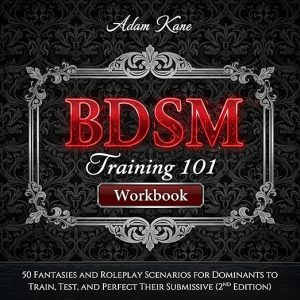
What actually separates a safe, consensual power exchange from something reckless or coercive? That's the question this audiobook spends nearly six hours answering, and it does so with more structure and care than the genre's reputation might suggest. Skylar Reyes has built an instructional guide, not an erotic story, covering the psychology behind dominant and submissive roles, negotiation frameworks, safety protocols, and specific training techniques, alongside practical advice on equipment and finding compatible partners. The tone throughout stays closer to a relationship-and-communication guide than to narrative erotica, which is worth knowing upfront if you're expecting something plot-driven rather than genuinely instructional.
The book's own table of contents reads like a syllabus: psychological foundations, rules and protocols, training techniques and commands, illustrated descriptions of more than thirty training positions, and guidance on selecting equipment. It closes with genuinely practical resources, a negotiation checklist, sample relationship agreements, and scene templates, material clearly meant to be referenced and reused rather than just listened to once. That structure signals an author more interested in building a reference guide than telling a titillating story, and reviewers consistently confirm that's exactly what they got.
Comprehensive, No-Nonsense, and Never Textbook-Dry
Reviewer Gina Wing describes the approach as comprehensive and no-nonsense, and that phrase captures the book's tone well. This isn't coy or euphemistic about its subject matter, but it also isn't shock-value content; the emphasis throughout stays on communication, consent, and psychological safety as the actual foundation of the practices being described, rather than treating those as an afterthought to more explicit material. Eiman's review makes a similar point from a different angle, noting the book manages to feel informative 'without making you feel like you're reading a textbook on kink,' breaking down both the physical and the emotional sides of the subject.
JoMach83's shorter review calls it simply 'a deep dive in BDSM with comprehensive details on all kinds of kink,' and that breadth is real: the book doesn't limit itself to one narrow practice or dynamic but tries to map the wider landscape, from foundational psychology through specific physical positions to the paperwork side of building a lasting arrangement with a partner. For a genre where a lot of published material is thin or recycled, this reads as genuinely researched and organized around a coherent teaching structure rather than a loose collection of tips.
What's notably absent, in a genre with a reputation for excess, is any sense of glamorizing risk. The book repeatedly returns to safety planning, checking in with a partner, and recognizing when a dynamic has become unhealthy, treating those as central rather than obligatory disclaimers tacked onto more exciting material. That emphasis matches what several reviewers independently praised: a guide that respects both the psychological complexity of these dynamics and the real vulnerability involved in exploring them, rather than reducing the subject to technique alone.
The equipment and toy-selection guidance also stays refreshingly practical rather than trying to sell anything, focused on safety considerations and compatibility with different experience levels rather than brand recommendations, which keeps that section useful regardless of budget or where a listener is shopping.
Lower-Pressure Listening for Newly Curious Partners
For anyone newly curious about power exchange dynamics, or partners wanting a shared vocabulary before having a harder conversation together, the audiobook format has a real advantage: listening together, in a car or during a walk, creates a lower-pressure way to encounter unfamiliar material than sitting side by side with a physical book open to a specific chapter. Reviewer Eiman's point about feeling more prepared and less overwhelmed after finishing speaks to exactly this use case, education that reduces anxiety rather than material meant purely to arouse.
The negotiation checklist and sample relationship agreements, while obviously more useful in their written form for actual reference, still land as valuable content in audio because hearing the reasoning behind each element explained aloud, why a particular clause matters, what a vague agreement tends to miss, builds genuine understanding rather than just a document to sign. Couples exploring this together may get more out of listening jointly and discussing each section than either partner reading silently alone.
The book also earns points for treating both dominant and submissive roles with equal depth rather than centering one perspective and treating the other as reactive. Reyes explicitly frames the guide as useful whether you're dominant, submissive, or exploring both roles, and that even-handedness carries through the psychological sections in particular, examining what draws someone toward either role rather than assuming one is more natural or requires less explanation than the other.
Ten Ratings, and an AI Narrator
The elephant in the room is the narrator. This is Virtual Voice, Amazon's AI narration, and that's a real limitation for material this dependent on tone, warmth, and the specific feeling of authority or vulnerability in a human voice. A book about embodiment, presence, and the emotional nuance of consent and control is exactly the kind of content synthetic narration struggles with most; a skilled human narrator could shade a command or a safety instruction with real gravity or warmth that AI delivery tends to flatten into uniform, slightly mechanical evenness.
That said, this is instructional content more than performative storytelling, which softens the impact somewhat compared to Virtual Voice narrating a character-driven romance. Information about rules, protocols, and equipment survives flatter delivery better than emotionally charged scenes would. Anyone especially sensitive to synthetic narration, or planning to use this specifically as a shared, intimate listening experience with a partner, may want to sample a chapter first before committing to the full five hours and fifty-four minutes.
Worth knowing too: with only ten ratings behind the current 4.6 average, this doesn't have the depth of listener feedback a more established title would, so the strong scores should be read as an encouraging early signal rather than a large, settled consensus. Anyone relying heavily on crowd validation before trying niche instructional content like this should factor in that comparatively small sample size.
Formalizing Practices for Established Practitioners Too
Newcomers to power exchange dynamics looking for a structured, non-judgmental introduction will find real value here, as will more established practitioners wanting to formalize practices they've been doing more informally, negotiation, aftercare, ongoing check-ins. Couples specifically interested in introducing these elements into an existing relationship are named directly as an intended audience in the book's own framing, and those planning documents are genuinely useful reference material for exactly that purpose.
Those uneasy about synthetic narration handling emotionally sensitive material should sample a chapter before committing, since Virtual Voice's flat, even delivery is a real factor worth weighing here, not a minor technical footnote. Listeners hoping for narrative erotica, a story with characters and a plot, rather than an instructional guide, are also in the wrong place; despite the erotica genre tag, this functions as nonfiction education from the first chapter to the last.
- Voice: Virtual Voice's AI delivery is flat and even, a real limitation for material this dependent on tone and warmth.
- Big ideas: Consensual power exchange, negotiation and safety protocols, psychological foundations of D/s dynamics
- Atmosphere: Clinical but caring, instructional rather than narrative
- Worth it?: The content is genuinely thorough and thoughtful; sample a chapter first to see if the AI narration works for you.
Frequently Asked Questions
Is this audiobook narrative erotica or an instructional guide?
It's an instructional guide, not a story. Despite the erotica genre tag, the content functions as nonfiction education covering psychology, negotiation, safety, and technique.
How much does Virtual Voice narration affect this audiobook's quality?
It's a real factor. AI narration tends to flatten tone and warmth, which matters for content this dependent on emotional nuance, though the instructional structure survives it better than narrative content would.
Is this audiobook suitable for total newcomers to power exchange dynamics?
Yes. Reviewers specifically praise it as an accessible, non-judgmental introduction that avoids reading like a dry textbook while still covering serious psychological and safety ground.
Does this audiobook include practical resources beyond general advice?
Yes. It includes a negotiation checklist, sample relationship agreements, and scene templates, all designed as reusable reference material rather than one-time listening content.