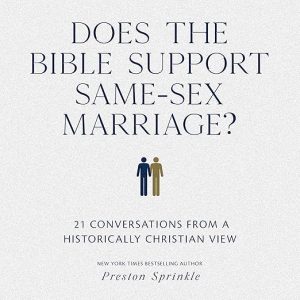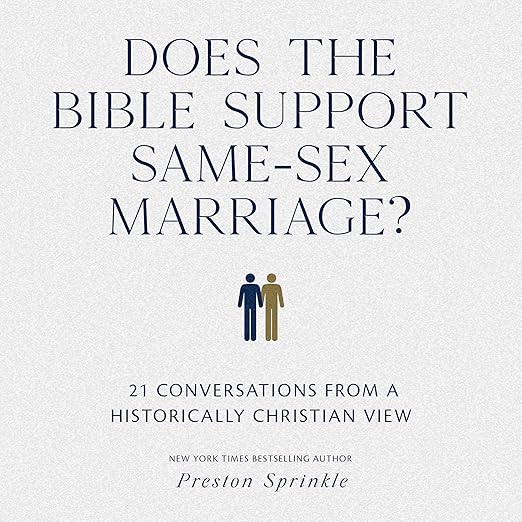
Preston Sprinkle answers twenty-one arguments in this audiobook, and that number is the first thing a buyer should know. Not a survey, not a history of the debate, not a case built from first principles: a list of twenty-one specific claims made in favor of same-sex marriage, each taken up and answered from the position the publisher calls "the historically Christian view of marriage." Four hours and fifty-one minutes divided twenty-one ways leaves under fifteen minutes per argument on average. Whatever else this is, it moves.
That structure tells you who the book serves and who it will frustrate, and saying so at the top seems fairer than burying it. Hold the traditional position and want it defended item by item, and this is built for you. Hold the affirming position, and you are listening to a rebuttal of your case, competently made and explicitly addressed to you. Sit somewhere in between hoping for both sides at full strength, and the format itself is not symmetrical: the affirming arguments arrive as prompts, and the answers get the last word every single time.
Five of Twenty-One Arguments Named on the Cover
Sprinkle names his targets on the cover copy, which counts for something. Five of the twenty-one appear there: that "The biblical writers didn't know about sexual orientation," that "Jesus never mentions homosexuality," that teachings on "women, slavery, and same-sex are on the same trajectory," that "Since some people are born gay, then being gay must be okay," and that "The Bible has been mistranslated." Anyone who has followed this argument for a decade will recognize all five as load-bearing rather than decorative. You can see before you buy whether the book is engaging the real objections or a softened version of them, and on this evidence it is the former.
Method matters more than conclusion here, at least to the reader who liked it most. A five-star reviewer reports that Sprinkle "delivers (as always) on his promise to create an open space for considering the arguments and counterarguments in support of same-sex marriage," and singles out something the very first chapter establishes: that "HOW these conversations take place is of the utmost importance so that people feel heard, understood, dignified and represented." A four-star reviewer in the United Kingdom reaches the same verdict in a single line, calling them "Clear and well-laid out arguments, presented in a gracious way," which is generous shorthand for a book made entirely of rebuttals.
Sprinkle's Narration Puts His Argument on Trial
Self-narration is doing genuine work on this title, and not as a cost saving. Sprinkle reads his own book, which on a text whose opening chapter argues that the manner of a disagreement determines whether the disagreement is worth having, puts the thesis directly under test. Handed to a hired professional, the tone would be one performer's interpretation of what gracious sounds like. Delivered by the author, it becomes a claim he is making about himself while making twenty-one rebuttals in a row. Whether that register holds through five hours of contested exegesis is precisely what a listener ends up assessing, and it is a legitimate thing to assess.
Somebody in the middle of a real situation makes the case for this format better than any pitch could. That reviewer describes values thrown "into direct conflict with the sudden (and unforeseen) gender transition" of an oldest child, and a search for theologians "who could help me understand both the nuances of Scripture and the struggles of my daughter without urging me to reject one or the other." That reader is inside a real predicament rather than a debate, and a recording under five hours is something you can finish inside a week instead of carrying around for a season.
Clear Argument or Word Salad, Debated by Reviewers
Clarity is contested here, and the disagreement is the single most useful thing on the listing. A one-star reviewer writing from Canada found the reasoning "way to confusing," reached for the phrase "word salad," and reports not finding it helpful "in any way." Set that beside the four-star reader who called the arguments clear and well laid out, and notice that the dispute is not about the conclusions at all. It is about legibility. My own read is that a text compressing twenty-one exegetical arguments into a quarter-hour apiece will feel efficient to a listener who already knows the vocabulary and impenetrable to one meeting it cold.
Purpose deserves separating from content as well. The publisher frames the goal as encouraging "respectful and thoughtful conversations," which is a claim about use rather than about truth: this is a book you are meant to argue from, not merely to finish. That has a practical consequence for the format, because a listener cannot flag a page or slip a bookmark into a rebuttal they expect to reach for later.
Read the score with some suspicion too. A 4.6 average rests on 250 ratings while only five written notices exist, and one of those notices consists of the single word "Happy" attached to four stars. So the average is being set almost entirely by people whose reasoning you cannot inspect, on a subject where reasoning is the entire product. Worth noticing as well: three of the five written reviews come from outside the United States, two from the United Kingdom and one from Canada, which suggests the argument travels further than the American cultural fight it usually gets filed under.
For Pastors and Parents, Not the Affirming Case
Traditional-view Christians who want the strongest objections taken seriously rather than caricatured are the core audience, and pastors, parents and small-group leaders who need the arguments in a usable order will get the most practical value. Anyone in the position that parent describes, holding a conviction and a relationship at the same time and unwilling to sacrifice either, should at least sample it. Readers on the affirming side who want to know what the best version of the opposing case looks like will find twenty-one of their own arguments stated plainly, whatever happens to them afterward.
Steer clear if you want the affirming case made by somebody who holds it, because that book is not this one and the conclusion here is settled before chapter one. This is also not a memoir, not a survey of the scholarly literature, and not a guide to loving a gay child, though at least one reviewer plainly arrived hoping for the last of those. Approached for what it is, a compact and deliberately courteous defense of a contested position that quotes the arguments against it rather than paraphrasing them, it does the job it set itself.
Before You Listen
Does the audiobook conclude that the Bible supports same-sex marriage?
No. Sprinkle defends the traditional Christian reading and answers twenty-one cases made for the affirming view. The publisher says as much plainly on the listing. Expect a defense rather than an open inquiry, however courteous the conduct of it, and expect the answers to close every exchange.
Which arguments does the book actually address?
Five of the twenty-one are named on the listing, and none is a straw man: the claim that ancient writers lacked any concept of orientation, the silence of Jesus on the subject, the trajectory argument from women and slavery, the appeal to innate desire, and the charge of mistranslation.
Is the author's own voice an advantage on this audiobook?
Arguably it is the point. His first chapter insists that how these conversations happen matters as much as their content, so hearing him deliver the rebuttals himself puts that claim under direct scrutiny in a way a hired reader could only approximate. It also keeps the register consistent across five hours.