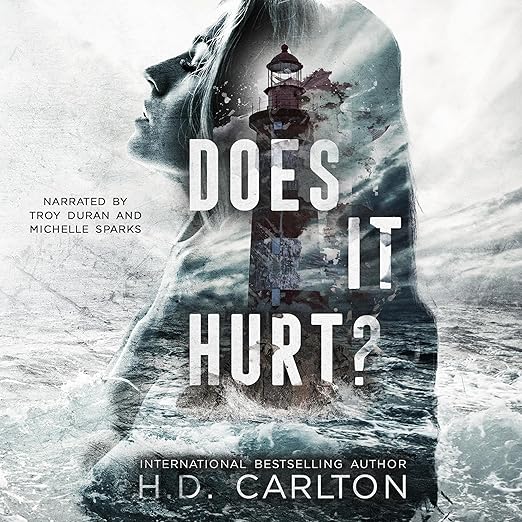
Enza Vitale appears in Does It Hurt? the way danger always appears in H. D. Carlton's fiction , not as a sudden event but as a slow unveiling that the narrator insists she is not attracted to even as everything she does suggests otherwise. Troy Duran narrates this audiobook, and the choice to cast a single male narrator for a dual-perspective dark romance is an interesting one. The novel alternates between Aza (whose real name, she has taken from a man she met under a waterfall) and Enzo (the enigmatic deep-sea researcher whose name she took), and Duran's navigation of that split is one of the more technically demanding aspects of this production.
Carlton describes the story in its simplest terms: a woman running from her past, a man running toward something darker than she can initially read, a shipwreck, a lighthouse, a decrepit island with a caretaker whose intentions become increasingly sinister. That structure , isolation, limited cast, escalating threat from multiple directions , is dark romance architecture at its most stripped down, and Carlton uses the compression to intensify rather than limit. The absence of normal social infrastructure means that Aza and Enzo have nowhere to deflect to. Their hostility, their attraction, and their survival calculations all happen in the same small space.
A Closer Look at Does It Hurt?
Duran's narration handles the tonal extremes this audiobook requires with evident commitment. Reviewers describe the audio experience as 'beyond amazing' and note that encountering this story for the first time on audio significantly shaped its impact. That response is specific to Duran's vocal choices in Enzo's chapters, which resist the temptation to render him as straightforwardly menacing. Enzo is morally complex in the way Carlton's best antagonist-heroes tend to be , he has genuine grievance against Aza, genuine intention to act on it, and an attraction he cannot reconcile with either. Duran finds a register for that contradiction that keeps Enzo from collapsing into either villain or romantic lead, which is exactly what the material requires.
The maritime setting is one of Carlton's more fully realized environments. The deep sea and its predators serve as consistent metaphor for Enzo's character , he studies apex predators because he recognizes himself in them, or at least in the story he tells himself about who he is. The lighthouse and the abandoned island extend that atmosphere into the survival stakes of the second half. Carlton builds environments that function as emotional landscapes, and this audiobook gives Duran the material to make those environments feel genuinely threatening rather than decorative.
Aza's identity arc , her search for selfhood after years of running, the question 'who am I?' that opens the novel and recurs throughout , is the element that distinguishes this title from a more straightforward survival thriller. Carlton is asking what happens when you have been nobody for so long that the prospect of being claimed by someone is both the thing you most want to resist and the thing you most want. That question is dark in the way the best of the genre is dark: not gratuitously, but because the emotional truth it is reaching toward requires going somewhere uncomfortable.
The audiobook's spice level is a legitimate selling point but is earned by the surrounding tension rather than inserted into it. One reviewer described a spice level of 'ten out of five,' which captures the intensity while also gesturing at how the heat functions: as the point where all the accumulated antagonism and desire finally finds expression, which makes it land very differently than explicit content that appears without context. Duran handles those sequences with professional composure and lets the emotional stakes established in earlier chapters carry most of the weight.
The morally complex hero is Carlton's signature, and Enzo is a strong example of the type. He is not redeemed in the conventional sense , the audiobook is not interested in washing his intentions clean. What shifts is Aza's understanding of him, and through her, the listener's. That repositioning happens gradually and feels earned by the time the audiobook reaches its conclusion. Listeners who reviewed the book favorably tend to cite this moral complexity as the central appeal.
Things to Know Before Starting Does It Hurt?
At twelve hours and seven minutes, this is a long audiobook for the dark romance genre, and the pacing in the middle sections can feel extended to listeners who want the external threat to the lighthouse situation to develop faster. Carlton is more interested in the psychological dynamics between Aza and Enzo than in plotting out the island danger sequentially, and the caretaker threat that should create external urgency is deployed somewhat unevenly.
The dual-POV structure with a single narrator requires some attentiveness in the chapters where the perspective shift is subtle rather than announced. Duran handles the transitions well, but listeners who prefer clearly differentiated voices for each POV may find the single-narrator approach limits the immersion during Aza's sections.
Who H. D. Carlton Is Writing For
Listeners who have read or listened to Carlton's other work , particularly her morally complex heroes and high-heat romantic dynamics , will find this audiobook a strong addition to her catalog. Troy Duran's narration adds significant value to the experience, and several reviewers explicitly recommend the audio format for a first encounter with the story. Those with low tolerance for dark romance tropes, intentionally morally gray heroes, or explicit content should approach with that knowledge. For everyone who arrived knowing what Carlton does and wanting more of it, this audiobook delivers completely.
How does Troy Duran handle narrating both Aza and Enzo in the audiobook?
He differentiates them through tone and pacing rather than through dramatically distinct voices, which suits Carlton's prose style. Aza's chapters tend toward a more searching, uncertain register; Enzo's are cooler and more controlled. The approach requires some attentiveness from listeners during perspective shifts.
Does the Does It Hurt? audiobook content include explicit scenes, and does Duran's narration handle them well?
The explicit content is significant and earned by the surrounding tension. Duran handles those sequences with professional composure and relies on the emotional context established in earlier chapters to carry the weight of the scenes , the approach is controlled rather than performative.
Is Does It Hurt? similar in tone to Carlton's Haunting Adeline audiobook?
In its moral complexity and dark romance architecture, yes. The setting and threat mechanics differ , Does It Hurt? is maritime survival rather than domestic obsession , but Carlton's signature approach to morally gray heroes and high-heat tension is consistent across both works.